Length of a line between origin and edge of a circle

Click For Summary
SUMMARY

The length of the line L drawn from the origin to the edge of a circle with radius R, centered at R along the X-axis, is determined by the angle α between the line and the X-axis. Using trigonometric principles, specifically the cosine function, the formula for L is established as L = 2R cos α. This relationship is derived from the diameter D of the circle, where D = 2R, and applying the cosine definition in the context of the triangle formed by the radius and the line L.

PREREQUISITES
  • Understanding of basic trigonometry, specifically cosine function
  • Familiarity with circle geometry and properties
  • Knowledge of Thales' Theorem and its application
  • Ability to interpret geometric diagrams and relationships
NEXT STEPS
  • Study the application of Thales' Theorem in various geometric problems
  • Explore advanced trigonometric identities and their applications
  • Learn about the properties of circles and their equations in coordinate geometry
  • Investigate the relationship between angles and lengths in different geometric shapes
USEFUL FOR

Mathematicians, geometry enthusiasts, students studying trigonometry, and anyone interested in the geometric properties of circles and angles.

jack476
Messages
327
Reaction score
124
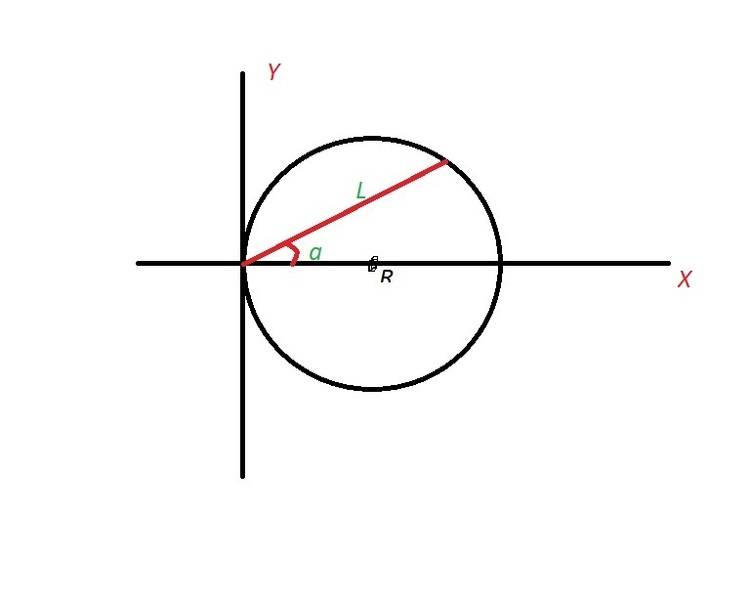
For a circle with radius R centered at R along the X-axis so that the edge of the circle touches the origin, what is the length of a line drawn between the origin and an edge of the circle in terms of the angle between that line and the X-axis? This isn't a homework problem, just something I'm trying to figure out.

IE in this picture (sorry about the MS Paint, I'm on a fairly old computer right now), what is the length of the line L in terms of the angle a and radius R? Any help is much appreciated, thank you.
fxIEn7b.jpg
 
Physics news on Phys.org
Are you firm in computing sides of triangles?
 
fresh_42 said:
Are you firm in computing sides of triangles?
Yes, I'm pretty comfortable with that. What are you suggesting?
 
There are 2 possible triangles you can use to compute L depending on a. One involves Thales' Theorem. But it also can be done without. Just look for triangles and right angles you can find in your graphic.
 
jack476 said:
For a circle with radius R centered at R along the X-axis so that the edge of the circle touches the origin, what is the length of a line drawn between the origin and an edge of the circle in terms of the angle between that line and the X-axis? This isn't a homework problem, just something I'm trying to figure out.

IE in this picture (sorry about the MS Paint, I'm on a fairly old computer right now), what is the length of the line L in terms of the angle a and radius R? Any help is much appreciated, thank you.

fxIEn7b.jpg

This article shows the trigonometry of working out L based on a circle with unit radius:

http://geowords.com/e_/06_wind&compass/pi/protractor.htm

Scroll down to 2) at the link. The diagram there:

chord.gif

Matches what you drew in the OP.

Taking the diameter of an arbitrary circle as D, which is the length of EB in the picture above, then cos α = AE / EB, or using your diagram, cos α = L / D.

Therefore, L = D cos α

or L = 2R cos α
 

Similar threads

  • · Replies 2 ·
Replies
2
Views
4K
  • · Replies 22 ·
Replies
22
Views
3K
  • · Replies 2 ·
Replies
2
Views
2K
  • · Replies 6 ·
Replies
6
Views
1K
  • · Replies 4 ·
Replies
4
Views
1K
  • · Replies 1 ·
Replies
1
Views
1K
  • · Replies 5 ·
Replies
5
Views
3K
  • · Replies 4 ·
Replies
4
Views
2K
  • · Replies 13 ·
Replies
13
Views
2K
  • · Replies 11 ·
Replies
11
Views
3K