Lennard Jones Potential & Kinetic Energy

Click For Summary

Discussion Overview

The discussion revolves around modeling the interaction of two particles using the Lennard-Jones potential, focusing on the relationship between potential energy and kinetic energy. Participants explore the challenges of setting initial conditions for the particles to enter the potential well, particularly in a one-dimensional context.

Discussion Character

  • Exploratory
  • Technical explanation
  • Debate/contested

Main Points Raised

  • One participant describes their approach to modeling the particles, specifying a total energy and kinetic energy based on the Lennard-Jones potential at a given separation distance.
  • Another participant questions the dimensionality of the model, suggesting that higher dimensions would require a centrifugal term, but later confirms the focus is on a one-dimensional model.
  • A different participant proposes that it might be beneficial to analyze the system from an inertial frame where one particle has zero velocity, indicating a potential simplification in calculations.
  • The original poster expresses uncertainty about their interpretation of energy requirements and calculations related to kinetic energy, indicating a need for clarification.

Areas of Agreement / Disagreement

Participants do not reach a consensus on the best approach to model the particles or the interpretation of energy requirements. Multiple viewpoints and suggestions remain present in the discussion.

Contextual Notes

The discussion does not resolve the uncertainties regarding the initial conditions for the particles or the implications of dimensionality on the model.

relskhan
Messages
5
Reaction score
0
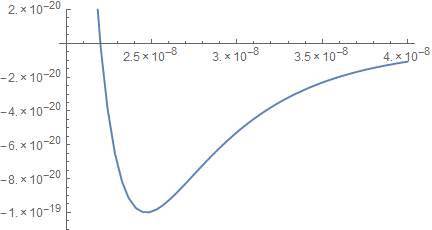
So I'm trying to model two particle interaction subject only to Lennard Jones potential. I have a specific potential I am using:
B3AADfbCIAEOi8o.jpg


My problem is forcing the two particles into the potential well. I have the particles at a separation distance of 2.5*10-8. The way I interpret this potential is that I can set a total energy of -6.0*10-20 by giving the particles a Kinetic Energy of 3.95*10-20 (Where Total Energy TE=KE + U or KE = TE - U => KE = -6.0*10-20 +9.95*10-20 = 3.95*10-20 , the -9.95*10-20 comes from U(2.5*10-8).

To set the kinetic energy I'm using 1/2 m (v12+v22). And giving particle 1 an initial velocity equal to some factor of particle 2's velocity.

Unfortunately, this is still not working. So I am either interpreting the different energy requirements on the diagram wrong - or not calculating the velocity for the KE correctly. Any ideas??
 
Physics news on Phys.org
How many dimensions? In dimensions higher than 1 you'll need a centrifugal term.

Actually, I'm not sure if this answers your question.
 
UVCatastrophe said:
How many dimensions? In dimensions higher than 1 you'll need a centrifugal term.

Actually, I'm not sure if this answers your question.
Good Point - I should have specified. This is all 1-D, I will 'upscale' to 3-D later, but for now, I just want the simplest model.
 
What isn't working about it? It might be easier to work out in an inertial frame where one particle has 0 velocity.
 
Calion said:
What isn't working about it? It might be easier to work out in an inertial frame where one particle has 0 velocity.
Well I didn't want to get into the details too far - I mostly want to make sure my interpretation of the Energies are correct. I could try starting the particle at 0 velocity - but - the potential will move it I'm sure.
 

Similar threads

  • · Replies 3 ·
Replies
3
Views
1K
  • · Replies 10 ·
Replies
10
Views
2K
  • · Replies 3 ·
Replies
3
Views
992
  • · Replies 30 ·
2
Replies
30
Views
3K
  • · Replies 2 ·
Replies
2
Views
2K
  • · Replies 6 ·
Replies
6
Views
2K
  • · Replies 3 ·
Replies
3
Views
2K
  • · Replies 9 ·
Replies
9
Views
4K
Replies
7
Views
2K
  • · Replies 9 ·
Replies
9
Views
3K