Lens with different refraction index on each side

Click For Summary
SUMMARY

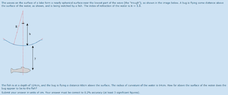
The discussion centers on the application of the lens formula for a system with different refractive indices on each side. The correct formula is n1/p + n2/q = -(n2-n1)/R, where n1 is the refractive index of the medium where the object (fly) is located, and n2 is the refractive index of the medium where the virtual image is formed. The user initially miscalculated the difference in refractive indices, leading to an incorrect virtual image distance of 35.155 cm instead of the correct 60.88 cm. The final calculation confirmed that the virtual image is indeed 60.88 cm above the water.

PREREQUISITES
  • Understanding of lens formulas and sign conventions in optics
  • Knowledge of refractive indices and their implications in optical systems
  • Familiarity with virtual images and their characteristics
  • Basic algebra skills for manipulating equations
NEXT STEPS
  • Study the derivation and applications of the lens maker's equation
  • Learn about sign conventions in optics, particularly for lenses
  • Explore the concept of virtual images in different optical setups
  • Investigate the effects of varying refractive indices on image formation
USEFUL FOR

Optics students, physics educators, and anyone involved in the study or application of lens systems and image formation in optics.

JoeyBob
Messages
256
Reaction score
29
Homework Statement
see attached
Relevant Equations
1/p+1/q=-2/R
So I am not really familiar with lens questions when there's 2 different refraction indexes. I tried using n1/p+n2/q=-(n2-n1)/R but it doesn't seem to work.

p would be the actual location of the fly and q would be the virtual location, what the fish sees if I am understanding correctly. n1 would be the index of refraction where the fly is and n2 where the virtual image is?

So 1/60+1.3/q=-1.3/64. q=-35.155

So the image is 35.155 cm above the water. But this is wrong, the answer is 60.88 cm
 

Attachments

  • question.PNG
    question.PNG
    16.4 KB · Views: 208
Physics news on Phys.org
JoeyBob said:
n1/p+n2/q=-(n2-n1)/R

So 1/60+1.3/q=-1.3/64
The 1.3 on the right side is not correct.
 
TSny said:
The 1.3 on the right side is not correct.
The rest is correct then?

Shouldn't it be on top according to the formula?
 
The rest is correct.

JoeyBob said:
Shouldn't it be on top according to the formula?
I'm not sure what you are asking here.
 
n1/p+n2/q=-(n2-n1)/R

is this formula incorrect here?
 
The formula looks correct, although I’m not sure what sign conventions you are using for R, etc.

You made a mistake in calculating ##n_2-n_1##.
 
  • Like
Likes   Reactions: JoeyBob
TSny said:
The formula looks correct, although I’m not sure what sign conventions you are using for R, etc.

You made a mistake in calculating ##n_2-n_1##.
ya I am dumb. 1.3-1 isn't the same as 1.3-0. I get q = -60.88 when I use 0.3, so 60.88 above the water.

Thanks.
 
  • Like
Likes   Reactions: berkeman
JoeyBob said:
ya I am dumb.
Not at all. We all make slips like this :oldsmile:

1.3-1 isn't the same as 1.3-0. I get q = -60.88 when I use 0.3, so 60.88 above the water.
Thanks.
Looks good.
 

Similar threads

  • · Replies 3 ·
Replies
3
Views
1K
  • · Replies 15 ·
Replies
15
Views
2K
  • · Replies 1 ·
Replies
1
Views
2K
  • · Replies 3 ·
Replies
3
Views
2K
  • · Replies 3 ·
Replies
3
Views
1K
Replies
4
Views
2K
Replies
3
Views
2K
  • · Replies 11 ·
Replies
11
Views
2K
  • · Replies 11 ·
Replies
11
Views
1K
Replies
2
Views
3K