Lever system - brake (counting of forces)

Click For Summary
SUMMARY

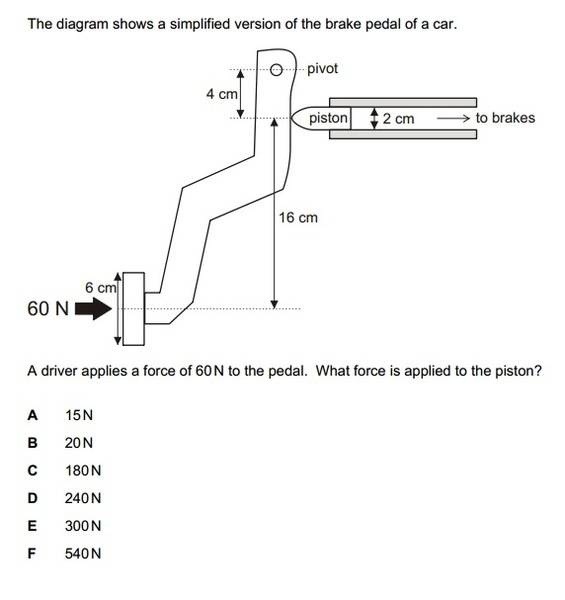
The discussion revolves around the application of the lever principle and hydraulic mechanics, specifically addressing the equation F1D1=F2D2. A participant incorrectly divided the force of 60N by 0.06m instead of using the correct lever arm of 0.2m, leading to confusion regarding the calculation of forces on a piston. The correct approach involves understanding that the question pertains to forces rather than pressures, and emphasizes the use of torque equilibrium for solving such problems.

PREREQUISITES
  • Understanding of the lever principle and torque calculations
  • Basic knowledge of hydraulic systems and Pascal's principle
  • Familiarity with force and area relationships in physics
  • Ability to apply equilibrium equations in mechanical systems
NEXT STEPS
  • Study the lever principle in detail, focusing on torque calculations
  • Learn about Pascal's principle and its applications in hydraulic systems
  • Explore force-area relationships in hydraulic mechanics
  • Practice solving equilibrium problems in mechanical systems using real-world examples
USEFUL FOR

Students of physics, mechanical engineers, and anyone involved in the design or analysis of hydraulic systems and lever mechanisms.
Bublifuk
Messages
5
Reaction score
0
Hello.
I tried to solve this question:
3586m3n.jpg

So F1D1=F2D2. Thus:
60N/ 0,06m x 0,2 m= f/0,02m x 0,04m
=100 Newton applied to the piston, but this doesn't fit to the answers offered.
What did I wrong?:(
 
Physics news on Phys.org
Why are you dividing the 60 N force by 6 cm?
 
Because it applies some force on the area, isn't it?

It's so easy, that I just need to divide 60N by 0,2M?
 
Bublifuk said:
Because it applies some force on the area, isn't it?

It's so easy, that I just need to divide 60N by 0,2M?

I think you are mixing the lever rule with the hydraulic press (Pascal principle).
The question is about forces. You don't need pressures. And dividing by 6 cm will not give pressure anyway (it's piston's diameter not its area).
Are there more questions related to the same diagram?
 
No, only this one.
Have you managed to solve it?
 
Use the equation for the lever or just equilibrium of torques around the pivot.
 

Similar threads

  • · Replies 7 ·
Replies
7
Views
2K
  • · Replies 28 ·
Replies
28
Views
2K
Replies
3
Views
2K
  • · Replies 5 ·
Replies
5
Views
7K
  • · Replies 26 ·
Replies
26
Views
9K
  • · Replies 4 ·
Replies
4
Views
2K
  • · Replies 4 ·
Replies
4
Views
4K
  • · Replies 4 ·
Replies
4
Views
8K
Replies
3
Views
5K
Replies
16
Views
3K