Lever system - brake (counting of forces)

Click For Summary

Homework Help Overview

The discussion revolves around a lever system problem involving forces and distances, specifically in the context of a hydraulic brake system. The original poster attempts to apply the lever principle to calculate the force on a piston but encounters discrepancies with the expected answers.

Discussion Character

  • Mixed

Approaches and Questions Raised

  • Participants explore the relationship between forces and distances in a lever system, questioning the application of the lever rule and the relevance of pressure in the context of the problem. There is confusion regarding the correct use of distances and whether to consider pressure or just forces.

Discussion Status

The discussion is ongoing, with participants providing insights and questioning each other's reasoning. Some guidance has been offered regarding the application of the lever equation and the equilibrium of torques, but no consensus has been reached on the correct approach.

Contextual Notes

There appears to be confusion regarding the distinction between lever mechanics and hydraulic principles, as well as the correct interpretation of the problem's parameters. The original poster's calculations and assumptions are under scrutiny.

Bublifuk
Messages
5
Reaction score
0
Hello.
I tried to solve this question:
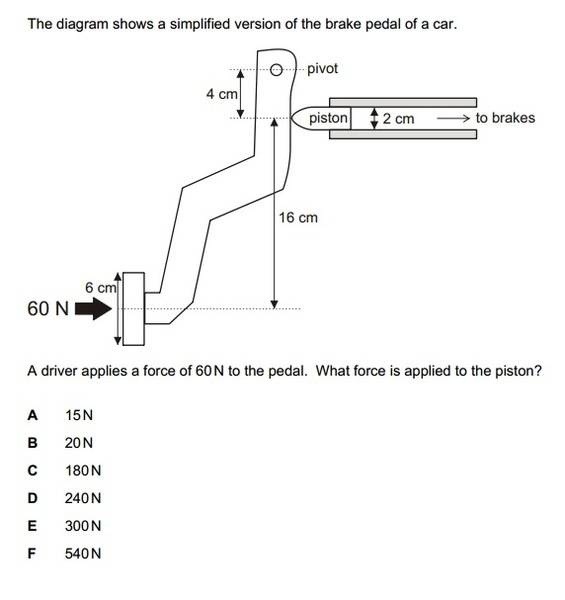
3586m3n.jpg

So F1D1=F2D2. Thus:
60N/ 0,06m x 0,2 m= f/0,02m x 0,04m
=100 Newton applied to the piston, but this doesn't fit to the answers offered.
What did I wrong?:(
 
Physics news on Phys.org
Why are you dividing the 60 N force by 6 cm?
 
Because it applies some force on the area, isn't it?

It's so easy, that I just need to divide 60N by 0,2M?
 
Bublifuk said:
Because it applies some force on the area, isn't it?

It's so easy, that I just need to divide 60N by 0,2M?

I think you are mixing the lever rule with the hydraulic press (Pascal principle).
The question is about forces. You don't need pressures. And dividing by 6 cm will not give pressure anyway (it's piston's diameter not its area).
Are there more questions related to the same diagram?
 
No, only this one.
Have you managed to solve it?
 
Use the equation for the lever or just equilibrium of torques around the pivot.
 

Similar threads

  • · Replies 7 ·
Replies
7
Views
2K
  • · Replies 28 ·
Replies
28
Views
3K
Replies
3
Views
2K
  • · Replies 5 ·
Replies
5
Views
7K
  • · Replies 26 ·
Replies
26
Views
9K
  • · Replies 4 ·
Replies
4
Views
2K
  • · Replies 4 ·
Replies
4
Views
4K
  • · Replies 4 ·
Replies
4
Views
8K
Replies
3
Views
5K
Replies
16
Views
3K