What is the force generated by a lever in a closed position?

Click For Summary
SUMMARY

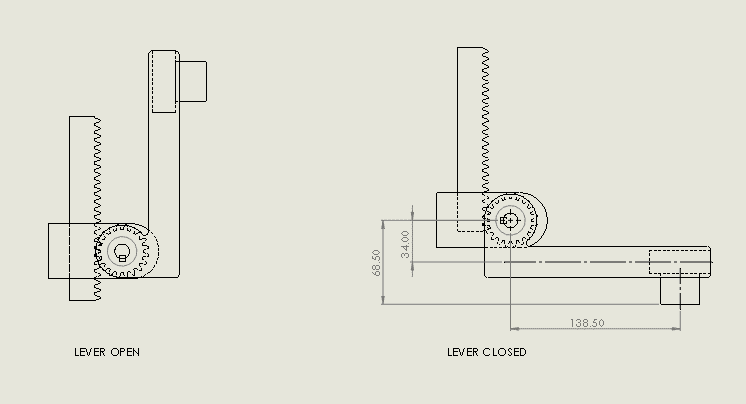
The discussion centers on calculating the force generated by a lever mechanism operated by a rack and pinion gear assembly, with a torque of 252 Nm and a lever arm length of 138.5 mm. The resulting force is determined using the formula: Force = Torque / Distance, which translates to Force = 252 Nm / 0.1385 m, yielding a specific force value. Participants emphasized the importance of clearly specifying units in technical drawings to avoid confusion in calculations.

PREREQUISITES
  • Understanding of torque and its units (Nm)
  • Knowledge of lever mechanics and rack and pinion systems
  • Ability to perform unit conversions (mm to m)
  • Familiarity with basic physics formulas involving force and distance
NEXT STEPS
  • Research the principles of torque in mechanical systems
  • Explore advanced calculations involving levers and mechanical advantage
  • Learn about the design considerations for rack and pinion gear assemblies
  • Investigate best practices for creating technical drawings with clear unit specifications
USEFUL FOR

Mechanical engineers, product designers, and anyone involved in the design and analysis of lever mechanisms and gear systems will benefit from this discussion.

IanPibworth
Messages
12
Reaction score
1
So..

I'm trying to figure out if a design Idea has any potential. The figure below shows a lever mechanism operated by a rack and pinion gear assembly. I've calculated the torque in the pinion to be 252 Nm.

What will be the force at the contact pad, generated by the lever when in the closed position?

Any and all advice welcome..
upload_2018-8-29_15-54-58.png
 

Attachments

  • upload_2018-8-29_15-54-58.png
    upload_2018-8-29_15-54-58.png
    3.3 KB · Views: 636
Engineering news on Phys.org
The resulting force is equal to the 252 Nm torque x the 138.5 mm? length (converted to m) in your drawing. (Note: No drawing is complete without at least a note specifying the units of its dimensions.)
 
  • Like
Likes   Reactions: IanPibworth and berkeman
Oh.. its really as simple as that? I feel a bit stupid asking now, I thought because of the offset there would be an additional calculation.

Yes, the full drawing border has the specified units, in this case its mm.

Thanks for your help.
 
JBA said:
The resulting force is equal to the 252 Nm torque x the 138.5 mm? length (converted to m) in your drawing. (Note: No drawing is complete without at least a note specifying the units of its dimensions.)
I think that should be

Force = torque/distance = 252/0.138
 
{/QUOTE] JBA, post: 6048274, member: 570081"]The resulting force is equal to the 252 Nm torque x the 138.5 mm? length (converted to m)[/QUOTE]

I intended the conversion to refer to the 138.5 mm length; but, I can see how it might be a bit ambiguous and misconstrued as referring to the multiplication result.
 
I wasn't referring to the conversion...

Torque = force * distance
so
Force = torque / distance
 
Now I see my ridiculous error. I must start checking my posts a lot more carefully. I think my advancing age is beginning to affect my mind.
 
Me too.
 

Similar threads

  • · Replies 9 ·
Replies
9
Views
2K
Replies
4
Views
2K
  • · Replies 28 ·
Replies
28
Views
2K
  • · Replies 17 ·
Replies
17
Views
4K
  • · Replies 1 ·
Replies
1
Views
2K
  • · Replies 3 ·
Replies
3
Views
4K
Replies
4
Views
1K
  • · Replies 47 ·
2
Replies
47
Views
7K
  • · Replies 2 ·
Replies
2
Views
2K
  • · Replies 5 ·
Replies
5
Views
5K