Discussion Overview
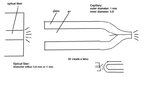
The discussion revolves around the challenges of efficiently coupling light from an optical fiber connected to a 365nm LED into a small glass capillary, which is intended to serve as a light source and guide. Participants explore various configurations, materials, and techniques to optimize light incoupling for applications in studying photocatalyst reactions.
Discussion Character
- Exploratory
- Technical explanation
- Debate/contested
- Experimental/applied
Main Points Raised
- One participant suggests treating the glass capillary like an optical fiber, where the core is air and the cladding is glass.
- Another participant proposes positioning the optical fiber directly against the glass sheath, despite diameter mismatches, or using a smaller fiber for better coupling.
- Some participants discuss the possibility of using a cone-shaped end on the capillary to improve light coupling.
- Concerns are raised about significant light losses during coupling, with one participant noting that about 90% of the initial power may be lost, questioning the reasons behind this loss.
- There are suggestions to fill the capillary with a high index fluid or to use clear epoxy to potentially enhance light transmission.
- One participant mentions the need to convert the optical mode to a coaxial waveguide mode to suit the capillary.
- Another participant raises a question regarding the reduction of phase space of light and its implications based on Liouville's Theorem.
- Some participants share experiences and references to previous work, including the use of graded index lenses and the importance of alignment in reducing losses.
Areas of Agreement / Disagreement
Participants express various viewpoints regarding the best methods for light coupling, with no consensus reached on a single effective approach. Multiple competing ideas and techniques are presented, indicating an unresolved discussion.
Contextual Notes
Participants mention limitations related to the physical setup, including diameter mismatches, the need for the capillary to accommodate a metal wire, and the challenges of achieving effective light coupling without significant losses.