Limit with integral and absolute value

Click For Summary

Discussion Overview

The discussion revolves around evaluating a limit involving an integral and the absolute value of a function. Participants explore the antiderivative of the function, the behavior of sine near zero, and the implications of limits as they approach zero.

Discussion Character

  • Exploratory
  • Technical explanation
  • Mathematical reasoning

Main Points Raised

  • One participant presents an integral solution resulting in [x + sin(x) - 1] and seeks further assistance.
  • Another participant clarifies that "sen" is an abbreviation for sine and discusses the antiderivative from 0 to x.
  • A participant points out a mistake regarding sin(0) and expresses a desire to avoid using L'Hôpital's rule.
  • There is a suggestion to use the limit ##\lim_{x \rightarrow 0}\frac{\sin (x)}{x}=1## to simplify the expression.
  • Concerns are raised about encountering a zero in the denominator, leading to discussions about the implications of dividing by a number approaching zero.
  • Participants discuss the behavior of the numerator 1 + sin(x)/x and its tendency towards zero, questioning whether this holds true from both the left and right sides of zero.
  • One participant notes that sin(x) and x behave similarly near zero, suggesting that ##\frac{\sin x}{x} \approx 1##.

Areas of Agreement / Disagreement

Participants express varying interpretations of the limit behavior and the implications of their calculations. There is no consensus on the final outcome or the handling of the absolute value in the denominator.

Contextual Notes

Some assumptions about the behavior of functions near zero are discussed, but the discussion does not resolve the mathematical steps or the implications of the absolute value in the limit.

Genilson
Messages
6
Reaction score
0
Hello good evening to all, I was studying here and got stuck with this.
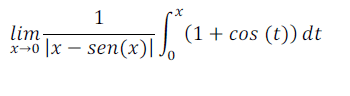
upload_2016-10-22_17-23-36.png

I solved the integral and got [x+sin(x) -1]
and that´s the farthest that I got. I would appreciate the help.
 
Physics news on Phys.org
Genilson said:
Hello good evening to all, I was studying here and got stuck with this.
View attachment 107864
I solved the integral and got [x+sin(x) -1]
and that´s the farthest that I got. I would appreciate the help.
Can you explain, what ##sen## means and where the ##1## in your antiderivative comes from?
 
  • Like
Likes   Reactions: Genilson
fresh_42 said:
Can you explain, what sen means
I believe it is another abbreviation for sine.
 
  • Like
Likes   Reactions: Genilson
yep , sorry (sen) = (sin).
Ok, the antiderivative should be
[ t + sin(t) ] from 0 to x.
Then I get [ x + sin(x) - 0 - sin(0) ] and Yep, I found my first mistake. sin(0) = 0

Btw I would like a solution without using L' Hopital rule, if there is one of course.
 
Genilson said:
yep , sorry (sen) = (sin).
Ok, the antiderivative should be
[ t + sin(t) ] from 0 to x.
Then I get [ x + sin(x) - 0 - sin(0) ] and Yep, I found my first mistake. sin(0) = 0

Btw I would like a solution without using L' Hopital rule, if there is one of course.
Are you allowed to use ##\lim_{x \rightarrow 0}\frac{\sin (x)}{x}=1##? If so, you could cancel the quotient by an ##x##.
 
  • Like
Likes   Reactions: Genilson
Yep, I can use sinx/x limit but it still leave me with 0 in the denominator
 
Genilson said:
Yep, I can use sinx/x limit but it still leave me with 0 in the denominator
And a ##2## in the nominator, which tells you?

Edit: Or more directly: What happens, if you divide a real number by a number that gets closer and closer to zero?
 
Last edited:
  • Like
Likes   Reactions: Genilson
it goes to + infinite, but Wolfram gives me as answer +inf and - inf.
 
Genilson said:
it goes to + infinite, but Wolfram gives me as answer +inf and - inf.
You'd probably ignored the absolute value of your denominator. How do you manage to get a negative number?
 
  • Like
Likes   Reactions: Genilson
  • #10
I have 1 + sinx/x in the numerator, so, they´re supposed to tend to zero isn´t it? from the left or from the right it will return me 0, or am I wrong?
 
  • #11
Genilson said:
I have 1 + sinx/x in the numerator, so, they´re supposed to tend to zero isn´t it? from the left or from the right it will return me 0, or am I wrong?
##\sin x## and ##x## are pretty much the same in a small neighborhood around zero, aren't they? This means ##\frac{\sin x}{x} \, \approx \,1##.
If ##x## is negative, then ##\sin x## is as well.
 
  • Like
Likes   Reactions: Genilson
  • #12
I've never seen it this way, thank you very much!
 

Similar threads

  • · Replies 1 ·
Replies
1
Views
1K
  • · Replies 2 ·
Replies
2
Views
3K
  • · Replies 5 ·
Replies
5
Views
1K
  • · Replies 8 ·
Replies
8
Views
3K
  • · Replies 8 ·
Replies
8
Views
3K
  • · Replies 3 ·
Replies
3
Views
3K
  • · Replies 14 ·
Replies
14
Views
4K
  • · Replies 8 ·
Replies
8
Views
4K
  • · Replies 31 ·
2
Replies
31
Views
5K
  • · Replies 2 ·
Replies
2
Views
2K