MHB Limits of Complex Functions .... Zill & Shanahan, Theorem 3.1.1/ A1

Click For Summary
SUMMARY

The discussion centers on the application of the triangle inequality in the proof of Theorem 3.1.1 (A1) from "Complex Analysis: A First Course with Applications" (Third Edition) by Dennis G. Zill and Patrick D. Shanahan. The theorem states that for a complex function \( f(z) = u(x,y) + i v(x,y) \) and a limit \( L = u_0 + i v_0 \), the inequality \( |f(z) - L| \leq |u(x,y) - u_0| + |v(x,y) - v_0| \) holds. Participants in the forum suggest comparing complex analysis to real analysis, emphasizing the structural differences and the importance of holomorphic functions. They also recommend reviewing the definitions of limits in both \( \mathbb{C} \) and \( \mathbb{R}^2 \).

PREREQUISITES
  • Understanding of complex functions and their components, specifically \( f(z) = u(x,y) + i v(x,y) \)
  • Familiarity with the triangle inequality in complex analysis, expressed as \( |z_1 + z_2| \leq |z_1| + |z_2| \)
  • Knowledge of limits in both \( \mathbb{C} \) and \( \mathbb{R}^2 \)
  • Basic concepts of holomorphic functions and differentiability in complex analysis
NEXT STEPS
  • Study the proof of Theorem 3.1.1 (A1) in "Complex Analysis: A First Course with Applications" by Zill and Shanahan
  • Learn about the differences between limits in \( \mathbb{C} \) and \( \mathbb{R}^2 \)
  • Explore the concept of holomorphic functions and their significance in complex analysis
  • Review the application of the triangle inequality in various contexts within complex analysis
USEFUL FOR

Students and educators in mathematics, particularly those focusing on complex analysis, as well as researchers interested in the foundational aspects of

Math Amateur
Gold Member
MHB
Messages
3,920
Reaction score
48
I am reading the book: Complex Analysis: A First Course with Applications (Third Edition) by Dennis G. Zill and Patrick D. Shanahan ...

I need some help with an aspect of the proof of Theorem 3.1.1 (also named Theorem A1 and proved in Appendix 1) ...

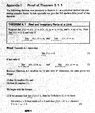
The statement of Theorem 3.1.1 (A1) reads as follows:

View attachment 9225
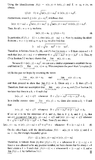
In the proof of Theorem 3.1.1 (A1) [see below] we read the following:

" ... ... On the other hand, with the identifications $$f(z) = u(x,y) + i v(x,y)$$ and $$L = u_0 + i v_0$$, the triangle inequality gives $$\mid f(z) - L \mid \ \leq \ \mid u(x,y) - u_0 \mid + \mid v(x,y) - v_0 \mid$$ ... ... "
My question is as follows:

How exactly do we apply the triangle inequality to get $$\mid f(z) - L \mid \ \leq \ \mid u(x,y) - u_0 \mid + \mid v(x,y) - v_0 \mid$$ ... ... ? Note: Zill and Shanahan give the triangle inequality as

$$\mid z_1 + z_2 \mid \ \leq \ \mid z_1 \mid + \mid z_2 \mid$$

My thoughts are as follows:

$$\mid f(z) - L \mid \ = \ \mid u(x,y) + i v(x,y) - (u_0 + i v_0 ) \mid \ = \ \mid ( u(x,y) - u_0 ) + i ( v(x,y) - v_0 ) \mid$$so in triangle inequality put

$$z_1 = u(x,y) - u_0 + i.0$$

and

$$z_2 = 0 + i ( v(x,y) - v_0 $$)and apply triangle inequality ...Is that correct?Hope someone can help ...

Peter==================================================================================The statement and proof of Theorem 3.1.1 (given in Appendix 1 where the theorem is called Theorem A.1) reads as follows:
View attachment 9226
View attachment 9227Hope that helps ...

Peter
 

Attachments

  • Zill & Shanahan - Theorem 3.1.1 or A1 ... Statement .png
    Zill & Shanahan - Theorem 3.1.1 or A1 ... Statement .png
    20.2 KB · Views: 158
  • Zill & Shanahan - 1 -Theorem 3.1.1 ... Proof ... Part 1.png
    Zill & Shanahan - 1 -Theorem 3.1.1 ... Proof ... Part 1.png
    80.3 KB · Views: 166
  • Zill & Shanahan - 2 -Theorem 3.1.1 ... Proof ... Part 2 ... .png
    Zill & Shanahan - 2 -Theorem 3.1.1 ... Proof ... Part 2 ... .png
    48.4 KB · Views: 139
Last edited:
Physics news on Phys.org
I'm going to suggest 2 things to streamline this. The main question is: what if, instead of $\mathbb C$ this was $\mathbb R^2$?

First, in general this is a good questions to ask as $\mathbb C$ in some sense is $\mathbb R^2$ with some 'tiny refinements' (i.e. geometrically pleasant field operations). One of the main points of complex analysis is that these 'tiny refinements' add a huge amount of structure and while definitions formally look about the same e.g. for differentiability on an open set in $\mathbb R^2$ vs $\mathbb C$, all kinds of things can be differentiable for the former that aren't for the latter -- and as a result only 'nice' functions are called holomorphic. So it's always a good question to have in the back of your mind and to try to make these comparisons.

Second, check on the definition of the limit in $\mathbb C$ vs that in $\mathbb R^2$. Consider $\mathbf z \in \mathbb R^2$ and
$f: \mathbb R^2 \to \mathbb R^2$. You'll see that $u(x,y) = z_1$ and $i v(x,y) = z_2$, i.e. they are isolating real and imaginary parts just like in the vector space interpretation of $\mathbb C$. Now apply results from your most recent thread about convergence in $\mathbb R^d$ iff there is component-wise convergence, selecting $d = 2$.
 
Yeah this shall be helpful, as one of the main points of complex analysis is that these 'tiny refinements' add a huge amount of structure and while definitions formally look about the same e.g. for differentiability on an open set in ℝ2 vs ℂ, all kinds of things can be differentiable for the former that aren't for the latter -- and as a result only 'nice' functions are called holomorphic. So it's always a good question to have in the back of your mind and to try to make these comparisons.
 
frapps11 said:
Yeah this shall be helpful, as one of the main points of complex analysis is that these 'tiny refinements' add a huge amount of structure and while definitions formally look about the same e.g. for differentiability on an open set in ℝ2 vs ℂ, all kinds of things can be differentiable for the former that aren't for the latter -- and as a result only 'nice' functions are called holomorphic. So it's always a good question to have in the back of your mind and to try to make these comparisons.
Thanks to steep and frapps11 for most helpful posts ...

I am still reflecting on what you have written ...

Thanks again!

Peter
 
As shown by this animation, the fibers of the Hopf fibration of the 3-sphere are circles (click on a point on the sphere to visualize the associated fiber). As far as I understand, they never intersect and their union is the 3-sphere itself. I'd be sure whether the circles in the animation are given by stereographic projection of the 3-sphere from a point, say the "equivalent" of the ##S^2## north-pole. Assuming the viewpoint of 3-sphere defined by its embedding in ##\mathbb C^2## as...

Similar threads

Replies
4
Views
2K
  • · Replies 2 ·
Replies
2
Views
2K
  • · Replies 4 ·
Replies
4
Views
2K
  • · Replies 6 ·
Replies
6
Views
2K
Replies
2
Views
2K
  • · Replies 4 ·
Replies
4
Views
2K
  • · Replies 4 ·
Replies
4
Views
2K
Replies
11
Views
3K
  • · Replies 2 ·
Replies
2
Views
2K
Replies
2
Views
1K