Linear particle accelerator design

Click For Summary
SUMMARY

This discussion centers on the design differences between two types of linear particle accelerators (linacs), specifically focusing on superconducting RF (radio frequency) accelerators. The conversation highlights that in superconducting RF cavities, the spacing between units does not increase as particles accelerate, unlike designs for slower-moving charged particles where spacing is crucial. The participants emphasize the importance of understanding whether the structures are standing wave or traveling wave types, as well as the relevance of RF frequency and the relativistic speed of particles in determining design parameters.

PREREQUISITES
  • Understanding of superconducting RF cavity technology
  • Knowledge of particle acceleration principles
  • Familiarity with standing wave and traveling wave structures
  • Basic concepts of relativistic physics
NEXT STEPS
  • Research the principles of superconducting RF cavities in particle accelerators
  • Explore the differences between standing wave and traveling wave accelerator designs
  • Study the impact of RF frequency on particle acceleration
  • Investigate the role of relativistic effects in high-energy particle physics
USEFUL FOR

Physicists, accelerator engineers, and students in particle physics who are interested in the design and functionality of linear particle accelerators and their applications in high-energy physics research.

emoney
Messages
2
Reaction score
0
I have a qustion about two types of accelerating designs.

In these types of design the plates get longer or spaced apart because the frequency of the RF power is constant but the particle is acclerated so it covers more distance in less time.
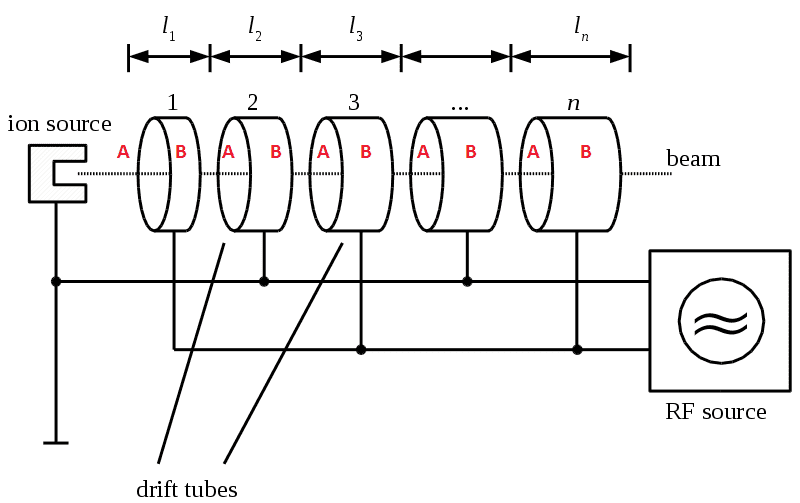
acc-linac-schema.png
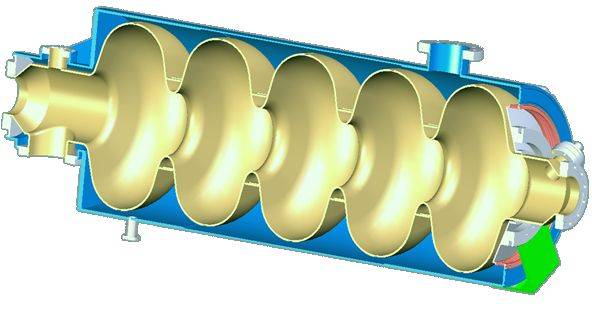
The other type of design looks like this:
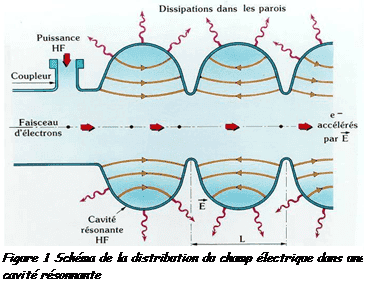
image037.png

2981_5.jpg


My question is, is why in these superconducting Rf accelerators that the units do not get place farther apart or grow in length as the beam go through.

What I am thinking is that the design with the plates increasing in spacing is for slow moving particle charged particles where acceleration is very large, and that the other design is for when the particles are already traveling very fast and acceleration very little so spacing is less important.

Is that right? or is there a different reason?
I
 
Physics news on Phys.org
You need to double check if these are all standing wave structure or if one of them is a traveling wave structure. The rf frequency used can also be a determining factor here. In addition, are these linacs used at the very beginning of the acceleration (i.e. Such as at the photoinjector) or are they where the particle bunches are already relativistic?

There are a lot of details here that are missing.

BTW, topics on accelerator science normally belongs in the Classical Physics forum, since classical E&M is usually the main subject area involved, such as in this one.

Zz.
 
I moved the thread.
emoney said:
What I am thinking is that the design with the plates increasing in spacing is for slow moving particle charged particles where acceleration is very large, and that the other design is for when the particles are already traveling very fast and acceleration very little so spacing is less important.
Right.
The superconducting RF cavities are typically used for electrons in the hundreds of MeV to GeV range, where the difference to the speed of light is negligible. It has to be, because frequency and wavelength in those cavities are linked via the speed of light (with some corrections due to the shape of the cavities).
 

Similar threads

  • · Replies 22 ·
Replies
22
Views
2K
  • · Replies 4 ·
Replies
4
Views
2K
  • · Replies 18 ·
Replies
18
Views
3K
  • · Replies 2 ·
Replies
2
Views
3K
  • · Replies 9 ·
Replies
9
Views
1K
  • · Replies 12 ·
Replies
12
Views
3K
  • · Replies 15 ·
Replies
15
Views
4K
Replies
1
Views
1K
  • · Replies 2 ·
Replies
2
Views
4K
  • · Replies 2 ·
Replies
2
Views
3K