Linearly Increasing Potential Well. Help

Click For Summary
SUMMARY

The discussion centers on the wave function behavior in a linearly increasing potential well, specifically regarding amplitude and wavelength as energy approaches the potential \( V_0 \). Participants clarify that both energy \( E \) and potential \( V_0 \) are constants in this context, despite the linear increase of \( V_0 \). The key takeaway is that the particle's kinetic energy is highest just before \( x = 0 \), leading to shorter wavelengths, while the amplitude decreases as the particle's energy transitions to a potential-dominated region. Understanding these dynamics is crucial for solving similar quantum mechanics problems.

PREREQUISITES
  • Quantum Mechanics fundamentals
  • Understanding of wave functions
  • Knowledge of potential wells
  • Familiarity with energy and potential energy concepts
NEXT STEPS
  • Study the behavior of wave functions in finite potential wells
  • Learn about the Schrödinger equation in varying potential scenarios
  • Research the concept of tunneling in quantum mechanics
  • Explore the relationship between kinetic energy and wavelength in quantum systems
USEFUL FOR

Students and educators in quantum mechanics, particularly those preparing for exams or seeking to deepen their understanding of wave functions in potential wells.

Brydan
Messages
2
Reaction score
0
[Note: no template because this post was moved from the QM subforum]

I was working on problem #41 and was confused about what the wave function would look like from the time x = 0 to when E=V0. (See image in attachments)https://mail.google.com/mail/u/0/?ui=2&ik=be26b6c94d&view=fimg&th=14c66f8d9fef8e09&attid=0.1&disp=inline&realattid=1497006575826501632-local0&safe=1&attbid=ANGjdJ9_sVoeG4InQCcYyJgM9GdXq5BJUBa-YH0cv1QCny82hco_1lvkH8I3AvpB_3B_zcwK5VVtj8BIZFl_yafUAFkA85LYwtvbi40WKWRnP6ch-psjeDgoFr6Vf7k&ats=1427656728466&rm=14c66f8d9fef8e09&zw&sz=w1896-h859In class we did this problem and my professor drew something on the board that looked similar to the image below, where both the amplitude and wavelength decrease from when x = 0 to when E = V0.
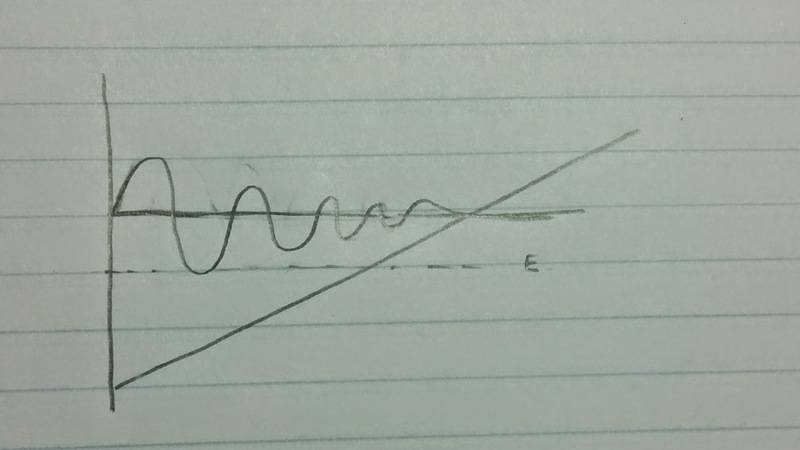
20150328_234815.jpg


However, I don't understand this solution. as according to the equations below, the wavelength should be increasing:
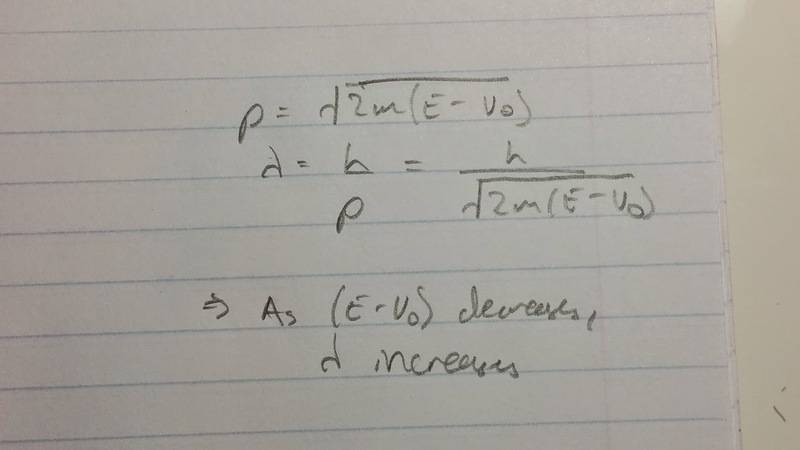
20150328_235319.jpg
Additionally, I don't understand why the amplitude would be decreasing.

I was wondering if anyone could perhaps clarify what the amplitude and wavelength should be doing and why. My test is tomorrow so any help would be greatly appreciated. Thanks!
 

Attachments

  • upload_2015-3-29_15-34-6.png
    upload_2015-3-29_15-34-6.png
    11.4 KB · Views: 739
Last edited by a moderator:
Physics news on Phys.org
In this problem, ##E## and ##V_0## are constants so thinking about what happens as the one approaches the other is distracting you from the point of the problem.
 
Nugatory said:
In this problem, ##E## and ##V_0## are constants so thinking about what happens as the one approaches the other is distracting you from the point of the problem.
But since V0 is increasing linearly wouldn't it not be considered a constant?
 
Suppose you made a crude approximation of that linearly-varying potential with (say) three sequential finite-wells...(which must be joined appropriately at their boundaries)...
 
The graph is wrong for two reasons, just to the left of x=0 the particle has its greatest kinetic energy and moves the fastest and is least likely to be found in some small interval. Near the point where the energy is nearly all potential the particle moves slowly and is more likely to be found. You should know which region has the shortest wavelength.
 
Hello Brydan, I hope you did well on the test. Your own hand-written thingy is along the lines of Spinnor's input and seems healthy to me. It's just that you used V0 instead of V there that confused Nugatory and yourself. So you should be able to qualitatively improve on teacher's rough sketch. And explain. Which is all the exercise requires.

Must say I have no idea what the composer of the exercise means with 'outside the potential well'. All I can distinguish is a region E > V and a region E < V.
 

Similar threads

  • · Replies 1 ·
Replies
1
Views
1K
  • · Replies 1 ·
Replies
1
Views
2K
  • · Replies 2 ·
Replies
2
Views
2K
Replies
1
Views
1K
  • · Replies 15 ·
Replies
15
Views
8K
Replies
11
Views
7K
  • · Replies 5 ·
Replies
5
Views
2K
  • · Replies 7 ·
Replies
7
Views
3K
  • · Replies 3 ·
Replies
3
Views
2K
  • · Replies 2 ·
Replies
2
Views
3K