Liquid temperature increases when flowing through a 100% efficient pump?

Click For Summary

Discussion Overview

The discussion revolves around the behavior of water as it flows through a 100% efficient pump in an ideal Rankine cycle, specifically addressing why the temperature of the water increases despite the pump's isentropic efficiency. The scope includes theoretical considerations of thermodynamics and fluid mechanics.

Discussion Character

  • Technical explanation
  • Conceptual clarification
  • Debate/contested

Main Points Raised

  • One participant questions why the temperature of the water increases from point 1 to point 2 in the pump if it is 100% efficient and does not increase entropy.
  • Another participant suggests that the pump exerts a force (pressure) on the water, which could increase temperature, but acknowledges the complexity due to the incompressibility of the fluid.
  • A further reply points out a contradiction in the constraints of considering water as incompressible while also discussing its compression effects, suggesting that the temperature increase is negligible and may be exaggerated in theoretical diagrams.

Areas of Agreement / Disagreement

Participants express differing views on the implications of the pump's efficiency and the nature of the fluid. There is no consensus on the extent of the temperature increase or the relevance of incompressibility in this context.

Contextual Notes

Participants note the potential contradiction in discussing the effects of compression while treating water as incompressible. The discussion also highlights the limitations of theoretical diagrams in accurately representing the phenomenon.

oksuz_
Messages
70
Reaction score
3
Hi,

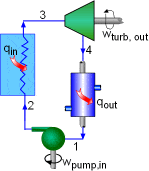
For an ideal Rankine cycle,

th100104p.gif


the temperature-specific entropy diagram can be given as follows,
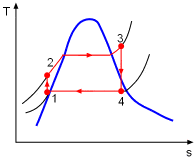
th100108p.gif


The pump in this cycle is isentropically 100% efficient.

My question is that why the temperature of the water increases as it flows through the pump (point 1 to 2) if the pump is 100% efficient. I can understand why point 2 is not on the saturation line (need higher temperature at a higher pressure to make a liquid saturated).

Thank you in advance.
 

Attachments

  • th100108p.gif
    th100108p.gif
    3.1 KB · Views: 801
  • th100104p.gif
    th100104p.gif
    4.4 KB · Views: 819
Last edited by a moderator:
Engineering news on Phys.org
oksuz_ said:
why the temperature of the water increases as it flows through the pump (point 1 to 2) if the pump is 100% efficient.

What does the pump do to the water? It doesn't increase its entropy (since it's 100% efficient), but it has to do something in order to make the water flow. What is that something?
 
It exerts a force (pressure) on the water. If the working fluid was gas, the pressure would increase its temperature. However, we are considering an incompressible fluid. Definitely, I am missing something.
 
oksuz_ said:
It exerts a force (pressure) on the water. If the working fluid was gas, the pressure would increase its temperature. However, we are considering an incompressible fluid. Definitely, I am missing something.
Your constraints are contradicting each other. You are asking about what happens when water is compressed, while saying you want to consider water to be incompressible. You have to pick one.

I do have an easy way out though: the effect you are asking about is almost nonexistent, so you can just ignore it. It is exaggerated on the generic diagram you posted so it can be seen. Look at a real t-s diagram for water and you'll have trouble even seeing it to quantify it.
 

Similar threads

Replies
21
Views
3K
  • · Replies 7 ·
Replies
7
Views
3K
  • · Replies 8 ·
Replies
8
Views
3K
  • · Replies 14 ·
Replies
14
Views
2K
  • · Replies 5 ·
Replies
5
Views
3K
Replies
12
Views
3K
  • · Replies 2 ·
Replies
2
Views
1K
  • · Replies 3 ·
Replies
3
Views
2K
Replies
3
Views
2K
  • · Replies 23 ·
Replies
23
Views
4K