Local Extrema of Quartic Function: Help Find (x, y) Points

Join the discussion
Ask a follow-up here, or get your own question answered by working scientists, mathematicians and engineers — people, not an autocomplete.
Real named experts · corrections over time · the nuance an AI answer skips
1 reply · 2K views
MarkFL
Gold Member
MHB
Messages
13,284
Reaction score
12
Here is the question:

Can someone please help me find local maximum and local minimum?

Let f(x) = 2x^4 - 4x^2 + 6

Find the point(s) (x, y) at which f achieves:

local maximum - (?,?)
local minimum - (?,?)

can someone help me please
I get 1 and -1 but its wrong apparently

I have posted a link there to this thread so the OP can view my work.
 
Physics news on Phys.org
Hello John,

We are given the function:

$$f(x)=2x^4-4x^2+6$$

And are asked to find the local extrema. In order to do this, we need to equate the first derivative to zero, and finct the critical values:

$$f'(x)=8x^3-8x=8x\left(x^2-1 \right)=8x(x+1)(x-1)=0$$

Hence, our critical values are:

$$x=-1,0,1$$

Observing that the roots here are all off multiplicity 1, and seeing that for $1<x$, we have:

$$f'(x)>0$$

we may then conclude that the sign of the derivative alternates across the 4 intervals made by dividing the real number line at the three critical values, hence we have:

$$f(x)$$ increasing on $$(-1,0)\,\cup\,(1,\infty)$$

$$f(x)$$ decreasing on $$(-\infty,-1)\,\cup\,(0,1)$$

Thus, by the first derivative test, we are led to conclude that we have the following:

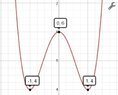
Relative minima at $$\left(-1,f(-1) \right)=(-1,4)$$ and $$\left(1,f(1) \right)=(1,4)$$

Relative maximum at $$\left(0,f(0) \right)=(0,6)$$

Here is a plot of the function and its relative extrema:

View attachment 2308
 

Attachments

  • john.jpg
    john.jpg
    14.9 KB · Views: 133