Rectifier
Gold Member
- 313
- 4
Hey there! Can someone please help me with this problem?
The problem
Translated from Swedish (sorry for possible grammatical errors):
L(from Europe) travels on the Trans-Siberian railway from Moscow to Vladivostok. His lamp battery dies when he reaches Irkutsk. He buys a Russian battery and that battery works as good as the European battery he had. After closer inspection of the battery, he finds that it is labeled 3,7 V. But he doesn't understand how it could work as good as his European one which was labeled 4,5 V.
He asked a Russian engineer that he met on the train and he explained that the Russian battery uses GOST classification. This means that 3,7 is the voltage across a 10 Ohm resistor that is attached to the battery and the voltage of the European battery describes the voltage of the source and does not say anything about the internal resistance.
What is the internal resistance of the Russian battery that L bought?
The attempt at a solution
I started with drawing a picture to represent the information given in the problem:
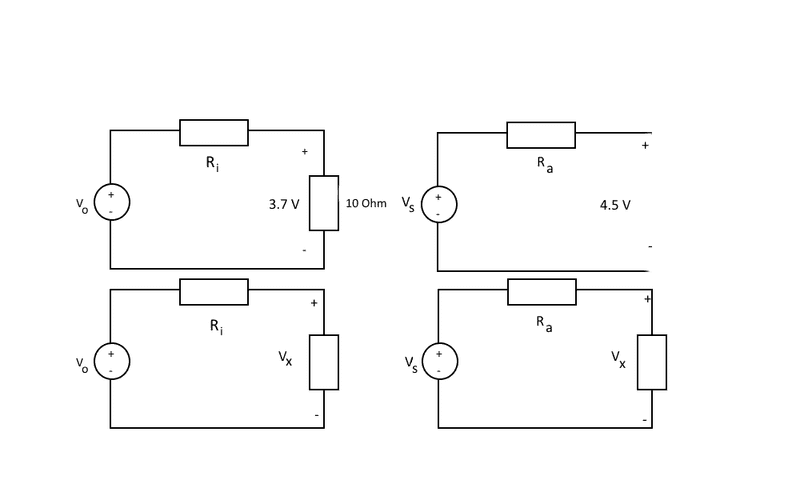
Russian battery on the left and European battery on the right.
We can draw following conclusion from the picture:
[itex]V_s=4.5[/itex] and we want to know what [itex]R_i[/itex] is.
One more important thing to notice is that the battery worked as good as the old one. Which means that the lamps brightness was the same in both cases. Since the lamp has a fixed resistance value (we can call it [itex]R_L[/itex]) and the voltage-drop ([itex]V_x[/itex]) was the same in both cases (when he had the 4,5V battery and the Russian one). Since resistance is fixed and voltage-drop is the same - the current through the lamp (and circuit) must be the same too.
These statements lead to following equations:
[itex]V=RI \\ I=\frac{4,5}{R} \\ I=\frac{4,5}{R_L+R_a}[/itex]
for the other battery it is
[itex]I=\frac{V_o}{R} \\ I=\frac{V_o}{R_L+R_i}[/itex]
Inserting one equation into another gives us
[itex]\frac{4,5}{R_L+R_a} = \frac{V_o}{R_L+R_i} \\ \frac{4,5(R_L+R_i)}{R_L+R_a} = V_o[/itex]
I have a few unknown variables here. In the next step I write an equation for the top picture of the Russian battery in terms of the voltage source.
[itex]3,7=\frac{10}{10+R_i}V_o \\ \frac{3,7(10+R_i)}{10}=V_o[/itex]
After inserting one equation into the other, we get :
[itex]\frac{3,7(10+R_i)}{10} = \frac{4,5(R_L+R_i)}{R_L+R_a}[/itex]
And here where I get stuck . I have got several unknown values left and I have no idea how to calculate them.
I have been sitting with this problem for two days now. I would really appreciate if someone could help me.
The problem
Translated from Swedish (sorry for possible grammatical errors):
L(from Europe) travels on the Trans-Siberian railway from Moscow to Vladivostok. His lamp battery dies when he reaches Irkutsk. He buys a Russian battery and that battery works as good as the European battery he had. After closer inspection of the battery, he finds that it is labeled 3,7 V. But he doesn't understand how it could work as good as his European one which was labeled 4,5 V.
He asked a Russian engineer that he met on the train and he explained that the Russian battery uses GOST classification. This means that 3,7 is the voltage across a 10 Ohm resistor that is attached to the battery and the voltage of the European battery describes the voltage of the source and does not say anything about the internal resistance.
What is the internal resistance of the Russian battery that L bought?
The attempt at a solution
I started with drawing a picture to represent the information given in the problem:
Russian battery on the left and European battery on the right.
We can draw following conclusion from the picture:
[itex]V_s=4.5[/itex] and we want to know what [itex]R_i[/itex] is.
One more important thing to notice is that the battery worked as good as the old one. Which means that the lamps brightness was the same in both cases. Since the lamp has a fixed resistance value (we can call it [itex]R_L[/itex]) and the voltage-drop ([itex]V_x[/itex]) was the same in both cases (when he had the 4,5V battery and the Russian one). Since resistance is fixed and voltage-drop is the same - the current through the lamp (and circuit) must be the same too.
These statements lead to following equations:
[itex]V=RI \\ I=\frac{4,5}{R} \\ I=\frac{4,5}{R_L+R_a}[/itex]
for the other battery it is
[itex]I=\frac{V_o}{R} \\ I=\frac{V_o}{R_L+R_i}[/itex]
Inserting one equation into another gives us
[itex]\frac{4,5}{R_L+R_a} = \frac{V_o}{R_L+R_i} \\ \frac{4,5(R_L+R_i)}{R_L+R_a} = V_o[/itex]
I have a few unknown variables here. In the next step I write an equation for the top picture of the Russian battery in terms of the voltage source.
[itex]3,7=\frac{10}{10+R_i}V_o \\ \frac{3,7(10+R_i)}{10}=V_o[/itex]
After inserting one equation into the other, we get :
[itex]\frac{3,7(10+R_i)}{10} = \frac{4,5(R_L+R_i)}{R_L+R_a}[/itex]
And here where I get stuck
. I have got several unknown values left and I have no idea how to calculate them. I have been sitting with this problem for two days now. I would really appreciate if someone could help me.
Last edited: