Looking for mechanical clutch solution

Click For Summary

Discussion Overview

The discussion revolves around finding a suitable mechanical clutch solution for a project involving a motor and two shafts, where one shaft can be manually rotated by a human. The focus is on ensuring that the human can easily rotate the shaft when the motor is not engaged, while also addressing the need for both shafts to move together when the motor operates. Participants explore various clutch designs and their implications for the project.

Discussion Character

  • Exploratory
  • Technical explanation
  • Debate/contested
  • Conceptual clarification

Main Points Raised

  • One participant proposes a gear-based solution where gears disengage when the motor is not active, allowing manual rotation of shaft 2.
  • Another participant raises concerns about the durability of gears and questions the power transfer, RPM, and operational direction of the proposed system.
  • A participant mentions the maximum expected RPM and torque, noting challenges in finding a suitable centrifugal clutch due to size constraints.
  • Further inquiries are made regarding power loss tolerances, engagement smoothness, and operational modes needed for the shafts.
  • Suggestions for alternative clutch designs include axial dog clutches, cup and cone clutches, and worm drives, with an emphasis on ease of construction.
  • One participant questions the necessity of disengaging the motor, suggesting a manual knob for operation instead.
  • A later reply discusses the specific application of a DIY smart lock system, indicating a preference for a dog clutch with centrifugal engagement to avoid the need for excessive manual rotation.
  • Concerns are raised about the abruptness of engagement/disengagement in centrifugal systems and the mechanics of using a worm drive for this purpose.

Areas of Agreement / Disagreement

Participants express a variety of viewpoints on the best approach to the clutch design, with no consensus reached on a single solution. Multiple competing ideas and concerns remain unresolved.

Contextual Notes

Participants discuss various assumptions regarding power requirements, engagement mechanisms, and the physical constraints of the project, which may affect the feasibility of proposed solutions.

Who May Find This Useful

Individuals interested in mechanical design, robotics, DIY electronics projects, and those exploring clutch mechanisms in engineering applications may find this discussion relevant.

Muted
Messages
7
Reaction score
0
Hi,

I made an electronics project but I'm having some mechanical problems. Particularly, I'm having issues finding a good clutch for my problem.

What I'm trying to do:
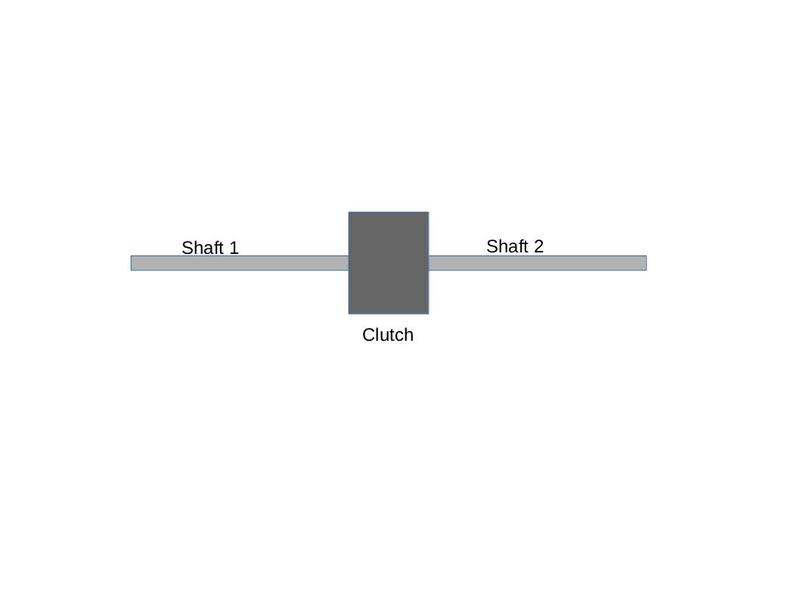
physics1.jpg

A motor is connected to shaft 1, a human can manually rotate shaft 2.
I want that when the motor isn't doing anything, a human can easily rotate shaft 2. In case it matters, the human will rotate the shaft at most 3 rotations in either direction. When the motor rotates, both shaft 1 and shaft 2 need to move.

The solution I came up with:
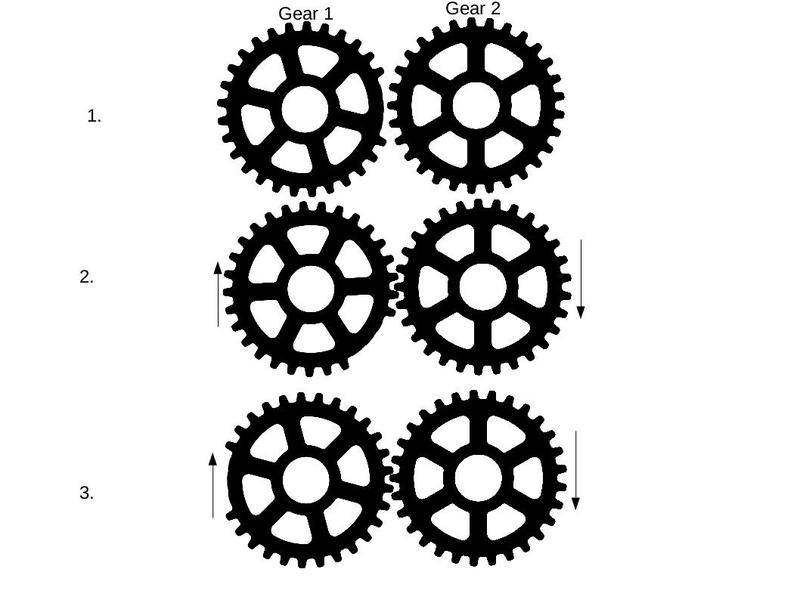
physics2.jpg

1) gear 1 and gear2 are not engaged, hence gear 2 can rotate freely when the motor is not moving
2) The motor is turning, the gears interlock and so gear2 turns
3) continues until back in position 1

There are a few problems such as you need to be sure that when motor is at rest, there are no gears interlocking. However I might be able to find a solution for this. My biggest problem however is that if the motor's batteries die when it is engaged, there is no way that the user will be able to rotate shaft 2. Any solutions are always welcome =) Thanks!
 
Engineering news on Phys.org
The gears on your proposed solution will not last long. And the output shaft will not have constant velocity.
What is the power transferred? RPM? Does it operate in both directions? How often will it need to be rotated manually?
Have you looked at centrifugal clutches? The type found in go carts & mini bikes can be had for ~$20 new. Remote control car scale clutches can also be found cheaply.
 
Thanks for the reply! It will rotate at a maximum of 100 RPM (freerun) probably and a maximum of 2Nm (stall) torque. Yes it operates in both directions. I have briefly looked at centrifugal clutches but haven't found any that are small enough (must fit in 3cm^3). Also, when motor turns at let's say 1.5Nm, it might only do 10RPM or so. Not sure if this is fast enough for centrifugal clutch.
 
Considering that you would like to have a Human easily operate shaft two I complete isolation between shafts may be in order. Humans are very low power producers.
I would be interested to hear further a few items. 1) How much power can you afford to lose to parasitic losses such as in using a fluid coupling? 2) Will the shafts be coming to rest for engagement and disengagement? 3) Does the engagement need to be smooth are can you afford some clunkiness? 4) What modes of connection do you need to achieve? ie. either shaft only, both shafts together, either shaft locks out the other, etc.
 
Sorry for late reply, I must of missed it somehow.

1) as little as possible since it will be battery powered and the motor will only have like 5W
2) yes, there will never be an engagement when one of the shafts is rotating
3) preferably smooth, but not necessary
4) either shaft2 should rotate or shaft1 and shaft2 should rotate together.

Also I was thinking about maybe finding a dc motor where I would need a small reduction so that a clutch would not be necessary. Someone told me that a 1:100 reduction should be small enough to be able to turn shaft + motor by hand without much problem. This would eliminate the need for a clutch. Is this a viable solution? Thanks!
 
The easiest of all clutches to make is the axial dog clutch .

Almost as easy is the cup and cone clutch .

Another easy one is to use worm drive and engage/disengage the worm .

Tell us more about the whole project - there may be completely alternative arrangements possible .
 
Last edited:
Why disengage the motor?

You could put a round knob on the motor shaft and turn that be hand when needed.
 
I'm making a DIY version of the Kwikset Smartcode. So basically I need a motor to lock/unlock my door while still working flawlessly with the key. However I want a different clutch system. They use a dog clutch with 180 degrees free turning to allow the key to rotate. However this means that the motor will mostly rotate 180 degrees before engaging. I'd like something that doesn't need this 180 degrees of play. (If this isn't clear I can upload an image).

From my research on line, it seems that I need a dogclutch with centrifugal engagement. The dog clutch because it would need high torque and the centrifugal engagement because I can't physically engage/disengage the clutch myself. However, this seems like it would have an abrupt engagement/disengagement. The engage/disengage worm also sounds interesting. Would this mean that I need to physically move the shaft of the worm with a different motor to engage/disengage it? Do you have any link to info on how this would work? Thanks!
 

Similar threads

  • · Replies 21 ·
Replies
21
Views
3K
  • · Replies 6 ·
Replies
6
Views
2K
  • · Replies 19 ·
Replies
19
Views
4K
Replies
3
Views
5K
Replies
2
Views
3K
Replies
19
Views
5K
Replies
5
Views
3K
  • · Replies 9 ·
Replies
9
Views
2K
  • · Replies 5 ·
Replies
5
Views
5K
  • · Replies 2 ·
Replies
2
Views
4K