Looking for what I thought would be a simple Permeability Q

Click For Summary
SUMMARY

This discussion focuses on calculating the permeability (μ) of ferromagnetic materials using the relationship between magnetic flux density (B) and magnetic field strength (H). Participants confirm that μ is a function of H, expressed as μ(H), and derive the equation B = μ(H)·H. They clarify that the derivative dB/dH can be approximated as μ under certain conditions, and emphasize the importance of using the correct units for B and H in calculations.

PREREQUISITES
  • Understanding of magnetic properties, specifically ferromagnetism
  • Familiarity with calculus, particularly differentiation techniques
  • Knowledge of magnetic hysteresis and its graphical representation
  • Basic concepts of magnetic flux density (B) and magnetic field strength (H)
NEXT STEPS
  • Study the derivation of the permeability equation in ferromagnetic materials
  • Learn about the implications of magnetic hysteresis in material science
  • Explore advanced differentiation techniques in multivariable calculus
  • Investigate the practical applications of permeability measurements in engineering
USEFUL FOR

Physicists, materials scientists, and engineers involved in magnetic material analysis and applications, as well as students studying electromagnetism and calculus.

tim9000
Messages
866
Reaction score
17
Hi, I've been thinking about how to calculate a permeability curve, I thought this would be an easy to find online but unfortunately I haven't had any luck.
From what I can graphically see below:
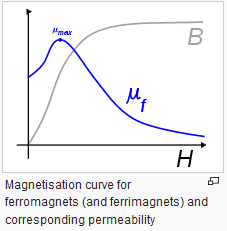
perm.PNG

It appears to me that mu for a ferromagnetic material is proportional to the derivative of B vs H, but if this is true, and if so what the actual relation is I haven't been able to find.

Anyone know?

Thanks
 
Engineering news on Phys.org
tim9000 said:
It appears to me that mu for a ferromagnetic material is proportional to the derivative of B vs H
That's an astute observation! The graph does indeed bear that resemblance.

Let's see ...

B and H are related in the usual way, viz., B=μH

Since μ changes with H, we can say μ is a function of H, writing this as μ(H). Accordingly, we can
write the equation more generally as B = μ(H).H

So, dB/dH = H.dμ/dH + μ

Now, on the right side if the first term were small in relation to the second (and you would need to look at typical values and graphs to see where this approximate could apply) you'd have your approximation

μ ≈ dB/dH http://imageshack.com/a/img29/6853/xn4n.gif
 
Last edited by a moderator:
Svein said:
Hi, I remember what a hysteresis curve is, but I don't see what it has to do with finding the mu of a steel.

NascentOxygen said:
That's an astute observation! The graph does indeed bear that resemblance.

Let's see ...

B and H are related in the usual way, viz., B=μH

Since μ changes with H, we can say μ is a function of H, writing this as μ(H). Accordingly, we can
write the equation more generally as B = μ(H).H

So, dB/dH = H.dμ/dH + μ

Now, on the right side if the first term were small in relation to the second (and you would need to look at typical values and graphs to see where this approximate could apply) you'd have your approximation

μ ≈ dB/dH http://imageshack.com/a/img29/6853/xn4n.gif

I'm sorry it's been so long since I've done multivariable calculus, I'm sure that was simple but could you tell me the working, did you use implicit or partial differentiation? Or just the old product or chain rule?

So since μ = dB/dH - H.dμ/dH
to calculate current μ you could just use a previous value of μ in H.dμ/dH, for a really close approximation. What units would dB/dH be in? Because B is in Teslas, I'm assuming it would be in too, as the graph indicates, but I notice it is H/m, does this mean the graph isn't scaled correctly?

Thanks
 
Last edited by a moderator:
In that differentiation I used the derivative of a product rule.

dB/dH will have the same units as B/H.
 
NascentOxygen said:
In that differentiation I used the derivative of a product rule.

dB/dH will have the same units as B/H.

Ok so the actual working is:
dB/dH = H.dμ(H)/dH + μ(H)*dH/dB

but we don't worry that μ is a function of H, but what happened to the dH/dB, why was that zero?

Ok, so if μ's units are [H/m] but on the graph μmax is like probably over a Tesla, they've taken liberties with its scale I assume.
 
tim9000 said:
Ok so the actual working is:
dB/dH = H.dμ(H)/dH + μ(H)*dH/dB

but we don't worry that μ is a function of H, but what happened to the dH/dB, why was that zero?
Nothing happened to dH/dB, because it isn't there. That term is dH/dH
 
Going right back to the start ...

You have a graph of B vs H, so why can't you take values of B and divide by the corresponding H to obtain μ?
 
NascentOxygen said:
Going right back to the start ...

You have a graph of B vs H, so why can't you take values of B and divide by the corresponding H to obtain μ?
Yeah I suppose you're right, I was just thinking it was strange that μ is an inherent property of the material that causes be, yet we use B to find it. So I was thinking (not that I achieved it) that there was some expression for μ without B.
Though, how is that term dH/dH ?
I was thinking let u = μ, v = H
d(u.v)/dB = μ*dH/dB + H*dμ/dB

what am I doing wrong?
Thanks
 
  • #10
d(u.v)/dH
 
  • #11
NascentOxygen said:
d(u.v)/dH
OMG, what was I thinking. Thanks!
 

Similar threads

Replies
10
Views
3K
  • · Replies 50 ·
2
Replies
50
Views
4K
  • · Replies 9 ·
Replies
9
Views
3K
  • · Replies 2 ·
Replies
2
Views
3K
  • · Replies 1 ·
Replies
1
Views
2K
  • · Replies 5 ·
Replies
5
Views
2K
Replies
1
Views
2K
  • · Replies 5 ·
Replies
5
Views
3K
  • · Replies 18 ·
Replies
18
Views
5K
Replies
14
Views
3K