High School Minimum Velocity Required for Loop-The-Loop Problem

  • Thread starter Thread starter JackFyre
  • Start date Start date
Click For Summary
The discussion centers on determining the minimum velocity required for a particle to successfully complete a loop-the-loop without falling. It establishes that at the top of the loop, the particle must have a velocity greater than zero to maintain contact with the track, implying that the minimum velocity should be slightly more than 2√gr. If the particle only reaches this velocity, it will have zero kinetic energy at the top and lose contact, following a parabolic trajectory instead. The conversation highlights the importance of maintaining a non-zero normal force to ensure the particle remains on the track throughout the loop. Overall, achieving a minimum velocity above this threshold is crucial for successful completion of the loop.
JackFyre
Messages
15
Reaction score
7
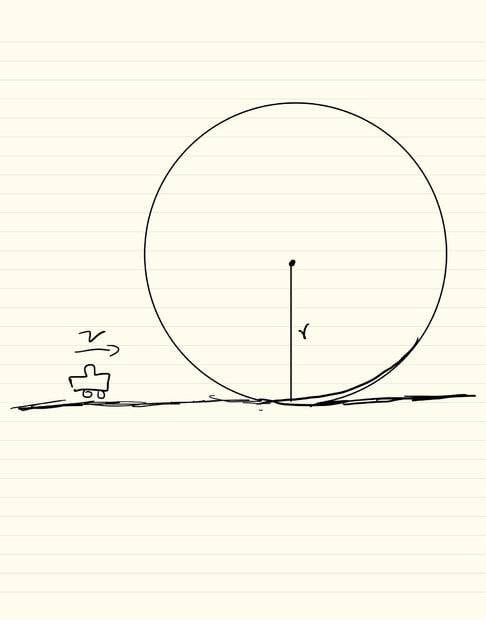
A question regarding the minimum velocity required by a particle to 'do a loop' without falling-

Assuming the particle has a velocity v before reaching the loop. Then-
KE = mv²/2, at the bottom of the loop.

potential energy at the top-most point of the loop= 2mgr (2r = h)
then, by the law of conservation of energy, mv²/2 = 2mgr, and we get v = 2√gr
in this case, the particle will have zero kinetic energy at the the top of the loop, an will fall, as it has 0 velocity. However, if the initial velocity were slightly higher, say v+Δv, then the particle will have some velocity a the top of the loop.

By this logic, should not the minimum velocity for a particle to safely complete a loop be just a little more than 2√gr ?
unnamed.jpg
 
Physics news on Phys.org
In order for the particle to complete the loop, the normal force from the track onto the particle must be nonzero.

Do you see what that implies for the minimum velocity ( and hence kinetic energy ) the particle must have at the top of the loop?
 
Last edited:
  • Like
Likes Lnewqban and JackFyre
JackFyre said:
. . . by the law of conservation of energy, mv²/2 = 2mgr, and we get v = 2√gr
in this case, the particle will have zero kinetic energy at the the top of the loop, an will fall, as it has 0 velocity.
The particle will lose contact with the track before it reaches the top. When that happens, it will describe a parabolic trajectory inside the loop and land on the opposite side of the track. The kinetic energy will never go to zero. Reaching zero KE could be the case if one had a bead on a ring that is constrained to stay on the circle and the normal force is allowed to change direction from radially in to radially out.
 
Last edited:
kuruman said:
The particle will lose contact with the track before it reaches the top. When that happens, it will describe a parabolic trajectory inside the loop and land on the opposite side of the track. The kinetic energy will never go to zero. Reaching zero KE could be the case if one had a bead on a ring that is constrained to stay on the circle and the normal force is allowed to change direction from radially in to radially out.
Thanks, that clears it up!
 
Topic about reference frames, center of rotation, postion of origin etc Comoving ref. frame is frame that is attached to moving object, does that mean, in that frame translation and rotation of object is zero, because origin and axes(x,y,z) are fixed to object? Is it same if you place origin of frame at object center of mass or at object tail? What type of comoving frame exist? What is lab frame? If we talk about center of rotation do we always need to specified from what frame we observe?

Similar threads

  • · Replies 19 ·
Replies
19
Views
6K
Replies
8
Views
4K
  • · Replies 12 ·
Replies
12
Views
12K
  • · Replies 5 ·
Replies
5
Views
2K
  • · Replies 13 ·
Replies
13
Views
3K
Replies
5
Views
2K
  • · Replies 16 ·
Replies
16
Views
3K
  • · Replies 15 ·
Replies
15
Views
5K
  • · Replies 21 ·
Replies
21
Views
3K
  • · Replies 6 ·
Replies
6
Views
2K