Lorentz transformation of the "bilinear spinor matrixelement"

Click For Summary

Discussion Overview

The discussion revolves around the Lorentz transformation of bilinear spinor matrix elements in the context of quantum field theory. Participants explore the transformation properties of these matrix elements, specifically addressing the roles of various gamma matrices and the implications of index manipulation.

Discussion Character

  • Exploratory
  • Technical explanation
  • Mathematical reasoning

Main Points Raised

  • Garlic expresses confusion regarding the transformation of the bilinear spinor matrix element, particularly how the original matrix element containing Γ12T transitions to ΓμνT and the origin of the Γ02T element.
  • One participant proposes a transformation for the matrix element Aμν and questions how it should be expressed in the primed frame.
  • Another participant suggests that the transformation should involve an inversion of indices in the Lorentz transformation, indicating a possible misunderstanding of the index ordering.
  • Further contributions suggest writing the transformed matrix element in terms of the original spinor fields and the Lorentz transformation, introducing the concept of the S-matrix for spinors.
  • Participants discuss the implications of using the identity relation involving the S-matrix in the context of the transformation.
  • One participant expresses satisfaction upon resolving their confusion about the transformation, although they note an issue with the orientation of indices.

Areas of Agreement / Disagreement

Participants do not reach a consensus on the correct transformation process, as there are multiple interpretations and approaches presented regarding the handling of indices and the application of the Lorentz transformation.

Contextual Notes

There are unresolved questions regarding the specific forms of the Lorentz transformation matrices and the implications of index ordering, which may affect the clarity of the transformation process.

Garlic
Gold Member
Messages
181
Reaction score
72
Dear reader,

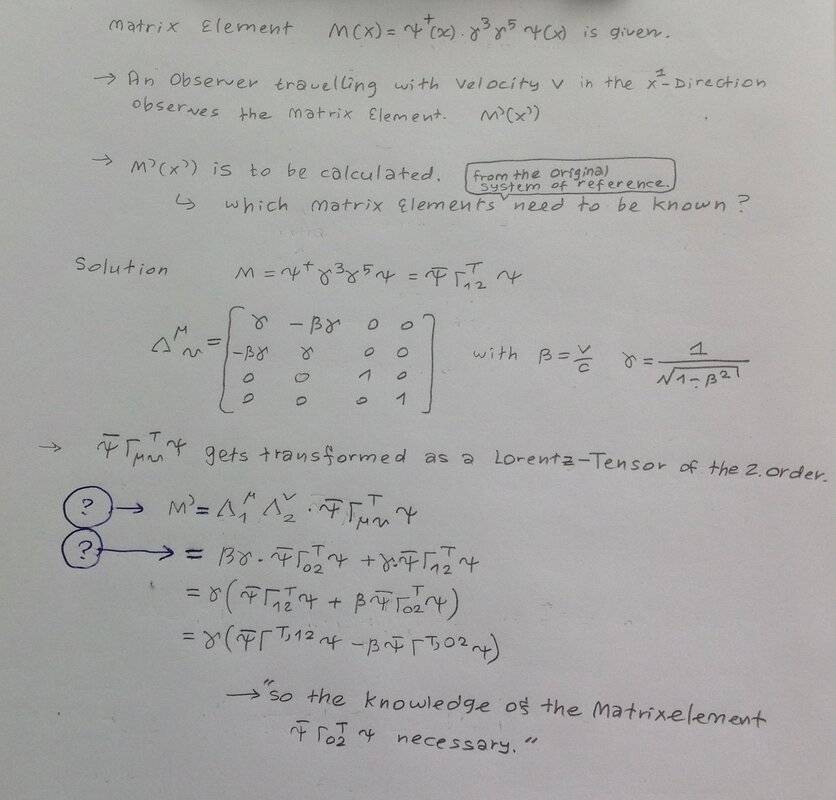
there is a physics problem where I couldn't understand what the solutions.
It is about the lorentz transformation of a bilinear spinor matrix element thing.

So the blue colored equation signs are the parts which I couldn't figure out how.
There must be some steps in between which were skipped on the solution.

For example, we know that the original matrixelement contains Γ12T. Why does it turn back to ΓμνT? Where does the Γ02T element come from?

And lastly, why did we have to transpose the Γ's in the end, so that the indices get to the top?

Thank you very much for your time :)

-Garlic
IMG_0192.JPG
 
Physics news on Phys.org
Garlic said:
For example, we know that the original matrixelement contains Γ12T. Why does it turn back to ΓμνT?

First question first. Suppose
$$A_{\mu \nu} =\bar{\psi} \Gamma^{T}_{\mu \nu} \psi.$$
In the primed frame, what is ##A'_{\alpha \beta}##?
 
George Jones said:
First question first. Suppose
$$A_{\mu \nu} =\bar{\psi} \Gamma^{T}_{\mu \nu} \psi.$$
In the primed frame, what is ##A'_{\alpha \beta}##?

I suppose:
$$
A'_{\alpha \beta}= \Lambda_{\alpha}^{\: \mu} \Lambda_{\beta}^{\: \nu} A'_{\mu \nu} = \Lambda_{ \alpha}^{\: \mu} \Lambda_{\beta}^{\: \nu} \bar{\psi} \Gamma^{T}_{\mu \nu} \psi
$$

So M should transform like this:
$$
M_{\alpha \beta} \rightarrow M'_{\alpha \beta}= \Lambda_{\alpha}^{\: 1} \Lambda_{ \beta}^{\: 2} \bar{\psi} \Gamma^{T}_{1 2} \psi
$$
My intuition tells me the opposite of the solution...

Edit: I have an idea. ##\Gamma_{12}^T =\gamma^1 \gamma^2## so the indices on lorentz transformations should be inverted?

$$
M_{\alpha \beta} \rightarrow M'_{\alpha \beta}= \Lambda_{1}^{\: \alpha} \Lambda_{ 2}^{\: \beta} \bar{\psi} \Gamma^{T}_{1 2} \psi
$$
But still the \Gamma matrix has non specific indices.

Also I probably did the index ordering wrong. ##\Lambda^{ 1}_{\: \alpha}## or ##\Lambda_{ \alpha}^{\: 1}##
 
Last edited:
Garlic said:
So M should transform like
Sorry, my hint wasn't very good. Try this. Write
$$M' =\bar{\psi'} \left(x'\right) \Gamma^{T}_{12} \psi' \left(x'\right).$$
Now write each ##\psi' \left(x'\right)## in terms of ##\psi \left(x\right)##.
 
George Jones said:
Sorry, my hint wasn't very good. Try this. Write
$$M' =\bar{\psi'} \left(x'\right) \Gamma^{T}_{12} \psi' \left(x'\right).$$
Now write each ##\psi' \left(x'\right)## in terms of ##\psi \left(x\right)##.

Maybe like this?

$$
M' = \bar{\psi} \: (x) S(\Lambda^{-1}) \Gamma^{T}_{12} S(\Lambda) \psi \: (x)
$$
 
Garlic said:
Maybe like this?

$$
M' = \bar{\psi} \: (x) S(\Lambda^{-1}) \Gamma^{T}_{12} S(\Lambda) \psi \: (x)
$$

Now use ##I = S\left(\Lambda\right) S\left(\Lambda^{-1}\right)## between the ##\gamma## s.
 
So I just figured it out. :)
Although the indices are upside down, but I have a feeling they are the same as in the solution.

Now I'm stuck at the second part:
what am I doing wrong here? Am I using a wrong lorentz matrix?

IMG_0194.JPG
 
I understand it! I can't believe I did it! I feel intelligent :cool:

IMG_0195.JPG


Thank you so much for helping me!
 
  • Like
Likes   Reactions: vanhees71

Similar threads

  • · Replies 93 ·
4
Replies
93
Views
8K
  • · Replies 6 ·
Replies
6
Views
3K
  • · Replies 14 ·
Replies
14
Views
4K
  • · Replies 4 ·
Replies
4
Views
2K
  • · Replies 1 ·
Replies
1
Views
4K
  • · Replies 19 ·
Replies
19
Views
4K
  • · Replies 15 ·
Replies
15
Views
2K
  • · Replies 69 ·
3
Replies
69
Views
9K
  • · Replies 30 ·
2
Replies
30
Views
3K
  • · Replies 2 ·
Replies
2
Views
2K