Lorentz transformation validity

Click For Summary

Discussion Overview

The discussion centers on the validity and application of the Lorentz transformation, particularly in relation to coordinate systems and configurations. Participants explore the implications of choosing different reference frames and the conditions under which the Lorentz transformation is applicable, including considerations of curved spacetime.

Discussion Character

  • Technical explanation
  • Conceptual clarification
  • Debate/contested

Main Points Raised

  • Some participants assert that the Lorentz transformation is valid when the origins of the reference frames coincide at t=t'=0 and the axes remain parallel, referring to this as the standard configuration.
  • Others argue that while the standard configuration is convenient, one can choose any coordinate system, suggesting that the choice of coordinates is a matter of convenience rather than a strict requirement.
  • There are questions about the necessity of drawing axes parallel and how this relates to reading coordinates from graphs, with some participants seeking clarification on the definitions involved.
  • Some participants discuss the implications of choosing a reference event where coordinates equal (0, 0, 0, 0) across systems, raising questions about the applicability of this approach in curved spacetime.
  • It is noted that while Lorentz transformations can be applied in curved spacetime, they only hold in regions small enough to be treated as flat, indicating a limitation of the transformation.
  • A clarification is made that the transformation must map the same event labeled (0,0,0,0) in both coordinate systems to itself, which is a fundamental property of transformations.

Areas of Agreement / Disagreement

Participants express differing views on the necessity of the standard configuration for the Lorentz transformation, with some advocating for its importance while others emphasize the flexibility of coordinate choice. The discussion remains unresolved regarding the implications of curved spacetime on the validity of the Lorentz transformation.

Contextual Notes

Participants highlight limitations regarding the assumptions made about coordinate systems and the conditions under which the Lorentz transformation is applicable, particularly in relation to flat versus curved spacetime.

Pushoam
Messages
961
Reaction score
53
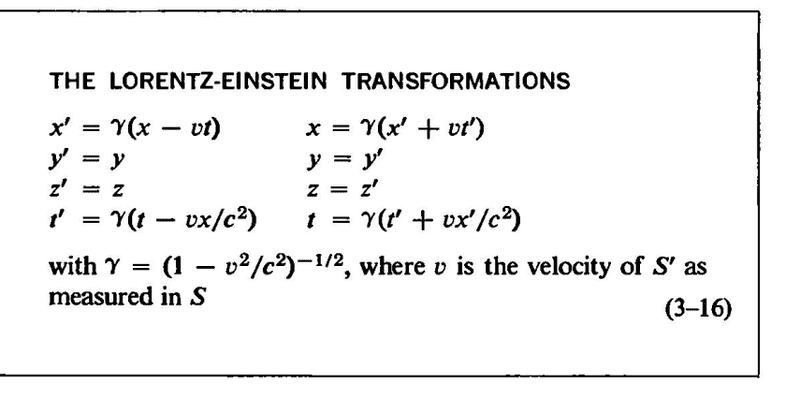
Is the Lorentz transformation given by the equations
lt.png

valid only if the origin of S and S' coincides at t=t'= 0 and the other axis (x,y,z) remains parallel to (x',y',z') respectively?
 
Physics news on Phys.org
Yes, that is sometimes called the standard configuration.
 
  • Like
Likes   Reactions: Pushoam
Dale said:
Yes, that is sometimes called the standard configuration.
But you can choose whatever coordinate system you want, right? So why complicate things?
 
mi.png
r
Why do we draw parallel to the axes?
What does ensure that reading off the intercepts this way gives the space and time coordinates?
 
Battlemage! said:
But you can choose whatever coordinate system you want, right? So why complicate things?
You could also choose the original frame for your coordinates. What coordinate system you pick is a matter of convenience. It is not always convenient to use the standard configuration.

Lorentz transformations include rotations and boosts. If you want to include translations in time and space, then you are talking Poincare transformations. If you want a completely arbitrary coordinate system, you are talking general coordinate transformations.
Pushoam said:
View attachment 205378r
Why do we draw parallel to the axes?
What does ensure that reading off the intercepts this way gives the space and time coordinates?
This is the definition of those coordinates.
 
  • Like
Likes   Reactions: Battlemage! and Pushoam
Pushoam said:
View attachment 205378r
Why do we draw parallel to the axes?
What does ensure that reading off the intercepts this way gives the space and time coordinates?
This is the same thing we do with an ordinary x-y position graph. Are you asking why an x-t (spacetime) graph works the same way, or are you asking why all graphs work this way?
 
  • Like
Likes   Reactions: robphy
jtbell said:
are you asking why all graphs work this way?
 
Pushoam said:
View attachment 205378r
Why do we draw parallel to the axes?

A line parallel to the x-axis is a line of constant t.
A line parallel to the t-axis is a line of constant x.

What does ensure that reading off the intercepts this way gives the space and time coordinates?

If a line parallel to the x-axis is a line of constant t, then that line passes through the t-axis at the value of t where x is zero.
If a line parallel to the t-axis is a line of constant x, then that line passes through the x-axis at the value of x when t is zero.

As the others have pointed out, this is the way we define things when we create graphs. It's what they mean, by definition. These points on the axes are called intercepts.
 
  • Like
Likes   Reactions: Pushoam
Battlemage! said:
But you can choose whatever coordinate system you want, right? So why complicate things?

If I understand the discussion correctly, this is not an issue of the choice of coordinate systems. Rather it's the choice of a reference event such that the values of the coordinates equal (0, 0, 0, 0) in all coordinate systems for that event.
 
  • #10
Mister T said:
If I understand the discussion correctly, this is not an issue of the choice of coordinate systems. Rather it's the choice of a reference event such that the values of the coordinates equal (0, 0, 0, 0) in all coordinate systems for that event.
But that doesn't work in curved spacetime, correct? Because inertial frames are local? Or does it work anyway since all zero's all transform to all zero's?
 
  • #11
Battlemage! said:
But that doesn't work in curved spacetime, correct? Because inertial frames are local? Or does it work anyway since all zero's all transform to all zero's?

It works in curved spacetime too, but only in the region of spacetime around the event that is is small enough to be treated as flat - outside of that region the Lorentz transformations don't work at all.

The word "since" above has things a bit backwards though. Things aren't working out because all zeroes transforms to all zeroes; instead all zeroes transforms to all zeroes because it has to. You've decided to label the same event (0,0,0,0) in both coordinate systems so unless there's a mistake somewhere the transformation between the two coordinate systems has to take (0,0,0,0) in one to (0,0,0,0) in the other because that's what a transformation does. This will be true in flat and curved spacetime, with inertial and non-inertial coordinates.
 

Similar threads

  • · Replies 101 ·
4
Replies
101
Views
7K
  • · Replies 7 ·
Replies
7
Views
2K
Replies
3
Views
1K
  • · Replies 54 ·
2
Replies
54
Views
4K
  • · Replies 20 ·
Replies
20
Views
3K
  • · Replies 1 ·
Replies
1
Views
1K
  • · Replies 3 ·
Replies
3
Views
2K
  • · Replies 6 ·
Replies
6
Views
2K
  • · Replies 54 ·
2
Replies
54
Views
3K
  • · Replies 9 ·
Replies
9
Views
2K