SUMMARY
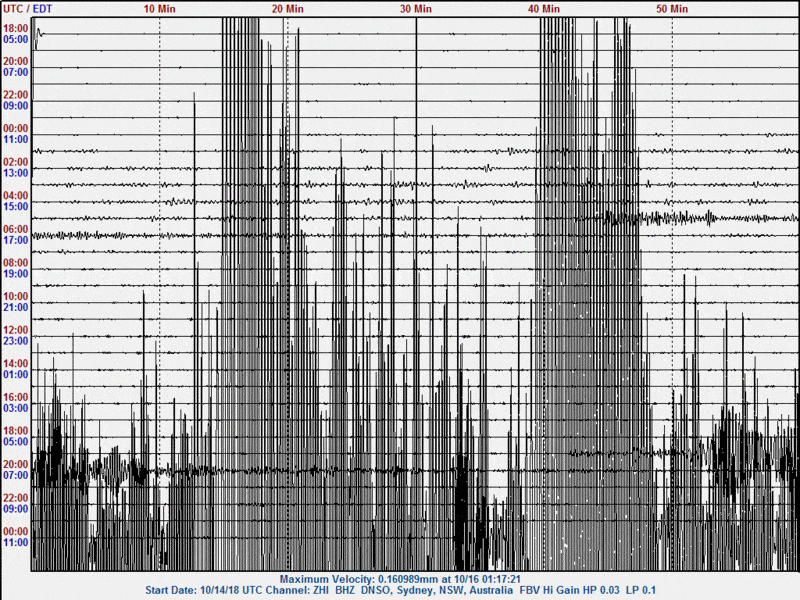
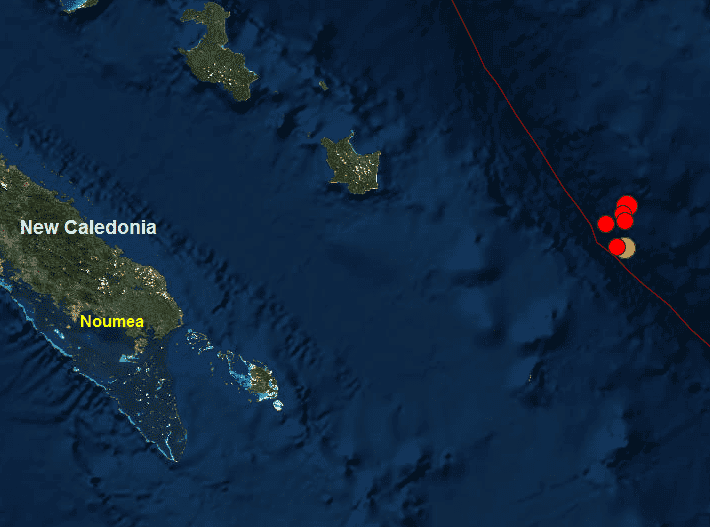
The discussion centers on two significant seismic events near Tadine, New Caledonia: a magnitude 6.3 earthquake occurring 170 km ESE and a magnitude 6.4 earthquake occurring 167 km E. These events are classified as separate due to identifiable P and S wave generation, despite their proximity in time (35 minutes apart). The M 6.3 is categorized as a foreshock, while the M 6.4 is considered the main shock. The amplitude of these earthquakes was surprisingly low compared to similar historical events in the region, which have been recorded in the high 6's.
PREREQUISITES
- Understanding of seismic wave types (P and S waves)
- Familiarity with earthquake magnitude scales (Richter scale)
- Knowledge of earthquake classification (foreshocks vs. main shocks)
- Awareness of seismic event reporting and analysis
NEXT STEPS
- Research seismic wave generation and propagation
- Study earthquake magnitude measurement techniques
- Explore case studies of foreshocks and main shocks
- Investigate historical seismic activity in New Caledonia
USEFUL FOR
Seismologists, geophysicists, earthquake researchers, and anyone interested in understanding earthquake dynamics and classifications.