M7.1 Molucca Sea, Northern Indonesia

  • Thread starter Thread starter davenn
  • Start date Start date
Click For Summary

Discussion Overview

The discussion revolves around a recent significant earthquake, a M7.1 event in the Molucca Sea, northern Indonesia. Participants explore various aspects of seismic activity, including the characteristics of their seismograph setups, challenges in noise reduction, and the broader implications of seismic research in different geological contexts.

Discussion Character

  • Exploratory
  • Technical explanation
  • Debate/contested
  • Mathematical reasoning

Main Points Raised

  • Some participants note the significance of the M7.1 earthquake, highlighting it as the first major quake in several months.
  • Questions arise regarding the setup of seismographs, with one participant inquiring about the connection to bedrock and the implications of local geological conditions on seismic readings.
  • Concerns about surface noise affecting seismic data are discussed, with suggestions for software that could help filter out unwanted sounds.
  • Participants share experiences of noise interference from construction and natural phenomena, detailing how different types of seismometers respond to various frequencies.
  • One participant raises questions about the geographical distribution of seismic research, asking whether it is concentrated in areas with favorable geology or widespread.
  • Another participant discusses the perception of earthquakes by individuals at sea, exploring how different types of seismic waves are felt depending on proximity to the quake.
  • Examples from New Zealand are provided, illustrating instances where fishermen reported feeling seismic activity while at sea.

Areas of Agreement / Disagreement

Participants express a range of views on the effectiveness of different seismic monitoring techniques and the influence of local geology on research. There is no consensus on the best methods for noise reduction or the geographical focus of seismic studies, indicating multiple competing perspectives.

Contextual Notes

Participants acknowledge limitations in their setups, such as the depth of bedrock and the impact of local construction noise. The discussion also highlights the complexity of seismic wave propagation and the challenges in interpreting data from various environments.

Who May Find This Useful

This discussion may be of interest to seismologists, engineers involved in seismic monitoring, and individuals studying the effects of earthquakes on different geological settings.

davenn
Science Advisor
Gold Member
Messages
9,715
Reaction score
11,761
TL;DR
M7.1 quake
hi guys

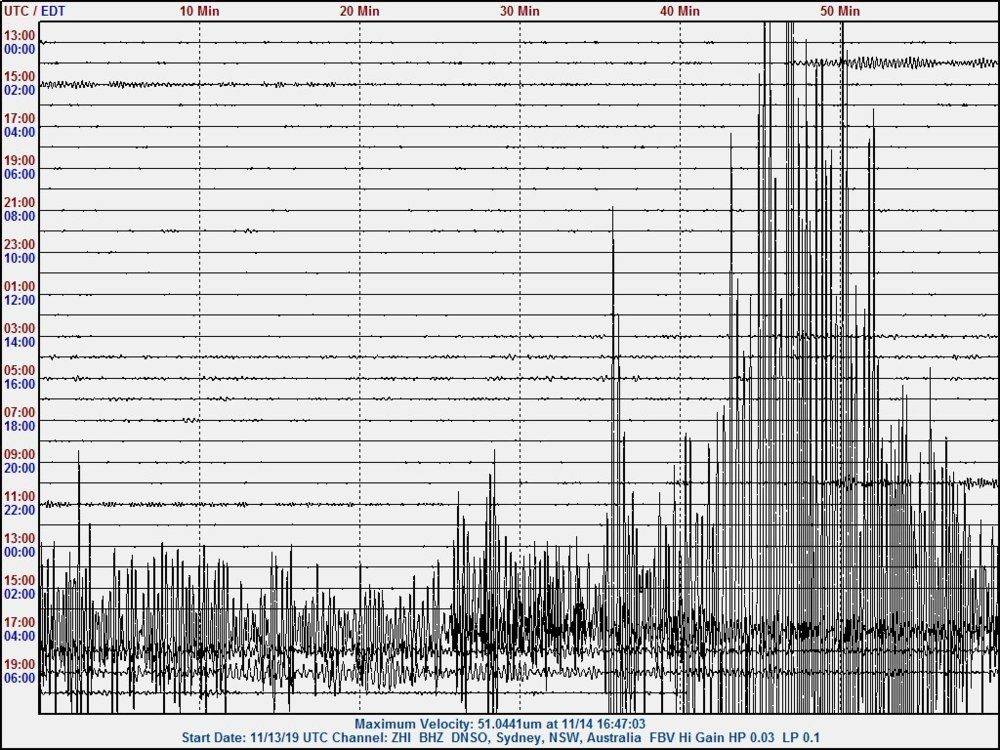
A significant quake this morning, a M7.1 Molucca Sea, northern Indonesia. This is the first M7-7.9 for 4 months which means we are still ~ 3-4 behind the yearly average.

M 7.1 - 138km E of Bitung, Indonesia
Time: 2019-11-14 16:17:40 (UTC)
Location: 1.600°N 126.416°E
Depth: 33.0 km
Image from my seismograph

191114 M7.1 Molucca Sea nthrn Indonesia zhi.jpg


and a real time trace in the link
http://www.sydneystormcity.com/seismograms.htmcheers
Dave
 
  • Like
Likes   Reactions: jim mcnamara, anorlunda, fresh_42 and 1 other person
Earth sciences news on Phys.org
Whew, 7.1 mag is no joke...
 
  • Like
Likes   Reactions: davenn
Dave - your setup, does your seismograph have a direct connection to bedrock? The one at the University of New Mexico does, but we are in the middle of a rift valley (Albuquerque) that has >500m+ of alluvium. It was an expensive exercise to go deep enough. So I would assume any installation has drilling costs.
 
jim mcnamara said:
Dave - your setup, does your seismograph have a direct connection to bedrock?

Hi Jim,
No it doesn't. I am not sure how deep the bedrock is below my location. I am at the base of a low sloping ridge that gently slopes down to the river. I am only 25-30m above sea level and the river at the end of my street is still tidal ~12km inland from the Sydney Harbour basin.

The long period seismometer that produced the above trace sits on a 1 metre square and 3cm thick concrete slab. The triaxial short period seismometers are just buried below ground level.Dave
 
How do you eliminate surface noise? i.e., trucks on the road
 
Hmm. Thinking about it there is AI software - RX7 - that sound engineers to remove untoward sounds. I would guess that some software must exist to do the same for your setup.

https://www.izotope.com/en/products/rx.html so-called sound repair - it recognizes noise you do not want and removes it from the data stream leaving what you do want. It "learns" good from bad. I believe it is open source. It has some requirement that you report back to the developers what your system has learned.
 
Any interesting sources that you pick up that aren't seismic related?
 
  • Like
Likes   Reactions: davenn
jim mcnamara said:
How do you eliminate surface noise? i.e., trucks on the road

The short period geophones pick up lots of noise, most coming from a huge multi-story apartment block construction across the road from home
you can see it active during daytime working hours ...

Clipboard01.jpg


been going for 12 months now :frown: can't wait till it finishes
The geophones have a resonant freq of 4.5 Hz. easily cover 0.5Hz to 15Hz. significant drop off either
side of that.

The long period seismometer ( a vertical sensor) covers from a high pass of 0.03 Hz to a low pass cutoff
of 0.1 Hz, 30 seconds to 10 seconds. It doesn't suffer from local man made noise, other than if something
is dropped on the floor/ground in or near the house.

zhi.jpg
The above is the current screen dump as I type this.

Drakkith said:
Any interesting sources that you pick up that aren't seismic related?

The long period seismo ( that trace directly above) easily picks up ocean noise. I can see a cold front approaching up to 12 hours before it arrives. That is the pounding of the heavy surf on the coastline.

You can see a bit of extra noise at the tip of the trace, that is wind blowing on the house and
surrounding trees. In strong wind, that noise is quite significant.

The short period seismo's pick up mining blasts in the coal mines (open cut) in the Hunter Valley
~ 130 km to the north of me.

jim mcnamara said:
Hmm. Thinking about it there is AI software - RX7 - that sound engineers to remove untoward sounds. I would guess that some software must exist to do the same for your setup.

The guy in California who designed the datalogger hardware also wrote the software to drive it WinSDR (Windows Seismic Data Recorder) as well as a separate software package, Winquake, that saved files can be loaded into and analysed. With quake data from the USGS entered into Winquake and the program will set
all the wave arrival times of P, S, Surface and other ones ... pp, psp, pcp etc.
The program also has good adjustable filtering built into it ... hi, lo pass, notch, band pass all totally adjustable and the number of "poles" can be set.Dave
 
  • Informative
  • Like
Likes   Reactions: Drakkith, Bystander, jim mcnamara and 1 other person
Very informative posts Dave. Thank you.

Coincidentally, I also learned today that the area near New Orleans has 20K feet of sand on top of bedrock. Other locations are said to have unstable geologies that could liquify during a quake. So my question is: Is seismic research clustered in areas with favorable geology, or is it done pretty much everywhere?

A related question I've been wondering about for years, but can't find any data. People on a boat, far offshore where the ocean is deep. Do they feel earthquakes? I tried and failed to find personal accounts from people at sea directly sensing earthquakes.

When the crustal motion is horizontal, I could understand how little of it reaches the surface of the ocean. But when the crustal motion is vertical, the ocean must rise and fall with it (spawning tsunami). But also in the vertical case 10-30 second periods may be masked by ocean swells in the same frequency range.
 
  • Like
Likes   Reactions: davenn
  • #10
anorlunda said:
So my question is: Is seismic research clustered in areas with favorable geology, or is it done pretty much everywhere?

Seismic equipment is primarily in areas of known activity so as to monitor that activity. So, say, in the USA,
all of the west coast region California, Oregon and Washington states have the most concentrated network
of seismometers. a bit less in Arizona, Nevada, Utah and Idaho. and much more spread out the further east
of the Rockies. There is still a good concentration of stations right across the USA, mainly because of the different networks run by various organisations/universities etc an example ...

SCSN - Southern California Seismic Network ( CALTECH/USGS)
https://www.scsn.org/index.html
SCSN.jpg
NCSN - Northern California Seismic Network
http://www.ncedc.org/ncsn/
~ 580 stations

PNSN - Pacific Northwest Seismic Network
https://pnsn.org/
PNSN.jpg
United States National Seismic Network
http://www.fdsn.org/networks/detail/US/
US National Seismic Net.jpg
And there are other substantial networks, Hawaii and Alaska

anorlunda said:
A related question I've been wondering about for years, but can't find any data. People on a boat, far
offshore where the ocean is deep. Do they feel earthquakes? I tried and failed to find personal accounts
from people at sea directly sensing earthquakes.

If the quake is relatively close, within a few km's or so, yes they do. It is only the compressional P wave
pulse that they feel, as the S waves ( shear waves) cannot travel through a liquid.

I am aware of 2 occurrences back in my home country of New Zealand, when I lived there. Two large
events in the SW area of the South Island.
Both events were M6.5 + and some years apart. One report was from a couple of fishermen on a small boat
at the northern end of Lake Te Anau and in relatively shallow water < 30m (100ft). A very strong pulse that
they say almost capsized the boat. This event caused a small tsunami in the lake and the water was seen to
recede before rushing back in. This was verified by seismologists that visited the area to set up a small
network to record the aftershocks.
The other event was again by fishermen but this time at sea in a commercial fishing boat, offshore of
~ Milford Sound area and very deep water, several 100m. They stated that the thump on the bottom of the
boat was like that of running aground ... a bit difficult to do in such deep water 😉
They didn't find out till later about the big quake.

anorlunda said:
When the crustal motion is horizontal, I could understand how little of it reaches the surface of the ocean. But when the crustal motion is vertical, the ocean must rise and fall with it (spawning tsunami). But also in the vertical case 10-30 second periods may be masked by ocean swells in the same frequency range.

Yes, good comments.
But keep in mind that the felt effect on a boat occurs relatively close to the event as with the two
examples I commented on above. I would be surprised if it was felt much further than 15 - 20km from
the seafloor epicentre of the quake. Possibly several times that for huge M8 ++ events ... I have no info.
Also, because this is a relatively "close to event" occurrence, the frequency of the P wave is much higher,
1 sec or shorter periods, so the ocean swell period doesn't mask the effect.

These P wave pulses through water are called T waves ( or T phase). I have commented on them in
posts in years gone by. The T wave propagates from the sea floor at or near to the epicentre of the
quake. I record them from quakes onshore near the coast or offshore of the SW coast of the South Island
of NZ and periodically further south towards Macquarie Island. They will usually get trapped in the lower attenuation SOFAR channel not far above the seafloor, which acts as a waveguide.
https://en.wikipedia.org/wiki/SOFAR_channel
an example from my system ...
They are recorded on the short period geophone sensors.

The T wave is in the lower right edge of the trace. It was created by a M5.5 quake

1573946916238.png

cheers
Dave
 
  • Informative
Likes   Reactions: anorlunda

Similar threads

Replies
4
Views
2K
  • · Replies 1 ·
Replies
1
Views
3K
  • · Replies 0 ·
Replies
0
Views
858
  • · Replies 6 ·
Replies
6
Views
3K
  • · Replies 1 ·
Replies
1
Views
2K
  • · Replies 2 ·
Replies
2
Views
2K
  • · Replies 2 ·
Replies
2
Views
2K
  • · Replies 2 ·
Replies
2
Views
2K
  • · Replies 5 ·
Replies
5
Views
2K
  • · Replies 6 ·
Replies
6
Views
3K