Magnetic attraction force Question

  • Context: High School 
  • Thread starter Thread starter eightplusonefingers
  • Start date Start date
  • Tags Tags
    Attraction Force Magnet
Click For Summary

Discussion Overview

The discussion revolves around the magnetic attraction forces between disc magnets and a larger steel block, particularly when a bridging steel pole piece is introduced. Participants explore concepts related to magnetic circuits, the effects of magnet arrangement, and the influence of additional magnets on force without delving into extensive mathematical analysis.

Discussion Character

  • Exploratory
  • Technical explanation
  • Debate/contested

Main Points Raised

  • One participant questions the validity of a claim that adding a second magnet increases the force to 70% of the sum of the two, suggesting that making a magnet taller does not enhance its force on a steel piece.
  • Another participant argues that if the nearer magnet is not saturated, adding more magnets can increase the field strength due to remaining susceptibility, drawing a parallel to solenoidal electromagnets.
  • A participant mentions that the attractive force in a magnetic circuit is roughly proportional to surface area and the square of magnetic flux density, while inversely proportional to gap length, suggesting these principles could be used for rough assessments.
  • Discussion includes the concept of a "magnetic circuit," with some participants acknowledging its existence but noting that it may not directly aid in predicting force.
  • One participant shares a personal anecdote about learning practical electromagnetism through software, indicating the complexity of concepts like saturation and magnetic circuits.
  • A later reply discusses the induced magnetization of the steel coupling piece, suggesting it enhances the magnetic field applied to the steel block, potentially increasing the attractive force.

Areas of Agreement / Disagreement

Participants express differing views on the effects of adding magnets and the role of the pole piece, indicating that multiple competing perspectives remain without a clear consensus.

Contextual Notes

Some limitations in the discussion include the lack of specific information needed to predict forces accurately, as well as unresolved questions about the effects of magnet saturation and the precise role of the pole piece in enhancing attraction.

eightplusonefingers
Messages
1
Reaction score
0
Other than the most simple school stuff of attraction, repulsion and "lines of force", I've never studied magnets.

Hence this question.
magnets1


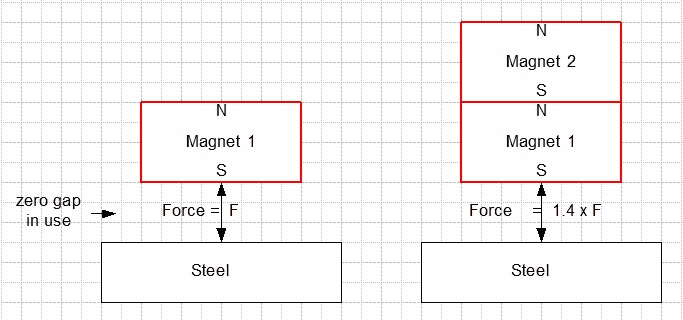
On the left we have a disc magnet diameter D attracted to a much larger lump of steel with force F (when there is no gap between).

If I add a second similar magnet, a website selling magnets I found tells me the force increases to about 70% of the sum of the two - shown on the right.
magnets2


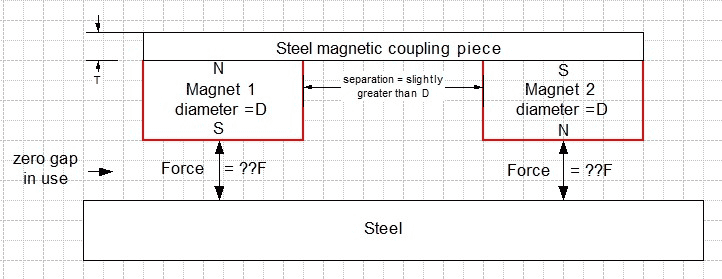
If I arrange the magnets as shown with the spacing a little more that the magnet diameter and a bridging steel pole piece straddling the two as shown. Note the right hand magnet has been flipped N-S

What is the force between each magnet and the lump of steel at the bottom?

Does that force vary much with the thickness of the pole piece T?

Does the pole piece even do anything useful?

Without the pole piece I assume the attraction of the two magnets in isolation would be F each but
Does the pole piece help increase this? if so how much by?

In my mind I have the idea that there is now a "magnetic circuit" via the pole piece and the steel lump at the bottom but is a magnetic circuit even a real thing.

Not looking for pages of maths just a real world idea of what it means
:lol:


TIA
 
Physics news on Phys.org
A "magnetic circuit" is a thing, but it probably does not help you. It does not directly help you predict the force.

Unfortunately, predicting the force is difficult, requires a lot of information that we don't have, and in many cases is approximate at best. I would go with what the vendor is saying, but be prepared to have to make measurements.
 
  • Like
Likes   Reactions: vanhees71
eightplusonefingers said:
If I add a second similar magnet, a website selling magnets I found tells me the force increases to about 70% of the sum of the two - shown on the right.
That's nonsense. Making the magnet taller does not increase its force on a steel piece attracted to one side.
 
eightplusonefingers said:
Not looking for pages of maths just a real world idea of what it means
Generally speaking, in a magnetic circuit, the attractive force is roughly proportional to the surface area and the square of the magnetic flux density, and inversely proportional to the gap length.
Maybe you can try to use these principles to make a rough assessment.
 
Last edited:
  • Like
  • Informative
Likes   Reactions: hutchphd, berkeman and vanhees71
berkeman said:
Making the magnet taller does not increase its force on a steel piece attracted to one side.
I disagree ...with caveats. So long as the nearer permanent magnet is not saturated then the addition of more magnets will increase the field because there is still some susceptability remaining in the lower magnet. The field strength at the lower pole will increase and the attraction is quadratic in that field strength at the pole. Its just like making a solenoidal electromagnet longer. Real magnets (particularly ones with some age on the) are seldom saturated.
Of course closing the magnetic circuit is a much better technique (or close the circuit and add magnets! )
 
hutchphd said:
So long as the nearer permanent magnet is not saturated then the addition of more magnets will increase the field because there is still some susceptability remaining in the lower magnet.
Interesting point; I hadn't considered that angle. I was mainly bothered by the longer magnetic path...
 
I once (20 yrs ago!) got a contract with some folks in Bedfordshire to design a magnet for a handheld blood coagulation meter. Having convinced them that I knew what I was doing, I had a big bunch of stuff to learn quickly. I downloaded a wonderful shareware product called Vizimag and started playing with it. I learned more practical E and M (particularly M) in a week than I thought possible.

I was hoping to be able to link to it here but it seems to be no longer extant. In any event if you can find it or something similar (it was basically 2D) , the whole concept of magnets, saturation, and magnetic circuits will get much simpler. If anyone knows of its present status please pass it along.
I did manage to design a good magnet but the parent device did not really succeed. Ah, well, I wanted them to redesign the optics, too...but got Nix'ed on that.
 
The steel "magnetic coupling" piece will have an induced magnetization - with a "north pole" on the right, and a "south pole" on the left. This will increase the strength of the magnetic field applied to the large steel block at the bottom, creating effectively a single large "north pole" on the right (at the bottom of the magnet) and "south pole" on the left. Assuming the magnetization of the steel block is not saturated, it will be more strongly magnetized than without the "coupling piece" on top. Hence the attractive force will be (somewhat) stronger.
 

Similar threads

  • · Replies 32 ·
2
Replies
32
Views
3K
  • · Replies 11 ·
Replies
11
Views
3K
  • · Replies 2 ·
Replies
2
Views
2K
  • · Replies 5 ·
Replies
5
Views
2K
  • · Replies 1 ·
Replies
1
Views
2K
  • · Replies 6 ·
Replies
6
Views
1K
  • · Replies 3 ·
Replies
3
Views
1K
  • · Replies 16 ·
Replies
16
Views
3K
  • · Replies 11 ·
Replies
11
Views
8K