Magnetic/electromagnetic induction

Click For Summary
SUMMARY

The discussion centers on the principles of magnetic induction involving a C-shaped iron core and a spinning dipole magnet. It establishes that the presence of a coil around the iron core generates opposing magnetic poles due to the current flowing through the coil. Specifically, when the coil is connected to an electrical circuit, the induced current increases the resistance against the magnet's motion, making it harder to turn the dynamo. This phenomenon illustrates the fundamental relationship between magnetic fields and induced currents in electromagnetic systems.

PREREQUISITES
  • Understanding of magnetic induction principles
  • Familiarity with electromagnetism concepts
  • Basic knowledge of electrical circuits and current flow
  • Experience with dynamo operation and its components
NEXT STEPS
  • Study Faraday's Law of Electromagnetic Induction
  • Explore the relationship between current and magnetic fields in coils
  • Investigate the operation of different types of dynamos
  • Learn about Lenz's Law and its implications in magnetic induction
USEFUL FOR

Physics students, electrical engineers, and hobbyists interested in understanding electromagnetic induction and its applications in devices like dynamos.

awpbash
Suppose there is a coil around a C-shaped iron core with a dipole magnet in the gap as shown in the dynamo below. As the magnet is spinning, in order to oppose the force, a changing pole is produced in the iron. (Eg. As N-pole approaches the iron core, a north pole is induced to oppose the movement.)
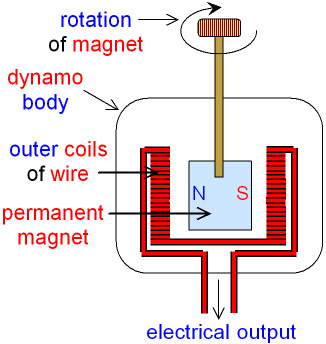
bicycle-dynamo.gif


However, if i were to recreate a similar setup with just a C-shaped iron core and a spinning dipole magnet, by magnetic induction, an unlike pole is induced.(Eg. As N-pole approaches the iron core, a S-pole is induced in order to be attracted.) Hence what i do not understand is how a coil is able cause the difference in induction of poles.
 
Physics news on Phys.org
Hence what i do not understand is how a coil is able cause the difference in induction of poles.
The coil alone does not make a difference. It is the current, if any, flowing in the coil that creates the poles opposing the movement.

You can feel this with a dynamo. It is relatively easy to turn when the coil is not connected, but gets harder in proportion to the current drawn, when an electrical circuit is attached. Attaching a short circuit makes it hardest to turn, as this allows most current to flow.
 
  • Like
Likes   Reactions: Delta2, cnh1995 and CWatters

Similar threads

  • · Replies 6 ·
Replies
6
Views
2K
  • · Replies 60 ·
3
Replies
60
Views
7K
  • · Replies 3 ·
Replies
3
Views
1K
  • · Replies 16 ·
Replies
16
Views
4K
  • · Replies 3 ·
Replies
3
Views
2K
  • · Replies 2 ·
Replies
2
Views
3K
  • · Replies 74 ·
3
Replies
74
Views
15K
  • · Replies 5 ·
Replies
5
Views
2K
  • · Replies 13 ·
Replies
13
Views
3K
  • · Replies 42 ·
2
Replies
42
Views
3K