crick
- 39
- 4
I have a doubt on this calculation of magnetic field in presence of displacement current. Consider a capacitor of radius ##R## and with plates at distance ##d## being charged: there is a displacement current in it.
Suppose that I want to calculate the magnetic field ##B## at a distance ##r < R## both inside and outside the capacitor.
Consider the two amperian-loops, both of radius ##r<R##, one inside and one outside the capcitor.
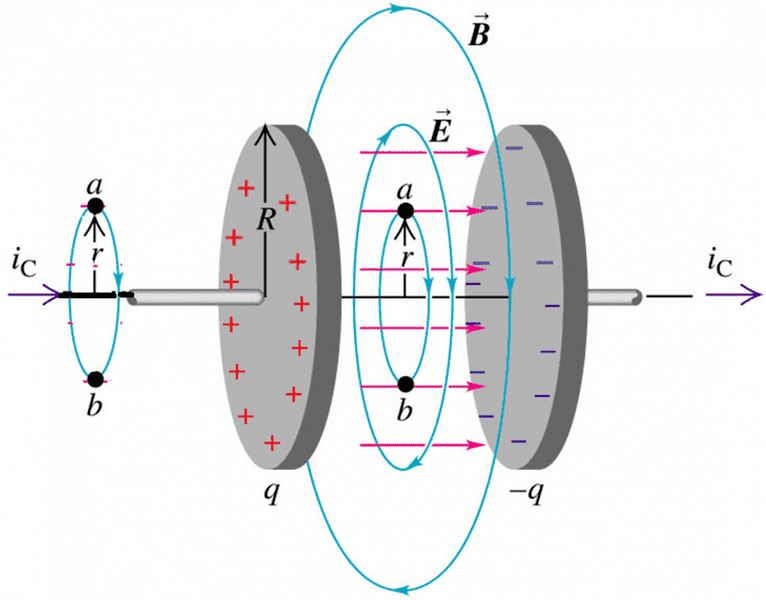
Outside: Ampere Law leads to
$$2 \pi r B= \mu_0 i_C \to B(r)=\frac{\mu_0 i_c}{2 \pi r} \tag{1}$$
Inside: Ampere Law leads to
$$2 \pi rB= \mu_0 \epsilon_0 \frac{\partial \Phi(E(t))}{\partial t}=\mu_0 \epsilon_0 \pi r^2 E(t)\to B(r)=\frac{\mu_0 \epsilon_0 r}{2} E(t)=\frac{\mu_0 \epsilon_0 r}{2d} V(t)\tag{2}$$
Where ##V(t)## is the voltage difference in the capacitor.
Therefore the two different magnetic fields, inside and outside the capacitor are different. Is that right?
I think it is not so strange since ##r<R## and therefore I did not consider all the displacement current, but only a part of it. Or am I missing something important?
Suppose that I want to calculate the magnetic field ##B## at a distance ##r < R## both inside and outside the capacitor.
Consider the two amperian-loops, both of radius ##r<R##, one inside and one outside the capcitor.
Outside: Ampere Law leads to
$$2 \pi r B= \mu_0 i_C \to B(r)=\frac{\mu_0 i_c}{2 \pi r} \tag{1}$$
Inside: Ampere Law leads to
$$2 \pi rB= \mu_0 \epsilon_0 \frac{\partial \Phi(E(t))}{\partial t}=\mu_0 \epsilon_0 \pi r^2 E(t)\to B(r)=\frac{\mu_0 \epsilon_0 r}{2} E(t)=\frac{\mu_0 \epsilon_0 r}{2d} V(t)\tag{2}$$
Where ##V(t)## is the voltage difference in the capacitor.
Therefore the two different magnetic fields, inside and outside the capacitor are different. Is that right?
I think it is not so strange since ##r<R## and therefore I did not consider all the displacement current, but only a part of it. Or am I missing something important?