Magnetic field lines around electron and wire seem to contradict

Click For Summary
SUMMARY

The discussion centers on the apparent contradiction between the direction of magnetic field lines around a wire and the flow of electrons. Participants clarify that while the right-hand rule indicates the direction of the magnetic field based on conventional current flow, electrons move in the opposite direction. This discrepancy arises from historical conventions established by Benjamin Franklin regarding current flow. Understanding the motion of conduction electrons in relation to the positive ion lattice is essential for grasping concepts like Faraday's Law and the operation of devices such as homopolar generators.

PREREQUISITES
  • Understanding of the right-hand rule in electromagnetism
  • Familiarity with the concept of electric current and electron flow
  • Basic knowledge of Faraday's Law of induction
  • Awareness of historical conventions in electrical theory, particularly Benjamin Franklin's contributions
NEXT STEPS
  • Research the application of the right-hand rule in various electromagnetic contexts
  • Study the implications of electron flow versus conventional current in circuit design
  • Explore the principles behind homopolar generators and their practical applications
  • Investigate the relativistic treatment of current-carrying wires in advanced physics
USEFUL FOR

Physics students, electrical engineers, educators, and anyone interested in the fundamental principles of electromagnetism and electric current behavior.

SamRoss
Gold Member
Messages
256
Reaction score
36
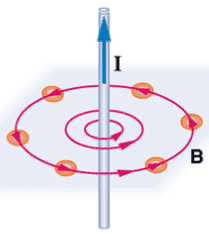
In the picture below, the direction of the magnetic field lines can be determined by using the right-hand rule with the thumb pointing in the direction of the current.
1604436073035.png


If we use the right hand rule in the picture below, thinking of the yellow arrow as the current, we would not get the correct direction for the magnetic field.
1604436057040.png


I'm aware that electrons do not literally spin around like little tops, but they are often depicted as spinning around because they have magnetic fields around them as if they were spinning. I'm curious as to why the electrons would be depicted as spinning around in a direction which would contradict the right-hand rule. Is it because their angular momentum is in this direction (that is, in a direction such that the relationship between it and the magnetic field can be found with a left-hand rule instead)?
 
Physics news on Phys.org
What is the charge of the electron, and what is the convention for the direction of charge flow in an electric current?
 
  • Like
Likes   Reactions: SamRoss
Nugatory said:
What is the charge of the electron, and what is the convention for the direction of charge flow in an electric current?

I see. So in the first picture I posted, the current is pointing up but the electrons would actually be flowing down. Is that it?
 
https://xkcd.com/567/
Yes, the direction of positive current flow is opposite to the direction of electron movement.
(And in practice it is almost never helpful or necessary to think about an electric current in terms of moving electrons)
 
  • Haha
  • Like
Likes   Reactions: berkeman and SamRoss
SamRoss said:
I see. So in the first picture I posted, the current is pointing up but the electrons would actually be flowing down. Is that it?
You can blame it all on Benjamin Franklin apparently.
 
  • Like
Likes   Reactions: SamRoss
Nugatory said:
https://xkcd.com/567/
Yes, the direction of positive current flow is opposite to the direction of electron movement.
(And in practice it is almost never helpful or necessary to think about an electric current in terms of moving electrons)
The cartoon is great, but I tend to the opposite opinion concerning the statement. To the contrary I think it's always of great advantage to think about the motion of the conduction electrons relative to the positive ion lattice in a metal when it comes to currents in usual conductors. With this in mind there's almost no more trouble with Faraday's Law of induction in connection with problems like the homopolar generator or the correct relativistic treatment of the current-carrying wire:

https://www.physicsforums.com/insights/homopolar-generator-analytical-example/
https://www.physicsforums.com/insights/relativistic-treatment-of-the-dc-conducting-straight-wire/
 

Similar threads

  • · Replies 5 ·
Replies
5
Views
1K
  • · Replies 22 ·
Replies
22
Views
2K
  • · Replies 2 ·
Replies
2
Views
2K
  • · Replies 22 ·
Replies
22
Views
2K
  • · Replies 1 ·
Replies
1
Views
2K
  • · Replies 1 ·
Replies
1
Views
858
  • · Replies 23 ·
Replies
23
Views
5K
  • · Replies 27 ·
Replies
27
Views
3K
  • · Replies 1 ·
Replies
1
Views
2K
  • · Replies 1 ·
Replies
1
Views
2K