Why is the magnetic force directed downward in this scenario?

Click For Summary
SUMMARY

The discussion centers on the direction of the magnetic force in a non-uniform magnetic field, specifically why it is directed downward despite initial expectations based on the right-hand rule. The key equations involved are the potential energy equation, E = -μ · B, and the force equation, F = -∇E. The torque τ = μ × B indicates that a magnetic dipole experiences torque but no net force in a uniform field. The force arises from the dipole moving towards regions of stronger magnetic fields, leading to a decrease in potential energy.

PREREQUISITES
  • Understanding of magnetic dipoles and their behavior in magnetic fields
  • Familiarity with the right-hand rule for determining force direction
  • Knowledge of potential energy concepts in physics
  • Basic grasp of vector calculus, particularly gradients
NEXT STEPS
  • Study the implications of torque in magnetic fields using the equation τ = μ × B
  • Explore the concept of potential energy in magnetic systems, focusing on E = -μ · B
  • Learn about the behavior of magnetic dipoles in non-uniform magnetic fields
  • Investigate the mathematical foundations of gradients in vector calculus
USEFUL FOR

Physics students, educators, and professionals in electromagnetism who seek to understand the behavior of magnetic forces and dipoles in varying magnetic fields.

Amaelle
Messages
309
Reaction score
54
Good day All!
while trying to solve this question
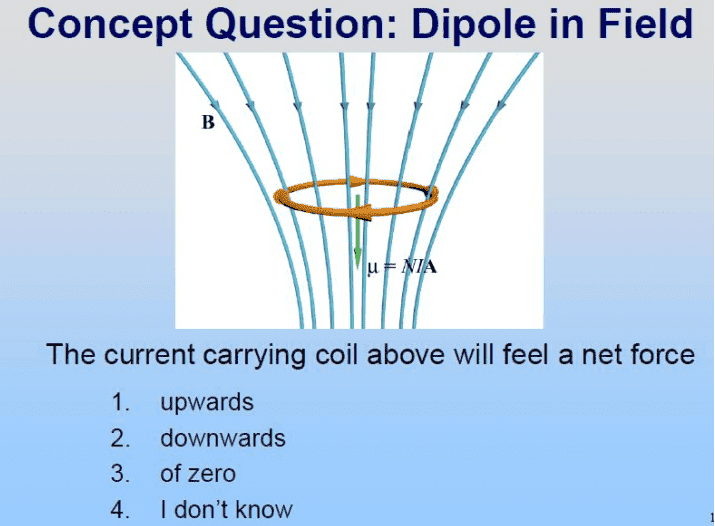
coil 1.png

I use the right hand rule and according to it the Force should be directed outward (pointing toward me)
but here is the answer that puzzeld me
coil 2.png


I really don't get why it is down , and would feel very grateful if someone can explain me the reason
thanks in advance!
 

Attachments

  • coil 1.png
    coil 1.png
    65.5 KB · Views: 869
  • coil 2.png
    coil 2.png
    47.3 KB · Views: 893
Physics news on Phys.org
The way I know how to work this one is to use potential energy ## E=-\mu \cdot B ##, and use the force ## F=-\nabla E ##. The first equation comes about because torque ## \tau=\mu \times B ## with a ## \sin(\theta) ## in the cross product, and the integral of ## E=\int \tau \, d \theta ## gives the ## \cos(\theta) ## which comes in the dot product ## E=- \mu \cdot B ##. ## \\ ## In a uniform magnetic field, a magnetic dipole can experience a torque, but no net force. The force is a result of the non-uniform magnetic field. In simple terms, the equation ## E=-\mu \cdot B ## will result in an attraction of a magnetic moment that is aligned with the magnetic field to a region of stronger magnetic field, because the potential energy ## E ## at the region of stronger magnetic field is more negative. The second equation ## F=-\nabla E ## is a quantitative expression of what I have just described qualitatively. ## \\ ## Notice also, if the magnetic moment is anti-parallel with the field, the dot product will make ## \cos(180^o)=-1 ##, and the potential energy ## E ## will be more positive if you move to a region of stronger magnetic field ## B ##.
 
Last edited:
  • Like
Likes   Reactions: Amaelle
Thanks a lot!
 
  • Like
Likes   Reactions: Charles Link

Similar threads

Replies
34
Views
2K
  • · Replies 11 ·
Replies
11
Views
2K
Replies
3
Views
1K
  • · Replies 6 ·
Replies
6
Views
1K
Replies
1
Views
2K
  • · Replies 4 ·
Replies
4
Views
3K
  • · Replies 1 ·
Replies
1
Views
1K
Replies
6
Views
2K
  • · Replies 2 ·
Replies
2
Views
2K
  • · Replies 43 ·
2
Replies
43
Views
4K