Undergrad Main Sequence Rules: Definition & Interpretation

Click For Summary
The main sequence on the HR diagram is defined primarily by stars fusing hydrogen in their cores, while the luminosity class V provides an empirical definition. There is ambiguity in determining the boundary between main sequence stars and subgiants, as subgiants have stopped core fusion and are fusing in shells around an inert core. The presence of double or triple stars complicates this further, as their combined spectra can obscure individual classifications. Additionally, unresolved binaries can lead to inaccuracies in distance measurements, affecting the perceived positions of stars. Understanding these complexities enhances the study of stellar evolution and classification.
Saturn_V
Messages
1
Reaction score
0
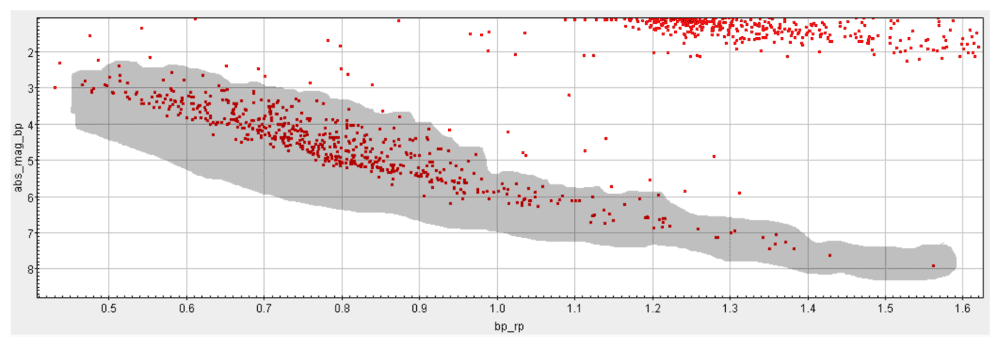
When viewing an HR diagram, the main sequence curve is apparent, and the general shape of it is obvious. However, in this truncated version, it's unclear to me exactly which stars should be considered main sequence. I've added a shaded grey area as what I think I should count as main sequence, but there's a bit of room for interpretation. Are there hard-and-fast rules, or is it a matter of opinion? What do you think of this shaded area?
reddit help hr diagram.PNG
 
Astronomy news on Phys.org
There are two possible definitions of the main sequence, one is empirical and is the luminosity class V, but more commonly the definition is physical rather than empirical-- it is stars that are fusing hydrogen in their core. So if we take the latter meaning, the "subgiants" that are between the main sequence and the red giant branch have stopped core fusion and are instead fusing in small shells around an inert core, but the core is not yet tiny and degenerate. As the core shrinks further and goes degenerate, the shell gets really tiny and even higher in temperature, and the envelope will puff out and the star will move up and to the right into the giant branch. So I think you'd have to use interior models to decide where the main sequence ends and the subgiants begin, but your shaded area is probably the right ballpark.

Another key point to bear in mind is that many stars are actually double or triple stars, and this normally cannot be determined with certainty when the stars are plotted on the H-R diagram, unless you can separate the spectra based on their Doppler shifts for "spectroscopic" binaries (close binaries seen not from above the orbits). So you can get points that are actually a kind of average of different stellar types, creating confusion as to exactly what type of star you are looking at.
 
  • Like
Likes JCMacaw and lomidrevo
Slightly OT: IIRC, a bunch of 'weird' Hipparchos distances have been attributed to orbital motion of unresolved binaries skewing the measured parallax. Some 'oops' seem due to mega-flares offsetting the nominal positions...

As mentioned above, spectroscopic binaries aligned such their orbital Doppler shifts are masked by surface activity are complex targets. Worse, contamination by mass-transfer or merger may skew determinations...

Must be said, watching such riddles and apparent paradoxes being patiently un-picked is excellent sport !
 
Hi, I saw someone with an avatar on a different forum that turns out to be the sombrero galaxy. AI says, too distant to know much about, aside from billions of starts, potentially tons of planets, and a supermassive black hole in the center. I find that setup fascinating, despite knowing close to nothing about the universe. So I ask: could anyone point me in the direction of, or provide information about this galaxy? I do not trust AI beyond general information, and I like to go pretty...

Similar threads

  • · Replies 9 ·
Replies
9
Views
3K
  • · Replies 2 ·
Replies
2
Views
5K
  • · Replies 34 ·
2
Replies
34
Views
6K
  • · Replies 9 ·
Replies
9
Views
3K
  • · Replies 10 ·
Replies
10
Views
3K
  • · Replies 46 ·
2
Replies
46
Views
8K
  • · Replies 17 ·
Replies
17
Views
2K
  • · Replies 21 ·
Replies
21
Views
5K
  • · Replies 62 ·
3
Replies
62
Views
10K
  • · Replies 150 ·
6
Replies
150
Views
23K