Dingomack
- 3
- 0
Hi,
I am using a deflected beam to create a parabolic curve to set the shape of horizontal seams between panels on a sail boat's sail. It will give me a tighter curve close to the mast and flatter out near the leach (the trailing edge). I.e. an aerofoil shape.
This is the boat, a radio controlled racing sailboat called an IOM:
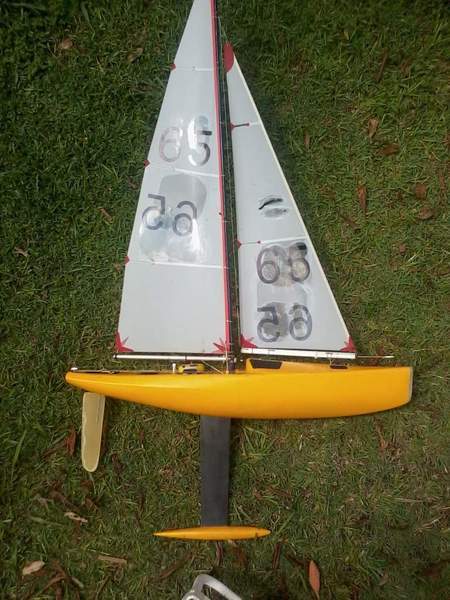
You can make out the horizontal seams- 3 on the large sail and two on the smaller.
The tool I use has two beams clamped together at one end. One beam is flexible the other consider rigid. At the other end I insert a spacer or shim to create a curve in the flexible beam. I fix the straight edge of my sail panel to this curve then straighten the beam, inducing a curve in the edge of the sail. A second sail panel is then fixed to the first and when they are removed from the tool a curve has been built into the two dimensional plane.
The most important result I am looking for when I make these sails is: what is the maximum camber, usually expressed as a % of the chord lenth. For example max. camber between 6 - 12% are common.
Now my problem is this: For a given length of beam how much deflection do I require to achieve a certain degree of max. camber, given the beam length itself will vary becaise of different size sails.
What I really need is a chart or table to read off the right shim width for a given chord length.
To give you a head start, the graph below is used in a similar tool to determine the deflection of a beam fixed in the middle. For a required % of max. camber it gives me a variable which I plug into a formula to arrive at my desired shim width. In the example below shims 1.7mm wide are inserted at each end.
View attachment Camber graph.doc
Example :
Cord 260mm
Draft required = 9%
following the graphic above at 9% correspond an Fm (multiplier factor)
of 0.66 %
Thickness of wedge will be :
260 /100 x 0.66 = 1.71 mm
One wedge at each side of the panel
(rounded at 1.70 mm)
Please note: the above example is for a gadget that is clamped in the middle. The problem with thatis it results in a curve in the seam that is tight in the middle and flatter at both ends - not an ideal aerofoil. I want the same thing but for two beams clamped at one end.
If anyone can give me any direction at all on this I would be most grateful.
I am using a deflected beam to create a parabolic curve to set the shape of horizontal seams between panels on a sail boat's sail. It will give me a tighter curve close to the mast and flatter out near the leach (the trailing edge). I.e. an aerofoil shape.
This is the boat, a radio controlled racing sailboat called an IOM:
You can make out the horizontal seams- 3 on the large sail and two on the smaller.
The tool I use has two beams clamped together at one end. One beam is flexible the other consider rigid. At the other end I insert a spacer or shim to create a curve in the flexible beam. I fix the straight edge of my sail panel to this curve then straighten the beam, inducing a curve in the edge of the sail. A second sail panel is then fixed to the first and when they are removed from the tool a curve has been built into the two dimensional plane.
The most important result I am looking for when I make these sails is: what is the maximum camber, usually expressed as a % of the chord lenth. For example max. camber between 6 - 12% are common.
Now my problem is this: For a given length of beam how much deflection do I require to achieve a certain degree of max. camber, given the beam length itself will vary becaise of different size sails.
What I really need is a chart or table to read off the right shim width for a given chord length.
To give you a head start, the graph below is used in a similar tool to determine the deflection of a beam fixed in the middle. For a required % of max. camber it gives me a variable which I plug into a formula to arrive at my desired shim width. In the example below shims 1.7mm wide are inserted at each end.
View attachment Camber graph.doc
Example :
Cord 260mm
Draft required = 9%
following the graphic above at 9% correspond an Fm (multiplier factor)
of 0.66 %
Thickness of wedge will be :
260 /100 x 0.66 = 1.71 mm
One wedge at each side of the panel
(rounded at 1.70 mm)
Please note: the above example is for a gadget that is clamped in the middle. The problem with thatis it results in a curve in the seam that is tight in the middle and flatter at both ends - not an ideal aerofoil. I want the same thing but for two beams clamped at one end.
If anyone can give me any direction at all on this I would be most grateful.
Last edited: