Manometer U Tube Homework: Solving Pressure in B

  • Thread starter Thread starter tsslaporte
  • Start date Start date
  • Tags Tags
    Manometer Tube
Click For Summary
SUMMARY

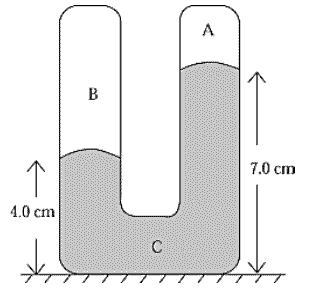
The discussion centers on solving a U-tube manometer problem involving two gases and mercury. The pressure in arm A is given as 1 × 10⁴ dyn/cm2, while the calculated pressure in arm B is 5 × 10⁴ dyn/cm2. The participant initially miscalculated the pressure difference but clarified that the total pressure in B must include the pressure from A, leading to the correct total pressure calculation. The key takeaway is understanding that the pressures at the bottom of the U-tube must be equal, necessitating the addition of pressures from both arms.

PREREQUISITES
  • Understanding of fluid statics and pressure measurement
  • Familiarity with U-tube manometers
  • Knowledge of pressure units such as dyn/cm2 and Pascal (Pa)
  • Basic principles of hydrostatics, including density and gravitational effects
NEXT STEPS
  • Study the principles of hydrostatic pressure in fluids
  • Learn about the applications of U-tube manometers in various fields
  • Explore the conversion between different pressure units, such as dyn/cm2 to Pascal
  • Investigate advanced fluid dynamics concepts related to gas pressure measurements
USEFUL FOR

Students in physics or engineering courses, particularly those studying fluid mechanics, as well as professionals involved in pressure measurement and analysis in various scientific applications.

tsslaporte
Messages
12
Reaction score
0
Homework Statement

ZJYtq.png


The U-tube in the figure is sealed at both ends. It contains a gas in A, another gas in B, and mercury in C. The heights of the mercury in the two arms are as shown. The density of mercury is 13.6 g/cm3. If the pressure in A is 1 × 10^4 dyn/cm2, the pressure in B is


The attempt at a solution

4-7 = 3CM

0.03m * 9.81 * 13600 kg/m^3 which = 4000 Pa which converts to 4x10^4 dyn/cm^2

But the answer given was 5x10^4 dyn/cm^2


I am not sure what I am doing wrong?


Edit: 4x10E4 is the pressure difference. So I have to add A which is 1x10E4 and that gives B = 5x10E4.

Could someone explain why I add A?
 
Last edited:
Physics news on Phys.org
One way to think about this problem is to calculate the pressure at the bottom of the U-tube. Look at the left U-tube column the pressure at the bottom is Pb+ hb*density*g that will equal the right U-tube Pa+ha*density*g

It is easy to see why you must add Pa if you are measuring the pressures at the bottom of the U-tube
 

Similar threads

Replies
6
Views
2K
  • · Replies 2 ·
Replies
2
Views
2K
  • · Replies 13 ·
Replies
13
Views
3K
  • · Replies 2 ·
Replies
2
Views
5K
  • · Replies 3 ·
Replies
3
Views
3K
Replies
1
Views
2K
  • · Replies 18 ·
Replies
18
Views
7K
Replies
10
Views
2K
  • · Replies 20 ·
Replies
20
Views
8K
  • · Replies 3 ·
Replies
3
Views
3K