Mars: estimations about its colonization - liquid water issue

  • Context: Undergrad 
  • Thread starter Thread starter thommy
  • Start date Start date
  • Tags Tags
    Liquid Mars Water
Click For Summary

Discussion Overview

The discussion revolves around the feasibility of colonizing Mars, particularly focusing on the challenges posed by the availability of liquid water and the implications for human missions. Participants explore various aspects of this topic, including the timeline for manned missions, the psychological and physical effects of long space travel, and potential solutions to the liquid water issue on Mars.

Discussion Character

  • Exploratory
  • Debate/contested
  • Technical explanation

Main Points Raised

  • Some participants express skepticism about the optimism surrounding Mars colonization, questioning the feasibility of sending a manned mission before 2030.
  • Concerns are raised regarding the long duration of space travel and its effects on astronauts and civilians, with some suggesting that experiences on the ISS may provide insights into handling such journeys.
  • There is a discussion about the challenges of reducing voyage length, with one participant noting that chemical rockets require significant fuel for shorter transit times, while electric thrusters may not be practical due to low thrust and long burn times.
  • Participants acknowledge the importance of liquid water for colonization, highlighting that Martian atmospheric pressure is below the triple point of water, which complicates the existence of liquid water.
  • One proposed solution to obtain liquid water is to melt ice at the polar caps, although this is challenged by concerns about sublimation due to low pressure.
  • The atmospheric conditions on Mars are discussed, noting that while the pressure is near the triple point of water, the cold temperatures typically keep water in solid form.
  • Questions are raised about the logistics of launching missions to Mars, including the narrow launch windows and the feasibility of sending supplies during pauses between crewed missions.

Areas of Agreement / Disagreement

Participants generally express skepticism about the timeline and feasibility of colonizing Mars, with multiple competing views on the challenges and solutions related to liquid water and long-duration space travel. The discussion remains unresolved regarding the practicality of proposed solutions and the overall optimism about colonization plans.

Contextual Notes

Limitations include uncertainties about the psychological effects of long-duration space travel, the technical challenges of reducing voyage length, and the specific conditions required for liquid water to exist on Mars. The discussion also highlights the dependence on various assumptions regarding technology and mission planning.

thommy
Messages
4
Reaction score
2
''Elon Musk says he plans to send 1 million people to Mars by 2050 by launching 3 Starship rockets every day and creating 'a lot of jobs' on the red planet''
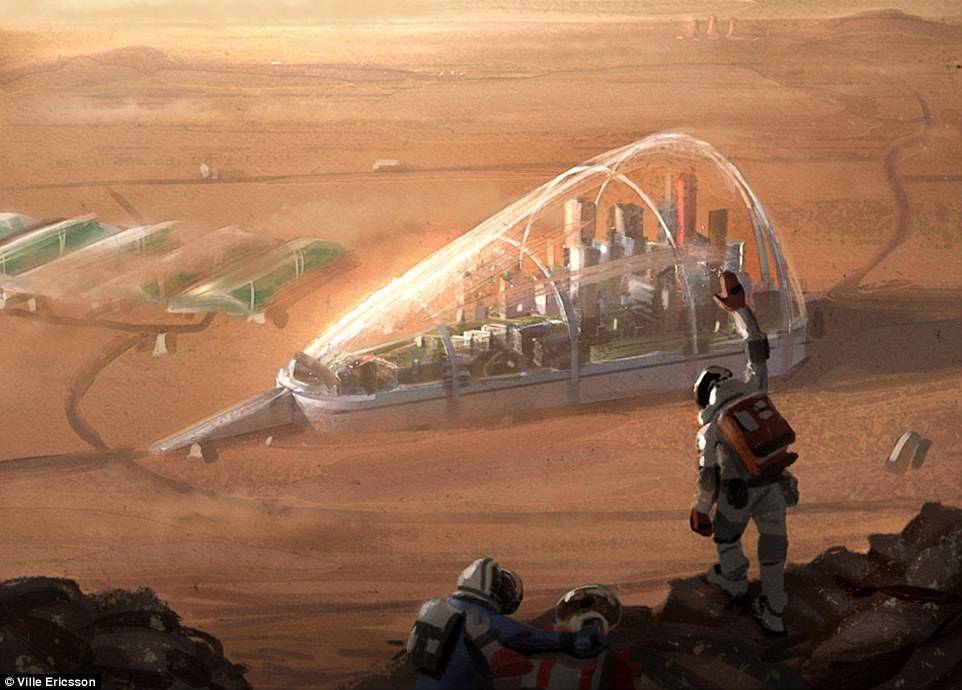
mars_colony.jpg

It's been a while since Elon made the above statement, however isn't he being extremely optimistic about everything, really?

What are your estimations about the colonization of Mars? Are we even going to send a manned mission there before 2030? How will astronauts let alone civilians react to the horrifically long voyage? Is the voyage length going to decrease substantially in the future? What are the first jobs (professions) going to be``? What's the Martian population going to look like in 2050? 2100?

I acknowledge that there are multiples problems we need to face then solve in order to properly colonize Mars, however having an abundance of liquid water seems quite important to me.
Unfortunately, the Martian pressure is well below the triple point of water, which means that water cannot exist as a liquid. What would possible solutions be to that specific problem?
 
Last edited by a moderator:
Physics news on Phys.org
thommy said:
It's been a while since Elon made the above statement, however isn't he being extremely optimistic about everything, really?

It's a load of nonsense, mostly. We don't even know how to survive long-term outside of Earth's biosphere.

thommy said:
Are we even going to send a manned mission there before 2030?

It's possible, but it seems unlikely to me.

thommy said:
How will astronauts let alone civilians react to the horrifically long voyage?

We can't know for sure, but people have been doing pretty well spending many months on the ISS, so a 5-6 month journey probably wouldn't be that big of an issue in terms of how people mentally and physically handle it.

I think the bigger problem is one of radiation exposure and the multi-year time frame spent away from Earth that such as mission requires.

thommy said:
Is the voyage length going to decrease substantially in the future?

Probably not. The amount of fuel needed with chemical rockets increases dramatically as you reduce transit time (more fuel needed for longer burns and higher velocities) which drastically increases your spacecraft 's mass and expense. Electric thrusters are an option, but they have such low thrust that the burn times are extremely long and may be problematic, not to mention they need huge amounts of electric power.

thommy said:
Mars, however having an abundance of liquid water seems quite important to me.
Unfortunately, the Martian pressure is well below the triple point of water, which means that water cannot exist as a liquid. What would possible solutions be to that specific problem?

Easy. Just melt the ice at the polar caps or other sources of ice water.
 
Drakkith said:
Easy. Just melt the ice at the polar caps or other sources of ice water.

Well, isn't ice going to sublime? The pressure is way too low.
 
thommy said:
Well, isn't ice going to sublime? The pressure is way too low.
The atmospheric pressure on Mars is (coincidentally) almost exactly the pressure at the triple point of water (~600 Pa). However, the temperature on Mars is on average much colder than the triple point, so water will almost always be present in its solid form—especially at the poles, where the ice caps are situated and which experience the coldest weather on Mars.
 
  • Like
Likes   Reactions: thommy
Is not the launch window a pretty narrow period every 2 years? What is he going to do for the pauses? Send non-human flights with supplies for long duration missions to mars? Is there even fuel and delta V capacity for that on the starship?
 

Similar threads

  • · Replies 2 ·
Replies
2
Views
3K
  • · Replies 12 ·
Replies
12
Views
4K
  • · Replies 65 ·
3
Replies
65
Views
26K
  • · Replies 5 ·
Replies
5
Views
2K
  • · Replies 21 ·
Replies
21
Views
5K
  • · Replies 60 ·
3
Replies
60
Views
11K
  • · Replies 17 ·
Replies
17
Views
8K
  • · Replies 1 ·
Replies
1
Views
4K