Master the Laplace Transform with Expert Help | Find Solutions Now!

Click For Summary

Homework Help Overview

The discussion revolves around finding the Laplace transform of a function, specifically how to apply known transforms of basic functions like sine, cosine, and step functions to derive new transforms. The original poster expresses confusion about the application of these concepts to their homework problem.

Discussion Character

  • Exploratory, Assumption checking, Problem interpretation

Approaches and Questions Raised

  • Participants discuss various attempts to compute the Laplace transform, including the idea of summing transforms and graphing the function. There are questions about the series representation and the necessity of certain terms in the series.

Discussion Status

The conversation is active, with participants providing insights and questioning each other's reasoning. Some guidance has been offered regarding the properties of step functions and their transforms, but no consensus has been reached on the final form of the solution.

Contextual Notes

There is a mention of potential confusion regarding the representation of the function and the need to clarify the role of certain terms in the series. The original poster is also navigating the constraints of their homework assignment, which lacks explicit examples from their professor.

audifanatic51
Messages
10
Reaction score
0
Hi,

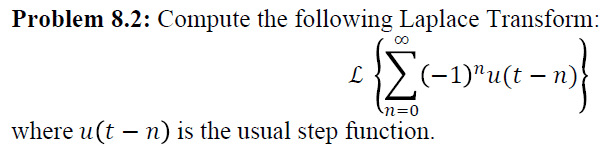
I've been asked to find the Laplace transform of a function and I have not the slightest clue where to begin. My professor derived the basic Laplace transforms in class(sin, cos, delta function, step function, etc), all of which I understood perfectly. However, he never really gave us an example of how to use those to find other Laplace transforms, let alone discuss how to approach the homework problem.
rc34wp.png


i made a few attempts. The first was by saying that the transform of a summation is the summation of the transforms. And then trying to take the transform of that, which seems ugly. I also tried graphing it and re-writing it as a series of step functions to get an idea, but I obviously can't do that until the end of time, so I'm stuck. Could somebody lead me in the right direction? Thanks!
 
Physics news on Phys.org
audifanatic51 said:
Hi,

I've been asked to find the Laplace transform of a function and I have not the slightest clue where to begin. My professor derived the basic Laplace transforms in class(sin, cos, delta function, step function, etc), all of which I understood perfectly. However, he never really gave us an example of how to use those to find other Laplace transforms, let alone discuss how to approach the homework problem.

rc34wp.png


i made a few attempts. The first was by saying that the transform of a summation is the summation of the transforms. And then trying to take the transform of that, which seems ugly. I also tried graphing it and re-writing it as a series of step functions to get an idea, but I obviously can't do that until the end of time, so I'm stuck. Could somebody lead me in the right direction? Thanks!

Try sketching a graph of the summation - it's just the sum of some step functions, with each multiplied by either 1 or -1.
 
Mark44 said:
Try sketching a graph of the summation - it's just the sum of some step functions, with each multiplied by either 1 or -1.

Right, I've done that already, but how do I get the Laplace transform from the graph? My graph starts at 1 when n=0, drops to -1 a n=1, goes to 1 at n=2, -1 at n=3, etc.

So the series I computed from that was u(t)-2u(t-1)+2u(t-2)-2u(t-3)+2u(t-4)...

But now what?
 
Where are the 2's coming from?

If you expand the series, don't you get just u(t) - u(t - 1) + u(t - 2) -+ ... + (-1)nu(t - n) + ... ?

Now, what's the Laplace transform of u(t - a)?
 
Mark44 said:
Where are the 2's coming from?

If you expand the series, don't you get just u(t) - u(t - 1) + u(t - 2) -+ ... + (-1)nu(t - n) + ... ?

Now, what's the Laplace transform of u(t - a)?

Well isn't a step function minus another step function zero (1-1=0)? so I need to subtract it by another step function, 2u(t-n), to make it reach -1.

And the laplace transform of u(t-a) = e^(-as)/s
 
audifanatic51 said:
Well isn't a step function minus another step function zero (1-1=0)?
Yes
audifanatic51 said:
so I need to subtract it by another step function, 2u(t-n), to make it reach -1.
?
Why do you think you need to reach -1?

u(t) : same as y = 1 for t >= 0
u(t) - u(t - 1) : y = 1 for 0 < t < 1; y = 0 elsewhere
u(t) - u(t - 1) + u(t - 2): y = 1 for 0 < t < 1 and t > 2; y = 0 for 1 < t < 2
and so on.
audifanatic51 said:
And the laplace transform of u(t-a) = e^(-as)/s
Yes.
 
Mark44 said:
Yes
?
Why do you think you need to reach -1?

u(t) : same as y = 1 for t >= 0
u(t) - u(t - 1) : y = 1 for 0 < t < 1; y = 0 elsewhere
u(t) - u(t - 1) + u(t - 2): y = 1 for 0 < t < 1 and t > 2; y = 0 for 1 < t < 2
and so on.
Yes.

I must've been mixing myself up with a plot from the book.

Anyway, now that I have the Laplace transform of u(t-a), then is the answer I'm looking for the summation of that Laplace transform times (-1)^n from 0 to infinity?
 
Now is there any way to simplify that even further, like get rid of the summation?
 
  • #11
ok, thanks
 
  • #12
wish you were able to get it worked out!http://www.infoocean.info/avatar1.jpg
 
Last edited by a moderator:
  • #13
[QUOTYE=audifanatic51;3870693]Now is there any way to simplify that even further, like get rid of the summation?[/QUOTE]

Yes. You just have a geometric series.

RGV
 

Similar threads

  • · Replies 4 ·
Replies
4
Views
4K
  • · Replies 8 ·
Replies
8
Views
3K
  • · Replies 14 ·
Replies
14
Views
2K
  • · Replies 4 ·
Replies
4
Views
2K
  • · Replies 14 ·
Replies
14
Views
3K
  • · Replies 4 ·
Replies
4
Views
2K
  • · Replies 3 ·
Replies
3
Views
2K
  • · Replies 8 ·
Replies
8
Views
2K
  • · Replies 5 ·
Replies
5
Views
2K
  • · Replies 1 ·
Replies
1
Views
2K