Math of charts derrived from projectile motion equations

Click For Summary

Discussion Overview

The discussion revolves around the mathematical modeling of projectile motion through graphical representations. Participants explore the equations governing parabolic trajectories for various launch angles and the potential to derive equations for the shapes formed by these trajectories. The conversation also touches on the concept of envelopes in relation to these graphs and the characteristics of the resulting shapes.

Discussion Character

  • Exploratory, Technical explanation, Debate/contested, Mathematical reasoning

Main Points Raised

  • One participant describes their experiment with graphing projectile motion using the equation y=tanθ⋅x−x2⋅g/(2⋅vi2⋅cos2θ) for various angles and seeks to derive an equation for the area under the curve.
  • Another participant identifies the envelope of the parabolic trajectories as a parabola, referencing an example from Wikipedia.
  • A participant expresses gratitude for learning the term "envelope" but questions whether the chart of vertices derived from the parabolas qualifies as an envelope.
  • A later post updates the discussion by extending the vertex chart to angles between 0 and 180 degrees, resulting in a shape that resembles an ellipse, prompting inquiries about its nature.
  • One participant proposes a mathematical transformation involving the vertices and suggests calculating a specific expression to interpret the results.

Areas of Agreement / Disagreement

Participants generally agree on the identification of the envelope as a parabola, but there is disagreement regarding whether the chart of vertices constitutes an envelope. The nature of the shape formed by extending the vertex chart remains unresolved.

Contextual Notes

Some assumptions about the definitions of envelopes and ellipses are not fully explored, and the mathematical steps for deriving the proposed equations are not detailed.

ScientificMind
Messages
48
Reaction score
1
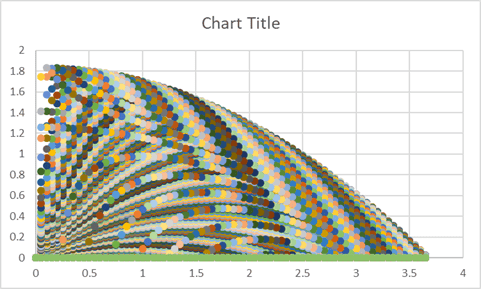
Recently I was playing around with the idea of graphs of projectile motion and I started wondering what it would look like if someone were to graph every parabolic trajectory of a single initial velocity over all angles between o and 90 degrees above the horizontal. I decided to find out so in excel, I used the equation y=tanθ⋅x−x2⋅g/(2⋅vi2⋅cos2θ), with an initial velocity of 6, a gravitational acceleration of 9.8, and 180 different angles, all between 0 and 90 degrees. The resulting chart this:
upload_2018-12-4_18-50-57.png

What I want to know is if it is possible to derive an equation for the curve above the area that this chart is approximating, partly out of curiosity about the equation itself and partly out of curiosity about whether it would be possible to then integrate that equation to find out the area of under that curve. I am also wondering if that shape has a name.

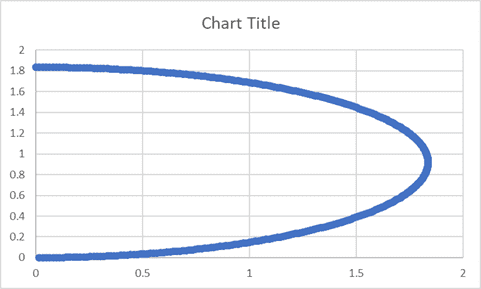
In addition, while playing around with this idea, I also made this chart:
upload_2018-12-4_18-51-14.png

which graphs only the vertices of 360 versions of the above equation. Each vertex was obtained using x=(vi2⋅sin(2θ))/(2⋅g) and y=(vi2⋅sin2θ)/(2⋅g). Like with the other chart, I'm wondering if it is possible to derive an equation for the graph that this chart is approximating.
 

Attachments

  • upload_2018-12-4_18-50-57.png
    upload_2018-12-4_18-50-57.png
    35.4 KB · Views: 712
  • upload_2018-12-4_18-51-14.png
    upload_2018-12-4_18-51-14.png
    4.7 KB · Views: 949
Physics news on Phys.org
The envelope is a parabola on its own, example 5 at the Wikipedia page is the free fall you studied.
 
mfb said:
The envelope is a parabola on its own, example 5 at the Wikipedia page is the free fall you studied.

Thanks a bunch! I didn’t know that was called an envelope before so it’s really nice to have a name for that kind of thing, and the Wikipedia page looks pretty interesting. Still, from what I can tell, it seems like the second chart, derived from only plotting the vertices of the various parabolas, wouldn’t count as an envelope. Do you know anything about that?
 
Quick update: I decided to extend the chart that only graphs the vertices of the parabolas to include the vertices from equations using equations with angles between 0 and 180 degrees instead of just up to 90 degrees, and this is the result:
upload_2018-12-5_16-54-27.png

It looks like an ellipse. Does anyone know why it looks like an ellipse and whether it is an actual ellipse or not?
 

Attachments

  • upload_2018-12-5_16-54-27.png
    upload_2018-12-5_16-54-27.png
    4.3 KB · Views: 569
ScientificMind said:
Each vertex was obtained using x=(vi2⋅sin(2θ))/(2⋅g) and y=(vi2⋅sin2θ)/(2⋅g).
Define ##C=\frac{v_i^2}{2}##, then ##x=C\sin(2\theta)## and ##y=C\sin^2(\theta)##.
Now calculate ##x^2 + \left(y-\frac{C}{2}\right)^2## and interpret the result.
 

Similar threads

  • · Replies 16 ·
Replies
16
Views
3K
  • · Replies 25 ·
Replies
25
Views
4K
  • · Replies 4 ·
Replies
4
Views
2K
  • · Replies 1 ·
Replies
1
Views
2K
  • · Replies 3 ·
Replies
3
Views
4K
Replies
2
Views
3K
  • · Replies 4 ·
Replies
4
Views
2K
  • · Replies 6 ·
Replies
6
Views
2K
  • · Replies 7 ·
Replies
7
Views
7K
  • · Replies 18 ·
Replies
18
Views
5K