Matrix Inversion for Variation of Parameters

Click For Summary

Discussion Overview

The discussion focuses on the process of inverting the Phi matrix in the context of solving differential equations using the method of variation of parameters. Participants explore different techniques for finding the inverse, including Cramer's rule and the adjoint method.

Discussion Character

  • Technical explanation
  • Mathematical reasoning
  • Debate/contested

Main Points Raised

  • One participant requests assistance with inverting the Phi matrix and expresses difficulty in matching the book's answer.
  • Another participant suggests using Cramer's rule to find the inverse, proposing to break the identity matrix into two columns.
  • A different participant reports success with the method after initially struggling, indicating that Cramer's rule was effective for them.
  • One participant mentions calculating the inverted matrix but still not obtaining the correct solution, seeking help to identify their mistake.
  • A participant clarifies that using Cramer's rule requires applying it twice to find the inverse and provides a detailed setup for the calculations.
  • Another participant questions whether the inverse is simply 1/det(Phi) * adj(Phi) and discusses the process of finding the adjoint and determinant, expressing uncertainty about their own calculations.

Areas of Agreement / Disagreement

Participants express differing views on the methods for inverting the matrix, with some supporting Cramer's rule while others reference the adjoint method. The discussion remains unresolved regarding the most effective approach and the correctness of individual calculations.

Contextual Notes

Some participants' calculations may depend on specific assumptions about the matrix structure, and there are unresolved steps in the mathematical processes discussed.

gkirkland
Messages
11
Reaction score
0
I am working on the following problem:
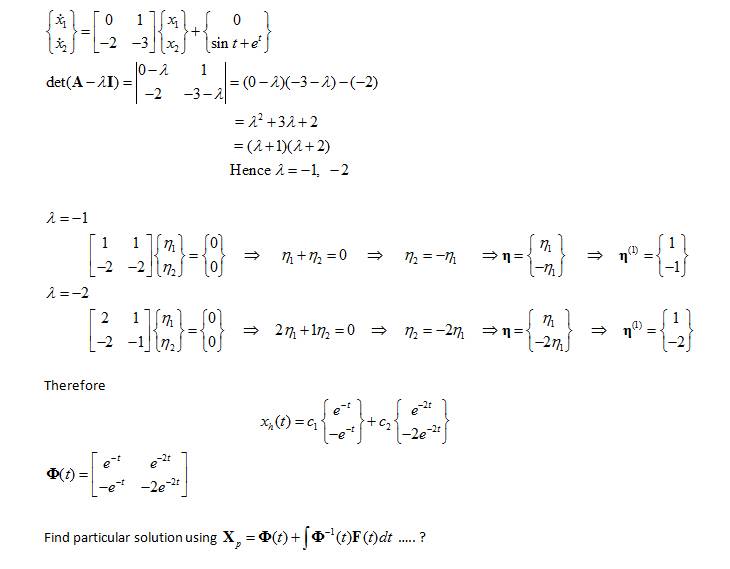
DE_zps79b1f9e4.jpg


Can someone please show or explain the steps to invert the phi matrix? I've given it a few tries, but I can't reach what the book has for the answer.

Please help! Thanks
 
Physics news on Phys.org
Phi(t)*Phi^-1(t) = I, where I is the 2x2 identity matrix.
You can use Cramer's rule to solve for the inverse by breaking the identity matrix into two columns.

If you post some of your work, we may help you spot what is going wrong with you calculations.
 
I didn't even think about using Cramer's rule to find the inverse! That was a great idea, got it on the first try.

Thanks!
 
So I calculated the inverted matrix, but for some reason I'm still not getting the correct solution. Can someone please spot my mistake?

DifferentialEquationsNotes_Page_2_zps1c63e27a.jpg

DifferentialEquationsNotes_Page_3_zpsbde458ee.jpg
 
I apologize for my lack of clarity in my earlier post.

In order to find the inverse of the Phi(t) matrix using Cramer's Rule, it must be used twice.

Code:
This is how the inverse is set up:
| e^-t    e^-2t|  |a11  a12|     |1  0|
|-e^-t  -2e^-2t|  |a21  a22|  =  |0  1|

where the a values represent the inverse of Phi(t). In order to calculate the a values,
the matrix equation above is split into two parts, like so:
Code:
This is how the inverse calculations are set up:
| e^-t   e^-2t|  |a11|     |1|
|-e^-t -2e^-2t|  |a21|  =  |0|
and
| e^-t   e^-2t|  |a12|     |0|
|-e^-t -2e^-2t|  |a22|  =  |1|

Cramer's Rule can be used to solve both systems. Remember, always check the calculations by multiplying Phi(t) by Phi^-1(t) to see if the Identity matrix is obtained.

I should point out that Phi^-1(t) is the inverse matrix of Phi(t) rather than 1/Phi(t)
 
isn't the inverse of the matrix 1/det(phi) * adj(phi) not just phi?
You have to find the adjoint of phi then multiply by 1/det(phi), the adjoint matrix being the transpose of the C expansion matrix, for a 2x2 it always works out to be that you swap the signs on entry 2 and 3 and swap the placement of entry 1 and 4.

but I am not sure, trying to work it out now also not getting the books answer..
 

Similar threads

  • · Replies 5 ·
Replies
5
Views
2K
  • · Replies 7 ·
Replies
7
Views
2K
  • · Replies 2 ·
Replies
2
Views
5K
  • · Replies 1 ·
Replies
1
Views
4K
  • · Replies 4 ·
Replies
4
Views
2K
  • · Replies 6 ·
Replies
6
Views
5K
  • · Replies 0 ·
Replies
0
Views
2K
  • · Replies 0 ·
Replies
0
Views
2K
  • · Replies 3 ·
Replies
3
Views
2K
  • · Replies 2 ·
Replies
2
Views
1K