Matrix which reverses Gram-Schmidt - Linear Algebra

Click For Summary
SUMMARY

The discussion focuses on the Gram-Schmidt process in linear algebra, specifically the challenge of reversing the transformation to express orthogonal vectors (q vectors) in terms of the original linearly independent vectors (a vectors). The user proposes that if vectors a1, a2, and a3 are linearly independent, then the orthogonal vectors should directly correspond to the original vectors, i.e., q1 = a1, q2 = a2, and q3 = a3. The complexity arises from the requirement that the orthogonal vectors must also be of unit length, complicating the transformation process.

PREREQUISITES
  • Understanding of the Gram-Schmidt process in linear algebra
  • Knowledge of linear independence and orthogonality of vectors
  • Familiarity with vector normalization techniques
  • Basic proficiency in matrix operations and transformations
NEXT STEPS
  • Study the derivation of the Gram-Schmidt process in detail
  • Explore methods for vector normalization to unit length
  • Investigate alternative orthogonalization techniques, such as the Modified Gram-Schmidt
  • Learn about matrix representation of linear transformations in linear algebra
USEFUL FOR

Students and professionals in mathematics, particularly those studying linear algebra, as well as educators seeking to deepen their understanding of vector transformations and orthogonalization methods.

Amadeo
Messages
28
Reaction score
9
Homework Statement
Let a1, a2, a3 be linearly independent vectors in R 3 , and let q1, q2, q3 be the vectors obtained from a1, a2, a3 by the Gram-Schmidt algorithm.

Define the linear transformation T : R 3 → R 3 by T(q1) = a1, T(q2) = a2 and T(q3) = a3.

For the choice of basis {q1, q2, q3} both for the input and output spaces, find the matrix MT which represents the linear transformation T for this choice of basis.
Relevant Equations
projection equation used in Gram-Schmidt: p=((a^t)(b))/((a^t)(a)) (a)
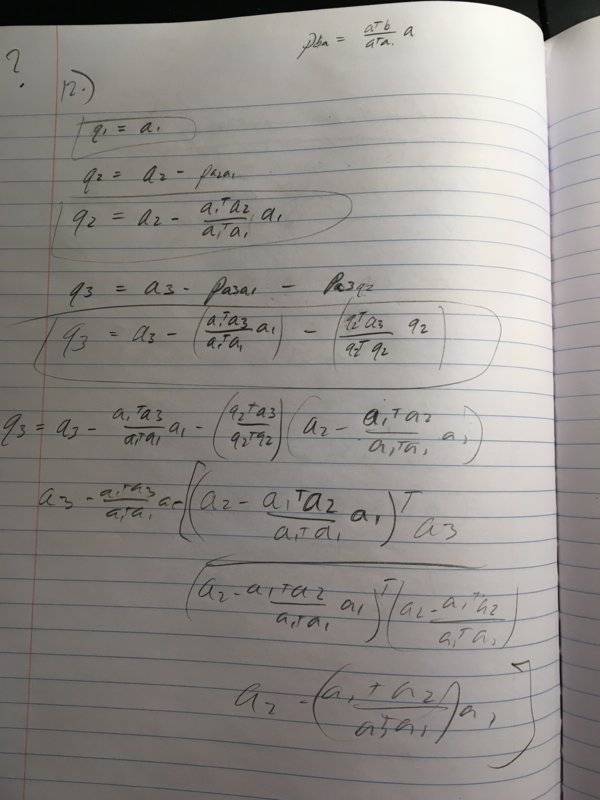
My idea was to write out the formulas for the orthogonal q vectors in terms of the input vectors using the basics of gram-schmidt. Then, I would rewrite those equations suhc that the a vectors were written in terms of the q vectors. And then, try to find some matrix which would capture the needed transformation. However, the q vectors must be written in terms of multiple a vectors, as well as other q vectors. Additionally, the need to make all of the orthogonal vecotrs of unit length makes it even more complicated. There must be another way.
IMG_1281.JPG
 
Physics news on Phys.org
If a1-3 are linearly independent vectors, shouldn't q1 = a1, q2 = a2, q3 = a3?

Because Gram-Schmidt method is about substracting the part of your vector that's represented in previous vectors. But there are no such parts since they are linearly independent.
 

Similar threads

  • · Replies 8 ·
Replies
8
Views
2K
  • · Replies 16 ·
Replies
16
Views
3K
  • · Replies 6 ·
Replies
6
Views
5K
  • · Replies 14 ·
Replies
14
Views
4K
Replies
4
Views
2K
Replies
4
Views
2K
  • · Replies 4 ·
Replies
4
Views
2K
  • · Replies 3 ·
Replies
3
Views
2K
  • · Replies 7 ·
Replies
7
Views
1K
  • · Replies 2 ·
Replies
2
Views
2K