Max Fidelity at $$F=|\langle\psi|\phi\rangle|^2$$

Join the discussion
Registration is free. Ask a follow-up in this thread, or start your own.
26 replies · 3K views
deepalakshmi
Messages
95
Reaction score
6
TL;DR
I have two pure states i.e. initial state and final state. I should get Fidelity as 1 when #t=\pi{/2}#
But I am not getting. What is wrong in my calculation?
$$F =|\langle\psi|\phi \rangle|^2$$
$$|\psi\rangle=|\alpha\rangle|0\rangle$$
$$|\phi\rangle= |\cos(t)\alpha\rangle|i\alpha\sin(t)\rangle$$
$$F=|(|\langle\alpha|\langle 0|)(|\cos(t)\alpha\rangle|i\alpha\sin(t)\rangle)|^2$$
Now simplifying $$\langle\alpha|\cos(t)\alpha\rangle$$
$$=e^{-\frac{|\alpha|^2}{2}}\sum_{n=0}\frac{(\alpha^\ast)^n}{\sqrt{n!}}\langle n|e^{-\frac{|\alpha\cos(t)|^2}{2}}\sum_{m=0}\frac{(\alpha\cos(t))^m}{\sqrt{m!}}|m\rangle$$
$$=e^{-\frac{|\alpha|^2}{2}}e^{-\frac{|\alpha\cos(t)|^2}{2}}\sum_{n=0}\sum_{m=0}\frac{(\alpha^\ast\alpha\cos(t))^n}{\sqrt{n!}}\langle n|m\rangle$$
$$=e^{{-|\alpha|^2}{/2}}e^{{-|\alpha\cos(t)|^2}{/2}}e^{|\alpha|^2\cos(t)}$$
Now simplifying $$\langle 0|i\sin(t)\alpha\rangle$$
$$=\langle 0| e^{-\frac{|\alpha\sin(t)|^2}{2}}\sum_{n=0}\frac{(\alpha i\sin(t))^n}{\sqrt{n!}}|n\rangle $$
$$=e^{-\frac{|\alpha\sin(t)|^2}{2}}$$
$$F=|e^{{-|\alpha|^2}{/2}}e^{{-|\alpha\cos(t)|^2}{/2}}e^{|\alpha|^2\cos(t)}e^{-\frac{|\alpha\sin(t)|^2}{2}}|^2$$
Now when t=0 , I am getting F=1.
when $t=\pi{/2}$ I am getting F= (4.5)(10^-5)
But my teacher says that even at #t=\pi{/2}#, I should get F=1. Here alpha is the coherent state and its value is sqrt5
Why should I get 1 and Why am i not getting 1?

What's wrong with my calculation?
 
Physics news on Phys.org
Demystifier said:
Have you resolved your errors in your previous calculation of the same type?
yes. I have done
 
  • Like
Likes   Reactions: Demystifier
No. He clearly told me I should get 1 at t= #/pi /2#.
 
Is there any theory that I should get constant fidelity for pure state even in different degrees i.e.0,90etc
 
Last edited:
I think I got what my teacher is saying.
I don't know if it make sense.
Since my state is pure, its fidelity should obey symmetry property i.e. $$F(\rho,\sigma)=F(\sigma,\rho) $$
so
$$|\langle\psi (\rho)|\psi (\sigma)|^2 = |\langle\psi (\sigma)|\psi (\rho)|^2$$
$$|\psi(\rho)\rangle = |\alpha\rangle |0\rangle$$
$$|\psi(\sigma)\rangle= |\alpha\cos(t)\rangle |i\alpha\sin(t)\rangle$$
therefore
$$|\langle\psi (\rho)|\psi (\sigma)|^2$$

$$=|(|\langle\alpha|\langle 0|)(|\cos(t)\alpha\rangle|i\alpha\sin(t)\rangle)|^2$$
$$= 1$$ (when t = 0)
similarly for
$$|\langle\psi (\sigma)|\psi (\rho)|^2$$
so I should get same fidelity irrespective of t
 
deepalakshmi said:
I think I got what my teacher is saying.
I don't know if it make sense.
Since my state is pure, its fidelity should obey symmetry property i.e. $$F(\rho,\sigma)=F(\sigma,\rho) $$
so
$$|\langle\psi (\rho)|\psi (\sigma)|^2 = |\langle\psi (\sigma)|\psi (\rho)|^2$$
$$|\psi(\rho)\rangle = |\alpha\rangle |0\rangle$$
$$|\psi(\sigma)\rangle= |\alpha\cos(t)\rangle |i\alpha\sin(t)\rangle$$
therefore
$$|\langle\psi (\rho)|\psi (\sigma)|^2$$

$$=|(|\langle\alpha|\langle 0|)(|\cos(t)\alpha\rangle|i\alpha\sin(t)\rangle)|^2$$
$$= 1$$ (when t = 0)
similarly for
$$|\langle\psi (\sigma)|\psi (\rho)|^2$$
so I should get same fidelity irrespective of t
I think it doesn't make sense
 
  • Haha
Likes   Reactions: Demystifier
When will the pure state have constant fidelity?
 
Is there something wrong with my initial and final state?
"The fidelity between two states can be shown to never decrease when a non-selective quantum operation
{\mathcal {E}}
is applied to the states" what does this mean and how is it related to my problem?
 
Last edited:
@Demystifier I am wrong. What my teacher meant was "At t = 90(degree), the fidelity is 0.00004 which is nearly equal to 0. But fidelity will be 0 only if the two states are orthogonal. But my case is not orthogonal. So he told me my calculation is wrong". I think it makes sense right?
Therefore something is wrong. But what is wrong?
My calculation for proving it is not orthogonal:
at t = 90(degree)
$$(\langle\alpha|\langle 0|)(|0\rangle|i\alpha\rangle)$$
$$\langle\alpha|0\rangle \langle 0|i\alpha\rangle$$
$$exp({-{|\alpha|}^2}{/2}) exp({-{|\alpha|}^2}{/2})$$
$$exp({-|\alpha|}^2)$$
But here if I substitute alpha as sqrt{5}
I am getting 0.006.
Then does it mean my state is orthogonal?( I am confused)
 
Last edited:
deepalakshmi said:
I am getting 0.006.
##0.006^2=0.000036\approx 0.00004##, which is the number your teacher gave. If you take my simplified expression in #4, you will see that the fidelity is really ##e^{-2|\alpha|^2}##, which is ##(e^{-|\alpha|^2})^2##.

deepalakshmi said:
Then does it mean my state is orthogonal?
No, it means that it's almost orthogonal.
 
At t=90(degree)
its inner product is approximately equal to 0.
Therefore its fidelity is 0 (approximately).
Is this statement correct?
 
Demystifier said:
Yes.
But if take smaller values of alpha, I am not getting this statement. Why? For example; take alpha= sqrt{1}. Its inner product is 0.36 and fidelity is 0.1
 
@Demystifier
Now considering t = 30(degree)
$$|\psi\rangle=|\alpha\rangle|0\rangle$$
$$|\phi\rangle= |\cos(t)\alpha\rangle|i\alpha\sin(t)\rangle$$
$$= |(\sqrt{3}{/2})\alpha\rangle|(1{/2})i\alpha\rangle$$
$$F=|\sqrt{3}{/4}(|\langle\alpha|\langle 0|)(|\alpha\rangle|i\alpha\rangle)|^2$$
$$=|\sqrt{3}{/4}(|\langle\alpha|\alpha\rangle)(\langle 0|i\alpha\rangle)|^{2}$$
$$=3/16|e^{-\frac{|\alpha|^2}{2}}|^2$$
$$=(3/16)e^{-5}$$
$$=0.001$$

If I consider
$$F= e^{-2|\alpha|^2(1-\cos(t))}$$
$$=e^{-10(1-\sqrt{3}{/2})}$$
$$=0.26$$
Why there is a change in fidelity?
 
Last edited:
Demystifier said:
You made an error again; ##|c\alpha\rangle \neq c| \alpha\rangle##.
Since C is just a value, can't I take it outside?
 
Then how should I find inner product of the state with value inside it?
 
deepalakshmi said:
Since C is just a value, can't I take it outside?
You can't. ##\alpha## is also just a value, why don't you take ##\alpha## outside instead? Think about it!
 
  • Informative
Likes   Reactions: deepalakshmi
$$F=|(\langle\alpha|\frac{\alpha\sqrt{3}}{2}\rangle)(\langle0|\frac{i\alpha}{2}\rangle)|^2$$

simplifying$$\langle\alpha|\frac{\sqrt{3}}{2}\alpha\rangle$$

$$=e^{-\frac{|\alpha|^2}{2}}\sum_{n=0}\frac{(\alpha^\ast)^n}{\sqrt{n!}}\langle n|e^{-\frac{|\alpha{\sqrt{3}{/2}}|^2}{2}}\sum_{m=0}\frac{(\alpha{\sqrt{3}{/2}})^m}{\sqrt{m!}}|m\rangle$$
$$
=e^{-\frac{|\alpha|^2}{2}}e^{-\frac{|\alpha{\sqrt{3}{/2}}|^2}{2}}e^{-\{(\sqrt{3}|\alpha|^2)/2)}
$$

Simplifying $$\langle 0|\frac{1}{2}i\alpha\rangle$$

$$=\langle 0| e^{-\frac{|i\alpha/2|^2}{2}}\sum_{n=0}e^{-\frac{|i\alpha/2|^2}{2}}\frac{(\alpha i{({1}{/2}}))^n}{\sqrt{n!}}|n\rangle$$

$$=e^{-\frac{|i\alpha/2|^2}{2}}$$

$$F=|e^{-\frac{|\alpha|^2}{2}}e^{-\frac{|\alpha{\sqrt{3}{/2}}|^2}{2}}e^{-\{(\sqrt{3}|\alpha|^2)/2)}e^{-\frac{|i\alpha/2|^2}{2}}|^2$$
 
  • Like
Likes   Reactions: Einstein44
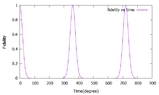
While increasing the degree( 0,30,60,etc) fidelity keeps on decreasing and reaches 0 (1,0.2,0,0,0...). So can I conclude that overlapping of the two quantum state decreases while increasing the degree(time)?
 
This is graph which I got while plotting fidelity vs time. According to my graph, fidelity decreases and reaches 0 but again increases and decreases.
 

Attachments

  • dataImg.png
    dataImg.png
    5.4 KB · Views: 167
deepalakshmi said:
This is graph which I got while plotting fidelity vs time. According to my graph, fidelity decreases and reaches 0 but again increases and decreases.
From this graph what observations can be made?