PakBosMuda
- 1
- 0
TL;DR Summary: An impulse is given to the pendulum so that it moves in 3 dimensions. What equations apply throughout its motion?
A particle of mass ##m## is suspended from a string of length ##\ell##. The string is then deflected at an angle ## \theta ##, where the particle and string are in the XY-plane.
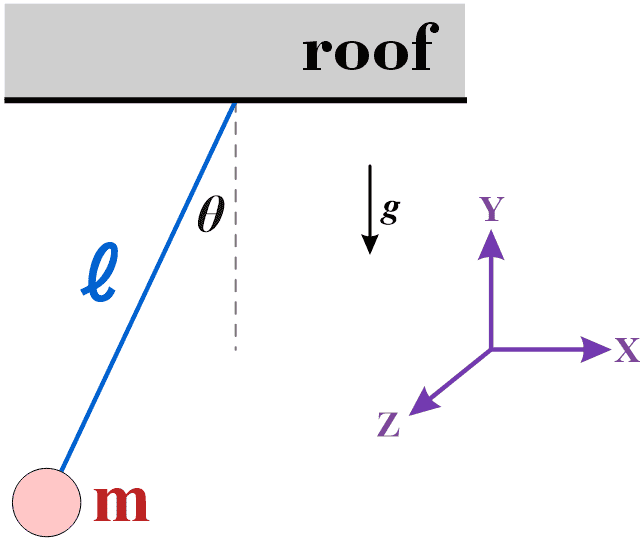
What is the maximum impulse in the Z-axis direction so that the particle does not hit the roof?
________________________________________________________________________
---------------------------------------------------------------------------
What I already know (CMIIW):
1. Throughout its motion, the energy of the particle is conserved:
$$E_{i} = E_{r}$$
$$PE_{i} + KE_{i} = PE_{r} + KE_{r}$$
$$-m.g. \ell . \cos \theta + \frac{1}{2} . m . v_{i}^2 = 0 + \frac{1}{2} . m . v_{r}^2$$
$$v_{i}^2 = 2g. \ell . \cos \theta + v_{r}^2$$
2. The condition for a particle not to hit the roof is that its final velocity vector (when on the roof) is in the XZ-plane ##\rightarrow \left( v_r \right) _y = 0##
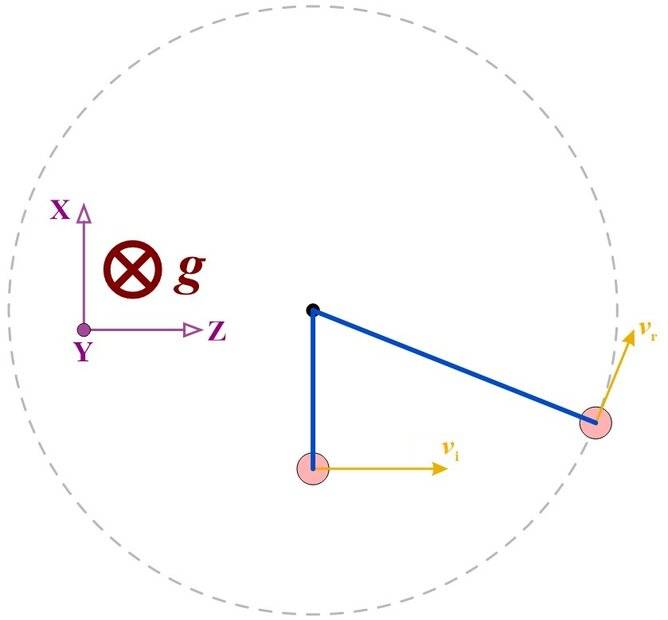
3. Angular momentum is NOT CONSERVED, because the weight creates torque (as well as linear momentum).
There are 2 unknown variables : ##v_i## and ##v_r##, while the only equation I have is energy conservation. What am I missing?
A particle of mass ##m## is suspended from a string of length ##\ell##. The string is then deflected at an angle ## \theta ##, where the particle and string are in the XY-plane.
What is the maximum impulse in the Z-axis direction so that the particle does not hit the roof?
________________________________________________________________________
---------------------------------------------------------------------------
What I already know (CMIIW):
1. Throughout its motion, the energy of the particle is conserved:
$$E_{i} = E_{r}$$
$$PE_{i} + KE_{i} = PE_{r} + KE_{r}$$
$$-m.g. \ell . \cos \theta + \frac{1}{2} . m . v_{i}^2 = 0 + \frac{1}{2} . m . v_{r}^2$$
$$v_{i}^2 = 2g. \ell . \cos \theta + v_{r}^2$$
2. The condition for a particle not to hit the roof is that its final velocity vector (when on the roof) is in the XZ-plane ##\rightarrow \left( v_r \right) _y = 0##
3. Angular momentum is NOT CONSERVED, because the weight creates torque (as well as linear momentum).
There are 2 unknown variables : ##v_i## and ##v_r##, while the only equation I have is energy conservation. What am I missing?