Maximizing rocket velocity - shoot fuel at once, or slowly?

Click For Summary

Discussion Overview

The discussion centers on the comparison of two rocket propulsion methods: one where all fuel is expelled at once and another where fuel is expelled in two separate bursts. Participants explore the implications of these methods on the final velocity of the rockets, considering factors such as momentum conservation and the relative speed of expelled fuel. The scope includes theoretical analysis and conceptual reasoning related to rocket dynamics.

Discussion Character

  • Exploratory
  • Technical explanation
  • Debate/contested
  • Mathematical reasoning

Main Points Raised

  • One participant questions the author's claim that the rocket expelling all fuel at once (Rocket A) will achieve a higher final velocity than the one expelling fuel in two bursts (Rocket B), suggesting that the velocity of the fuel should be considered relative to the rocket's velocity after fuel expulsion.
  • Another participant argues that the final velocity of the rocket is proportional to the average final velocity of the fuel, asserting that Rocket A must be faster since all fuel is expelled at the same speed.
  • A different perspective emphasizes the importance of momentum conservation, suggesting that the momentum gained from the first mass expelled in Rocket B is partially "wasted" in accelerating the second mass.
  • Some participants discuss the implications of the fuel speed being relative to the rocket's velocity before ejection, leading to confusion about whether it should be considered relative to the velocity after ejection.
  • A thought experiment involving a gun's muzzle velocity is presented to illustrate the effects of recoil on the perceived speed of expelled mass, drawing parallels to the rocket scenario.
  • One participant mentions that both burn profiles should yield the same total change of speed if the rocket equation is valid, but introduces the concept of the Oberth effect, which could favor Rocket A under certain conditions.

Areas of Agreement / Disagreement

Participants express differing views on the mechanics of fuel expulsion and its impact on rocket velocity, indicating that multiple competing perspectives remain unresolved. There is no consensus on which rocket configuration yields a higher final velocity.

Contextual Notes

Some assumptions about the relative speeds of the fuel and the rockets are debated, particularly regarding the timing of fuel expulsion and its impact on momentum. The discussion also touches on the influence of external factors like gravity and the Oberth effect, which complicate the analysis.

gumby
Messages
3
Reaction score
0
I stumbled upon a 3-year old article from Wired that poses this question on rockets:

Suppose I have two rockets with a mass M and fuel mass m. Rocket A shoots all the fuel at once (again, like a nuclear propulsion engine) with a fuel speed of u and rocket B shoots two blobs of fuel—first a shot of m/2 and another one of m/2. Both start from rest. Which rocket has the higher final velocity?

Assumptions:
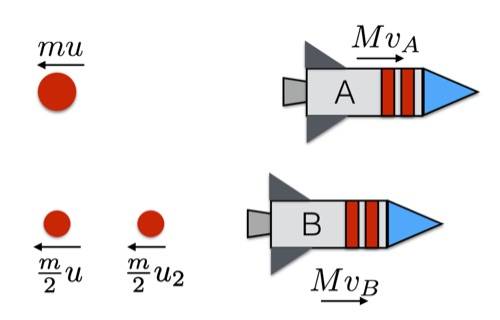
  • When fuel is expelled from a rocket, it leaves with a constant velocity that is relative to the rocket. I will call this the exhaust velocity and use the symbol u.
  • Momentum is conserved when stuff is shot out the back of the rocket (I already said this).
  • As fuel is consumed, the total mass of the rocket decreases. In fact, it might be easier to separate the mass into two parts: the mass of the fuel (mf) and the mass of the payload (M). Here, “payload” mass includes everything that is not fuel (rocket parts, humans, robots, computers, iPhones).
sketches_spring_2015_key1.jpg

link to full article: https://www.wired.com/2015/10/whatd-make-better-rocket-nuclear-ion-engines/

The author claims that rocket A will have the higher velocity, but if I actually write out all the momenta, it seems to me that rocket B should be faster. I believe the author's error is that the velocity of the fuel shot from rocket A should be v_A - u not u, since u is the fuel speed relative to the rocket. Am I correct in thinking that the author is mistaken, or am I missing something?

Thanks!
 

Attachments

  • sketches_spring_2015_key1.jpg
    sketches_spring_2015_key1.jpg
    11.1 KB · Views: 703
Physics news on Phys.org
The final velocity of the rocket will be proportional to the average final velocity of the fuel.
In both cases, half the fuel will be traveling at u.
In case A, the other half will also be traveling at u, but for B, it will be traveling slower (assuming it was also discharged at a velocity u relative to the spacecraft ).
So A has to be faster.
 
Calculate the total momentum of the left-moving mass. By momentum conservation, that will be the final momentum of the right-moving rocket. Which is greater? It will be more clear what is going on if you imagine the first case as the simultaneous expulsion of ##m_1## and ##m_2##; both end up moving to the left at speed ##u## in the first case. But in the second case, how does the speed of ##m_2## compare with the speed of ##m_1##?

At a more handwaving level... in the second case, some of the momentum gained from expelling the first mass is "wasted" accelerating the second mass to the right.
 
gumby said:
Hold on. The fuel speed is u relative to the rocket.
Yes, but it is relative to the speed of the rocket at the instant before the fuel is ejected, not the instant after.

Otherwise ##u## wouldn't be a constant, it would depend on the mass of the rocket plus the remaining fuel onboard.
 
I guess that's the point of my confusion then: why is u relative to the rocket's velocity before the fuel is ejected? It's been quite some time since I studied physics, so I very well could be wrong, but my intuition tells me it should be relative to the velocity after the fuel is ejected. My reasoning is this:

Suppose there is some amount of energy E stored in the rocket that will be completely converted into kinetic energy after ignition. Then we have E = \frac{1}{2} mv_{fuel}^2 + \frac{1}{2} Mv_{rocket}^2 (velocities relative to a stationary observer). If the rocket is massive enough such that the rocket's final velocity is essentially 0, then we will in fact have v_{fuel}=-u. However if the rocket is light enough such that the rocket achieves non-negligible velocity, then the speed of the fuel will be less than u, so u cannot be the speed relative to the initial rocket speed.

Or as a thought experiment, suppose I have a gun with a muzzle velocity of 1,000 m/s. If fire the gun while it's firmly attached to the ground (no recoil), the bullet's velocity will be 1,000 m/s relative to both the ground and the barrel. However if I fire the gun while standing on ice such that the recoil moves me backwards, I believe bullet's velocity should be 1,000 m/s relative to the barrel, and less than 1,000 m/s relative to the ice.

Does this make sense?
 
https://www.google.com/search?&q=lunar+lander+game+code

Finds over 200 000 hits. That program goes back over 40 years. If I recall correctly, the error checking in the DEC minicomputer version was incomplete. If you were low on fuel you could enter a short time, high, negative acceleration and "gain" fuel in your tanks. You could then proceed with the usual slower acceleration to a successful landing. That may have been a quirk in the program, but it seems to support that your B rocket would be faster. Then again, our current space program uses the A approach. Oh well. It was a fun game at the time.

Cheers,
Tom
 
gumby said:
Or as a thought experiment, suppose I have a gun with a muzzle velocity of 1,000 m/s. If fire the gun while it's firmly attached to the ground (no recoil), the bullet's velocity will be 1,000 m/s relative to both the ground and the barrel. However if I fire the gun while standing on ice such that the recoil moves me backwards, I believe bullet's velocity should be 1,000 m/s relative to the barrel, and less than 1,000 m/s relative to the ice.
That is a reasonable simplifying assumption. It amounts to assuming that the kinetic energy provided by the cartridge is identical in either case.

If one makes this assumption then it is clear that firing two notional bullets using one notional double-charge of powder is more efficient than firing two notional bullets in sequence one after the other. In either case, one has two bullets flying away and carrying momentum determined by their combined mass and the motion of their combined center of mass. But in the one case those two bullets are also carrying excess kinetic energy due to their relative motion. This leaves a tiny bit less kinetic energy available for the recoil of the gun.
 
Last edited:
As long as the rocket equation [1] is a valid model for the situation both burn profiles should yield the same total change of speed (delta-V). This can both be seen from the rocket equation or from conservation of momentum.

However, if the rocket is in a gravity field then the Oberth effect [2] comes into play. Here most of the delta-V from an impulsive burn will go into changing the rockets orbital energy if the maneuver is performed at periapsis. In this case your situation A will give more orbital energy than B if the second burn in B is done away from periapsis.

[1] https://en.wikipedia.org/wiki/Tsiolkovsky_rocket_equation
[2] https://en.wikipedia.org/wiki/Oberth_effect
 

Similar threads

  • · Replies 1 ·
Replies
1
Views
2K
  • · Replies 47 ·
2
Replies
47
Views
5K
  • · Replies 2 ·
Replies
2
Views
1K
  • · Replies 2 ·
Replies
2
Views
1K
  • · Replies 14 ·
Replies
14
Views
3K
  • · Replies 4 ·
Replies
4
Views
5K
  • · Replies 25 ·
Replies
25
Views
4K
  • · Replies 5 ·
Replies
5
Views
2K
  • · Replies 1 ·
Replies
1
Views
3K
  • · Replies 7 ·
Replies
7
Views
6K