Maximum height after a collision (general solution)

Click For Summary

Homework Help Overview

The problem involves a block of wood released from a height and a pellet that collides with it after the block has fallen a certain distance. The goal is to determine the maximum height reached after the collision, considering the effects of gravity and the inelastic nature of the collision.

Discussion Character

  • Exploratory, Assumption checking, Mathematical reasoning

Approaches and Questions Raised

  • Participants discuss the method of calculating the velocities before and after the collision, with some questioning the sign conventions used for gravity and velocity. There are mentions of potential sign errors in the equations and the treatment of momentum.

Discussion Status

Participants are actively engaging with the problem, offering insights into the algebraic complexities and sign conventions. Some have suggested reconsidering the direction of velocity vectors and the treatment of gravitational acceleration. There is no explicit consensus, but guidance has been provided regarding potential errors in the original approach.

Contextual Notes

Participants note the importance of consistent sign conventions for gravity and velocity, with discussions around whether to treat gravitational acceleration as negative or positive depending on the chosen direction. There is also mention of the implications of these choices on the final expressions used in the calculations.

qwertymeister42
Messages
5
Reaction score
1
Here's the situation:
A small block of wood of inertia mb is released from rest a distance h above the ground, directly above your head. You decide to shoot it with your pellet gun, which fires a pellet of inertia mp. After the block has fallen a distance d, the pellet hits it and becomes embedded in it, kicking it upward. At the instant of impact, the pellet is moving at speed vp.

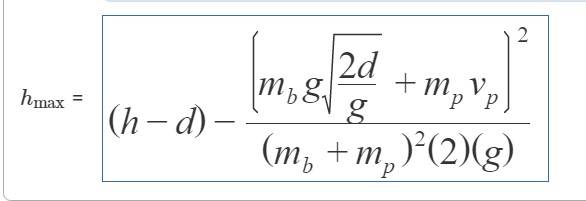
I'm supposed to find the maximum height formula, and this is what I got but it's incorrect:
http://imgur.com/gallery/QQoFRm7
QQoFRm7.jpg


*Relevant equations* :
x = vt + 1/2at^2
v = at
p = mv
vf^2=vi^2+2ad

Can someone help me on this? What I did was 1) found the velocity of the block after falling distance d, 2) found the velocity of the block + pellet after collision by viewing it as a completely inelastic collision, 3) plugged it into the vf^2 = vi^2+2ad, 4) added (h-d). Does anyone see where I'm going wrong? I have 2 more tries until I don't get any credit for it. I know this is a long problem so much thanks if anyone can point me in the right direction.
 
Last edited by a moderator:
Physics news on Phys.org
Right approach, but consider the directions of the velocity vectors before impact.
 
  • Like
Likes   Reactions: qwertymeister42
The algebra gets kind of tricky in this problem, but it looks like your method is good. I'm not sure why that large term in your equation is negative, but I haven't tried to work through all of your sign definitions. But I think that term should be positive. Also, in the denominator of that large term, inside the parentheses is the sum of the momentums of the pellet and the block just before impact. I would expect that one of those terms would be negative since the velocity of the pellet is upward and the velocity of the block is downward. This next thing is probably just my own preference, but also in that large term, I don't know why you have a 'g' in the denominator inside the radical and a 'g' in the numerator outside the radical. It seems simpler to me to just have a 'g' in the numerator inside the radical. Okay, maybe I'm being too picky about that one. :)
 
  • Like
Likes   Reactions: qwertymeister42
I think it might be a sign error related to g but I'm not sure. When you have g in an equation is it supposed to just be the magnitude? I viewed g as -9.8, which is why I subtracted the second term from (h-d) iirc (it's 5:30 AM right now and I haven't had the chance to really look it over in depth again)

And additionally w/the direction of the velocities, I've been doing something similar and "adding a negative". Is this wrong to do that?
 
Last edited:
I think you are right that the problem with your solution not being correct is related to gravity being a negative. But I'm not sure what is the best way to deal with that. Some of the more seasoned guys on here may know of a prescribed method to deal with that, but I don't. I think it might work if you define the up direction as negative, and the down direction as positive. That way your g will be a positive value. But the catch there is that, in the final step, when you use one of the kinematic equations to solve for x (the total distance that the block and pellet move together), the resulting expression will be positive in the down direction. So the increase in height of the block and pellet combination would then be the negative of that expression. . . . I think. :)
 
qwertymeister42 said:
When you have g in an equation is it supposed to just be the magnitude
Your choice, as long as you are consistent.
My view is that if you have adopted the sign convention that up is positive then the symbol g has a negative value, and change in velocity after time t is gt, not -gt. But almost everybody takes g to have a positive value and writes the change in velocity as -gt.
With regard to your algebra in this question, you have g inside a square root sign, so presumably you are giving it a positive value. So what is the correct sign on the momentum of the block of wood, ##m_b\sqrt{2gd}##, just before impact?
 
  • Like
Likes   Reactions: qwertymeister42
haruspex said:
Your choice, as long as you are consistent.
My view is that if you have adopted the sign convention that up is positive then the symbol g has a negative value, and change in velocity after time t is gt, not -gt. But almost everybody takes g to have a positive value and writes the change in velocity as -gt.
With regard to your algebra in this question, you have g inside a square root sign, so presumably you are giving it a positive value. So what is the correct sign on the momentum of the block of wood, ##m_b\sqrt{2gd}##, just before impact?

Ah I think I see where I went wrong, thank you! It should be -mb√2gd.
 
qwertymeister42 said:
Ah I think I see where I went wrong, thank you! It should be -mb√2gd.
Yes.
 
  • Like
Likes   Reactions: qwertymeister42
Just wanted to post an update, I got the right answer: it was (h-d) + (-mb√2gd... thanks for the help everyone! Pesky sign errors...
 
  • Like
Likes   Reactions: TomHart

Similar threads

  • · Replies 2 ·
Replies
2
Views
5K
  • · Replies 15 ·
Replies
15
Views
5K
  • · Replies 4 ·
Replies
4
Views
1K
  • · Replies 7 ·
Replies
7
Views
5K
  • · Replies 4 ·
Replies
4
Views
3K
Replies
335
Views
17K
Replies
3
Views
2K
  • · Replies 2 ·
Replies
2
Views
3K
Replies
1
Views
2K
  • · Replies 7 ·
Replies
7
Views
3K