Maximum impact parameter given effective potential

4 replies · 2K views · last reply
stephen8686
Messages
42
Reaction score
5
This problem is from David Morin's classical mechanics textbook:
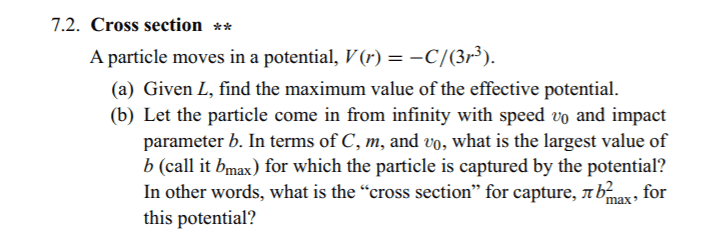
Printed textbook problem 7.2 'Cross section' about a particle in the potential V(r) = -C/(3r^3), with parts (a) maximum effective potential given L and (b) the maximum impact parameter b_max for capture.

I am having trouble with Part b. Here is the textbook's answer:
Textbook page showing an effective potential curve V_eff(r) against r with a dashed energy level E and a maximum V_eff^max marked, plus equations 7.57 to 7.60 for capture cross section.


I do not understand why large particle energies lead to capture. I would think that smaller energies would lead to capture because the particle wouldn't have enough energy to escape the gravitational potential, whereas large energy particles could woosh past. If someone could explain why my intuition is wrong, that would be very helpful.
 
PeroK said:
How do you make out that larger energies lead to capture?
That's what the answer says, "The condition for capture is therefore ##V_{eff}^{max}\leq E## " That is the part of the answer that I don't understand
 
stephen8686 said:
That's what the answer says, "The condition for capture is therefore ##V_{eff}^{max}\leq E## " That is the part of the answer that I don't understand
That condition resolves into a smaller impact parameter and smaller cross section for capture for greater energy.
 
stephen8686 said:
That's what the answer says, "The condition for capture is therefore ##V_{eff}^{max}\leq E## " That is the part of the answer that I don't understand
That equation in itself is about the relationship between angular momentum and energy. But, angular momentum increases with energy if other factors are held constant, so it doesn't say what you are thinking it says.