Maximum Induced Voltage of an AC Generator

Click For Summary
SUMMARY

The maximum induced voltage of an AC generator occurs when the loop is parallel to the magnetic field, regardless of its initial orientation. This conclusion is derived from the relationship between the induced electromotive force (EMF) and the angle of the loop with respect to the magnetic field, expressed mathematically as $$\mathcal{E}=-\frac{d\Phi}{dt}=-\omega A_0\cos\theta(t)$$. The maximum voltage is reached when the angle $$\theta(t)$$ equals multiples of $$k\pi$$, confirming that the induced EMF is maximized when the loop is aligned with the magnetic field. The initial angle does not affect this outcome.

PREREQUISITES
  • Understanding of AC generator principles
  • Familiarity with electromagnetic induction
  • Knowledge of trigonometric functions, particularly sine and cosine
  • Basic calculus, specifically differentiation
NEXT STEPS
  • Study the mathematical derivation of induced EMF in AC circuits
  • Learn about the role of magnetic flux in electromagnetic induction
  • Explore the implications of varying loop orientations on induced voltage
  • Investigate the applications of AC generators in real-world scenarios
USEFUL FOR

Students of physics, electrical engineers, and anyone interested in understanding the principles of electromagnetic induction and AC generator functionality.

LePainguin
Messages
1
Reaction score
1
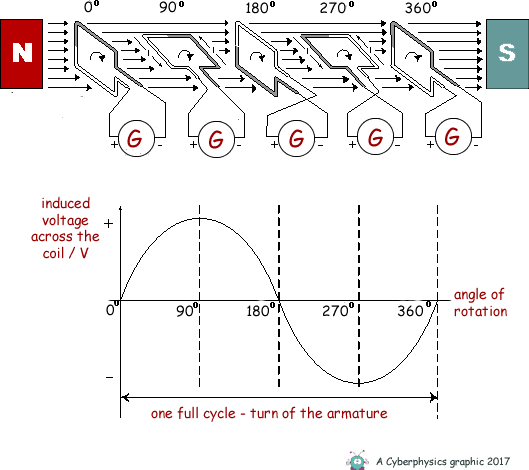
I would like to ask a question about the induced voltage of an AC generator. So, according to a graph I found on Google, the maximum induced voltage is reached when the loop is parallel to the loop. (The graph shown below.)
generatorgraph.png

Then I was wondering, what if the loop is initially (when it is at 0 degrees) parallel to the magnetic field instead of it being perpendicular like in the graph. Would it reach the maximum induced voltage when the loop is perpendicular now, or would it still be when it's parallel?
 
  • Like
Likes   Reactions: Delta2
Physics news on Phys.org
LePainguin said:
Then I was wondering, what if the loop is initially (when it is at 0 degrees) parallel to the magnetic field instead of it being perpendicular like in the graph. Would it reach the maximum induced voltage when the loop is perpendicular now, or would it still be when it's parallel?

Why would it? All you're doing is a relabelling of coordinates ##\theta'= \theta -\pi/2##, and you still should expect the same physical results - that the greatest induced EMF occurs when the loop is horizontal.
 
  • Like
Likes   Reactions: LePainguin
This is due to a property of the ##\sin (\omega t+\phi)## function regarding its first and second derivative.

Indeed the flux through the loop is $$\Phi=A_0\sin\theta(t)$$ where ##\theta(t)=\omega t +\phi## the angle the loop makes with the field at time t.
The induced voltage is then $$\mathcal{E}=-\frac{d\Phi}{dt}=-\omega A_0\cos\theta(t)$$
The maximum or minimum of the voltage is when $$\frac{d\mathcal{E}}{dt}=0\Rightarrow\omega^2 A_0 \sin\theta(t)=0\Rightarrow \theta(t)=k\pi, k=0,1,2,...$$

So the maximum or minimum is when the angle the loop makes with the field is ##k\pi## which in other words means when the loop is parallel with the field. And this result is independent of the initial angle ##\phi=\theta(0)## that the loop makes with the field at t=0.

PS: My angle ##\theta(t)## is defined as the angle the tangential to the loop makes with the field lines. Your schematic seems to define the angle ##\theta'(t)## as the angle of the normal to the loop makes with the field lines. Hence the two angles relate by the equation $$\theta'(t)=\theta(t)+\frac{\pi}{2}$$.
 
Last edited:

Similar threads

  • · Replies 4 ·
Replies
4
Views
2K
  • · Replies 13 ·
Replies
13
Views
3K
  • · Replies 16 ·
Replies
16
Views
4K
  • · Replies 2 ·
Replies
2
Views
3K
  • · Replies 3 ·
Replies
3
Views
2K
  • · Replies 6 ·
Replies
6
Views
2K
  • · Replies 7 ·
Replies
7
Views
2K
  • · Replies 2 ·
Replies
2
Views
2K
  • · Replies 3 ·
Replies
3
Views
1K
  • · Replies 2 ·
Replies
2
Views
2K