Maxwell Kinetic Energy Distribution

Click For Summary

Discussion Overview

The discussion revolves around calculating the kinetic energy distribution of nitrogen molecules using the Maxwell Kinetic Energy Distribution (M.K.E.D). Participants explore the relationship between kinetic energy, temperature, and the distribution of molecular speeds, while seeking clarification on integration techniques and the interpretation of various formulas.

Discussion Character

  • Exploratory
  • Technical explanation
  • Mathematical reasoning
  • Debate/contested

Main Points Raised

  • One participant expresses uncertainty about starting the calculation of kinetic energy distribution and questions the interpretation of the kinetic energy formula.
  • Another participant clarifies that K represents the kinetic energy of a molecule and suggests using molar kinetic energy or total kinetic energy depending on the context.
  • A participant inquires about calculating the kinetic energy of a molecule within a specific range, K to K+dK.
  • There is a distinction made between using K = 1/2*mv² and the mean kinetic energy formula 3/2kBT, with some arguing that K is simply a value rather than a function of gas properties.
  • Multiple participants discuss the probability distribution function g(K) and its relation to the average kinetic energy of gas molecules at temperature T.
  • One participant emphasizes the need for clarity on the specific problem being solved, suggesting that the integration of g(K) may be the goal.
  • Another participant points out that the distribution of speeds differs from the distribution of energies and mentions the gamma distribution form of g(K).
  • There are discussions about the limits of integration for calculating fractions of molecules with kinetic energy between two values, K1 and K2.
  • Some participants suggest using Excel or other tools for numerical integration, while others seek a solution without calculators, referencing the gamma function and error function.
  • One participant provides a detailed mathematical formulation involving the Maxwell distribution and suggests checking the anti-derivative for accuracy.

Areas of Agreement / Disagreement

Participants do not reach a consensus on the specific problem being solved, with some focusing on integration techniques while others emphasize the interpretation of kinetic energy values. The discussion remains unresolved regarding the best approach to calculate the desired fractions of molecules.

Contextual Notes

There are limitations regarding the clarity of the problem being addressed, as well as the dependence on definitions and the need for numerical values in integration. The discussion also highlights the complexity of transitioning between different forms of energy distribution.
TeslaPow
Messages
40
Reaction score
1
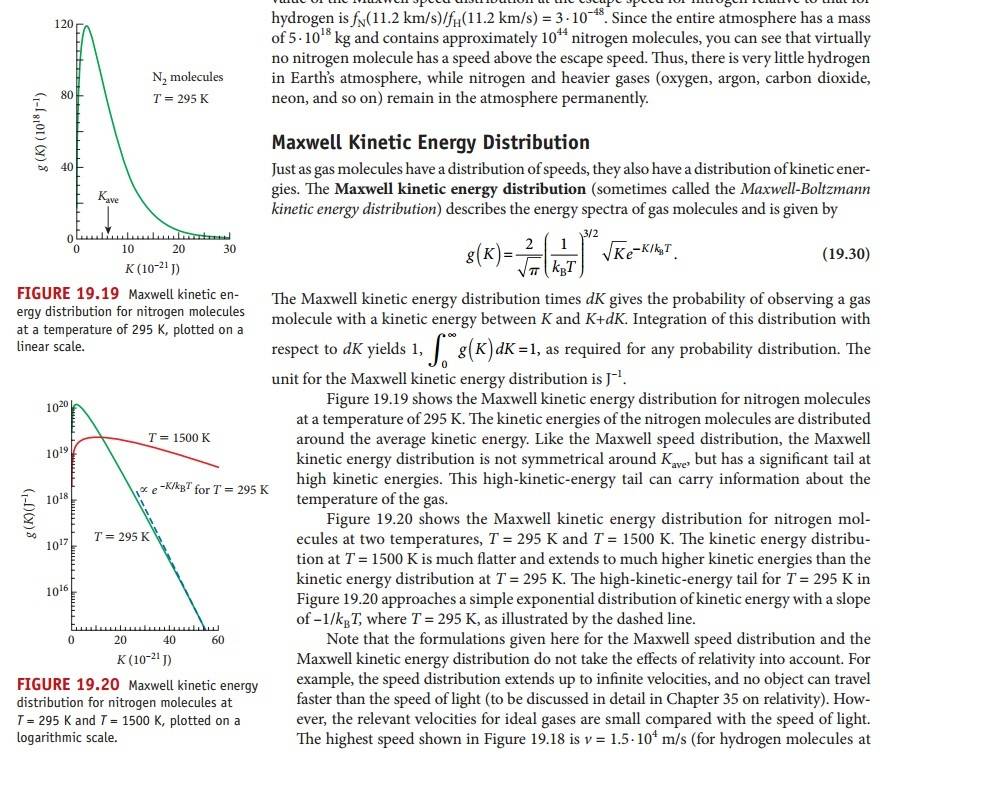
I want to calculate the kinetic energy distribution amongst let's say nitrogen molecules by using M.K.E.D, but not sure where to start.
I posted a picturefrom my physics book where the formula is shown, there was no example in the book.

maxwell_kinetic_energy_distribution.jpg


As for g(K), is K the same as the kinetic energy formula Ktot = N[1/2m(v`^2)] = 3/2NKbT or 3/2KbT ?
 
Physics news on Phys.org
K there is the kinetic energy of a molecule, as you can tell by the scale of 10-21 J. You can use the molar kinetic energy if you replace kB in the formula by R = NAkB. Or total kinetic energy if you replace kB with nR.
 
So how do I proceed from here on how to calculate the kinect energy of a molecule between K and K+dK ?
 
K = 1/2*mv2. You can't use 3/2kBT because that's the mean kinetic energy of all the molecules in the sample.
 
The probability to find a molecule with kinetic energy between ##K## and ##K+\mathrm{d} K## is ##g(K) \mathrm{d} K##. So what's the average kinetic energy of a molecule when you have a gas with temperature ##T##?
 
vanhees71 said:
The probability to find a molecule with kinetic energy between ##K## and ##K+\mathrm{d} K## is ##g(K) \mathrm{d} K##. So what's the average kinetic energy of a molecule when you have a gas with temperature ##T##?
Exactly, but there's a derivation that needs to be done, and from previous experience the solution to this can be looked up at an integration table. Don't know what the solution is.
 
Solution to what? It's not clear what you're after. You first asked about calculating the kinetic energy distribution. You have it, it's g(K). Then you ask how to calculate the ke of a molecule between K and K+dK. It's K. You don't calculate it, it's just a value of ke. There is a distribution of ke values in any gas sample. K isn't a function of the properties of the gas or conditions. g(K) is. K is just a variable.
 
mjc123 said:
Solution to what? It's not clear what you're after. You first asked about calculating the kinetic energy distribution. You have it, it's g(K). Then you ask how to calculate the ke of a molecule between K and K+dK. It's K. You don't calculate it, it's just a value of ke. There is a distribution of ke values in any gas sample. K isn't a function of the properties of the gas or conditions. g(K) is. K is just a variable.

Here's an earlier thread I posted from the distribution of speeds,

https://www.physicsforums.com/threads/maxwell-boltzmann-distribution.757539/post-4772356

Is the procedure similar? Thanks for the engagement
 
STATE VERY SPECIFICALLY WHAT PROBLEM YOU'RE TRYING TO SOLVE. You've been asked to do that and haven't.

The thread you refer to suggests you're looking for how to integrate g(K). But read your earlier posts, that's not what you've asked for. You asked for the kinetic energy of a molecule between K and K+dK. That's just K. Did you mean you wanted the fraction of molecules with kinetic energy between K and K+dK? That's just g(K)dK. Do you want to find the fraction of molecules between two values K1 and K2? Integrate g(K)dK from K1 to K2.

Note that as KE = 1/2 mv2, the distribution of speeds is different from the distribution of energies. You used an error function before, but not here. g(K) has the form of a gamma distribution. The general form of a gamma distribution is
f(x; α,β) = xα-1α*ex/β/Γ(α)
Here α = 3/2 and β = kT
 
  • #10
Thanks for your advice and patience, I want to find the fraction of molecules between two values:

maxwell_kinetic.jpg

So I just fill in the missing parameters in equation 8-14, by using E = 1/2*m*v^2 ?
What are the values of K1 (E1) and K2 (E2) in the definite integral?
 
  • #11
There are no missing parameters in equation 8-14.
The values of E1 and E2 in the definite integral are 0 and ∞. You are also given the answer. Are you saying you want to integrate between two limits not equal to 0 and ∞?
This, however, gives you the average KE over that range. But you said you want to find the fraction of molecules between two values. For that you need to integrate equation 8-13 between E1 and E2 (and divide by N).
 
  • #12
mjc123 said:
There are no missing parameters in equation 8-14.
The values of E1 and E2 in the definite integral are 0 and ∞. You are also given the answer. Are you saying you want to integrate between two limits not equal to 0 and ∞?
This, however, gives you the average KE over that range. But you said you want to find the fraction of molecules between two values. For that you need to integrate equation 8-13 between E1 and E2 (and divide by N).

So by looking at integral tables, integral-tables.com, which one is the right to use?
 
  • #13
I'm not familiar with that website, but you can do it e.g. in Excel, using the gamma.dist function. For example, if you want the fraction of molecules with KE between K1 and K2, you would use the formula
=gamma.dist(K2, alpha, beta, true) - gamma.dist(K1, alpha, beta, true)
where K1 and K2 are your limiting energy values, K2 > K1
alpha = 1.5
beta = the value of kBT
"true" is the value of the variable CUMULATIVE
 
  • #14
Alright, then I have an alternative to double check my answer. Thanks for your help.
 
  • #15
Is there somebody who can help me with the integration for the maxwell kinetic energy equation in 8-13 with the fraction of molecules with KE between K1 and K2?
 
  • #16
I have told you how to do it. What's your difficulty?

As your problem seems to be more mathematical (how to do an integration) than physical (understanding Maxwell's distribution), I suggest you post a question in the maths forum; you may get more appropriate help.
 
  • #17
TeslaPow said:
Is there somebody who can help me with the integration for the maxwell kinetic energy equation in 8-13 with the fraction of molecules with KE between K1 and K2?
There is no analytical formulation for usch a definite integral. @mjc123 has explained how to do it with Excel. You can also do it with, e.g., WolframAlpha. Note that you need numerical values for K1 and K2.
 
  • Like
Likes   Reactions: vanhees71
  • #19
There is an anti-derivative to the Maxwell distribution function, i.e. a cumulative distribution function, but it is expressed in terms of the error function, another integral. But technically logarithms are defined as integrals so that, at least, is a better format.

Using the kinetic energy form the differential probability density is:
d\rho = g(K)dK = \frac{2}{\sqrt{\pi}} E_T^{-3/2}K^{1/2}e^{-K/E_T} dK
where E_T = k_B T is the thermal energy factor.

Converting to unitless kinetic energy factor u= K/E_T gives:
d\rho = \frac{2}{\sqrt{\pi}} u^{1/2} e^{-u}du

Integrating once by parts and performing another substitution, u=t^2 on the remaining integral term will yield a Gaussian integral equivalent to the error function. So i.t.o. the error function you should get:
\rho - \rho_0 = \text{erf}(\sqrt{u}) - \frac{2}{\sqrt{\pi}}u^{1/2}e^{-u}

You should double-check my work by differentiating this (looking up erf) and verify it is the correct anti-derivative, and also checking my earlier substitutions.
 

Similar threads

  • · Replies 4 ·
Replies
4
Views
3K
  • · Replies 4 ·
Replies
4
Views
5K
  • · Replies 3 ·
Replies
3
Views
3K
  • · Replies 2 ·
Replies
2
Views
2K
  • · Replies 11 ·
Replies
11
Views
2K
  • · Replies 3 ·
Replies
3
Views
2K
  • · Replies 12 ·
Replies
12
Views
3K
  • · Replies 16 ·
Replies
16
Views
2K
  • · Replies 5 ·
Replies
5
Views
2K
  • · Replies 18 ·
Replies
18
Views
3K