Maxwell's calculations on electromagnetism's speed = light speed

Click For Summary
SUMMARY

This discussion centers on the mathematical derivation of the speed of light from Maxwell's equations, specifically through the relationship between the electric constant (ε0) and the magnetic constant (μ0). Participants clarify that the speed of light (c) can be calculated using the formula c = 1 / √(ε0 * μ0), which involves multiplying these constants rather than dividing them. The conversation also touches on the historical context of these constants and their values, highlighting differences in units used during Maxwell's time compared to modern SI units.

PREREQUISITES
  • Understanding of Maxwell's equations
  • Familiarity with the concepts of electric constant (ε0) and magnetic constant (μ0)
  • Basic algebra and calculus skills
  • Knowledge of SI units and their historical context
NEXT STEPS
  • Study the derivation of the wave equation from Maxwell's equations
  • Explore the historical development of electromagnetic theory
  • Learn about the significance of ε0 and μ0 in modern physics
  • Investigate the differences between SI units and other unit systems used in electromagnetism
USEFUL FOR

Students of physics, educators in electromagnetism, and anyone interested in the mathematical foundations of light speed and electromagnetic theory.

Bill McKay
Messages
5
Reaction score
1
I'm studying history of electromagnetism. Here is my question regarding Maxwell's classical brilliant work.
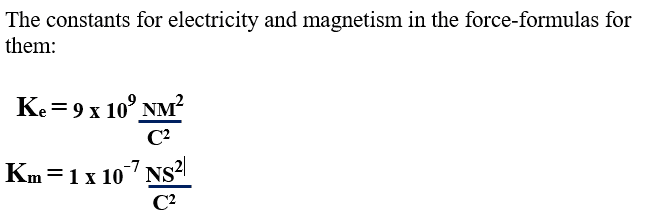
I understand these constants (for now)
upload_2019-3-19_17-42-0.png

And I understand this:

upload_2019-3-19_17-45-29.png


And I understand this:

upload_2019-3-19_17-46-47.png

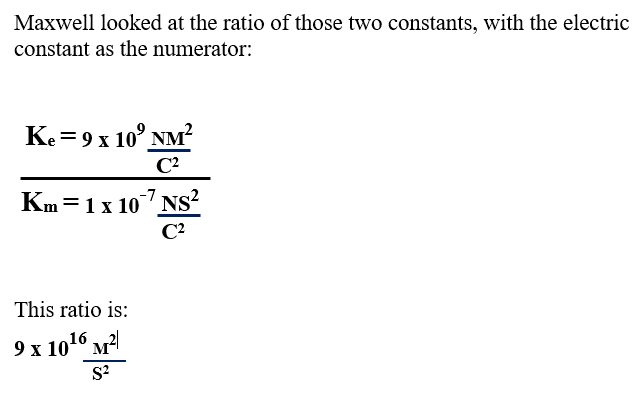
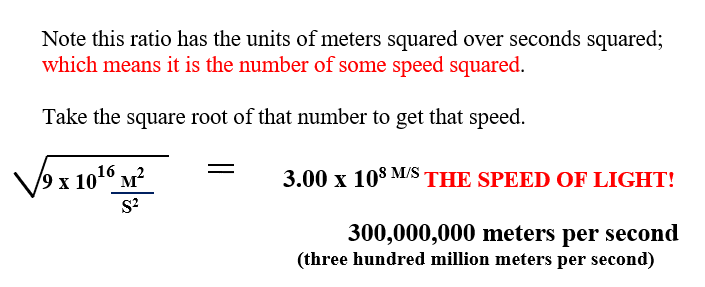
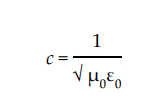
But I need to understand how this math below gets us to the speed of light. I don't understand the MATH. Just educate me on the math of this below and how the fraction below get me to 3 x 10 to the 8th. thanks.

upload_2019-3-19_17-50-38.png
 

Attachments

  • upload_2019-3-19_17-42-0.png
    upload_2019-3-19_17-42-0.png
    3.8 KB · Views: 1,359
  • upload_2019-3-19_17-45-29.png
    upload_2019-3-19_17-45-29.png
    5.3 KB · Views: 1,499
  • upload_2019-3-19_17-46-47.png
    upload_2019-3-19_17-46-47.png
    10.1 KB · Views: 1,377
  • upload_2019-3-19_17-50-38.png
    upload_2019-3-19_17-50-38.png
    817 bytes · Views: 922
  • upload_2019-3-19_17-50-43.png
    upload_2019-3-19_17-50-43.png
    817 bytes · Views: 481
Last edited:
Physics news on Phys.org
I don't understand your question. Did you look up the values of ε0 and μ0 and try calculating the result? If you did, it should come out right. Or is your question about the units?
 
The symbols for meter, second, and the speed of light are lower case.
 
Thanks -yes I need to clarify. Look at the way I arrived at the speed of light from simply dividing the two constants and taking the square root of that. I saw that somewhere on the web. Then look at the more classic formula at the very end. That may be Maxwell's derivation or someone else's method. But I'm told that that last equation on my question, also gets you to the speed of light. I do not understand how that fraction is manipulated mathematically to get 3 x 10 to the 8th power (speed of light in m/s).
 
You multiply ε0 by μ0, take the square root, and take one over that. That gives you the speed of light. I think I'm still missing your question.
 
mu symbol of course is the magnetic constant and epsilon is the electric constant. That I know. My problem is math. But one would have to be dividing them instead of multiplying them and I don't know how one does the math.
 
What does "take one over that" mean?
 
No. You don't divide them. You multiply them. It's not quite the same as your first example.
 
If I have a number like 2, and I take 1 over it, I get 1/2, which is 0.5.

It's what the\frac{1}{x} button on your calculator does.
 
Last edited:
  • Like
Likes   Reactions: marcusl
  • #10
  • #12
A.T. said:
You mean the calculation of the value? Use a calculator:
https://www.google.com/search?q=1/+sqrt(mu_0+*+epsilon_0)

I do use a calculator. That is not my question. That is how I did the first calculations I posted here. And of course got the speed of light when I DIVIDED one constant by the other; took the ratio of the two with the electric constant as the numerator. Then taking the square root of that (on my calculator) I got the speed of light. That method I saw in a video of Maxwell's life.

Let's start over again. My problem is that the equation I'm asking about is the one posted below. So note that the method does not divide (take a ratio) of the two constants but in fact multiplies them. So it is a different approach then what I first saw in the aforementioned video.

So the first thing I noticed was that and it confused me. I'm really not needing to understand how that was derived not now. I was just curious how the process had changed from division to multiplication of the two constants. So we can skip my question of how this equation was derived.


upload_2019-3-20_11-44-17.png

My main question now is that the constant values I obtained from the video confused me because, below those values are different, meaning we are talking about a different approach to the whole question. Can anyone explain why the values of the constants are different in my original post than those in the equation immediately above?

I'm sure I seem naive to most of you but thanks for trying to work with me on this. I'm reviewing algebra and starting into calculus also so I'm hoping to get more sopohisticated about this.
 

Attachments

  • upload_2019-3-20_11-44-17.png
    upload_2019-3-20_11-44-17.png
    4.3 KB · Views: 759
  • #13
We are here to help. But asking us to watch a 28 minute video to find out what you're talking about is beyond the effort that most of us are willing to go. Can you at least give us the minute and second in the video where they describe the equation? Understand that even that stretches our PF rules. Usually, we require peer reviewed published papers, or textbooks as references.
 
  • #14
One way to see the difference is to realize that the constants you called Ke and Km in your original post are related to ε0 and μ0 by:

Km = μ0 / (4π)
Ke = 1/(4 π ε0)

So \frac{K_e}{K_m} = \frac{1}{\epsilon_0 \mu_0} = c^2
 
  • Like
Likes   Reactions: Socius
  • #15
Bill McKay said:
Can anyone explain why the values of the constants are different in my original post than those in the equation immediately above?
The equation ##c = 1 / \sqrt {\varepsilon_0 \mu_0}## implies SI units (Système Internationale a.k.a. "meter-kilogram-second"), which were codified after Maxwell's time. Maxwell used different units for electromagnetic quantities.

Historically, physicists and engineers have used various sets of units for electromagnetic quantities. You can get an idea of the history and complexities here:

http://histoires-de-sciences.over-blog.fr/2013/11/electrical-units-history.html
https://en.wikipedia.org/wiki/Centimetre–gram–second_system_of_units
https://en.wikipedia.org/wiki/International_System_of_Units
 
  • #16
I don't know, whether the question has been answered. There are two questions in one, namely about the mathematics of how to derive this result (that's quite easy to answer with sufficient math) and the historical one. The latter is very interesting but involved. The point is that electromagnetic waves have not been discovered yet. They were a prediction of Maxwell's theory. What was known of course was the speed of light, but it was not known that light in fact is a electromagnetic wave (at a frequency/wavelength the receptors in our eyes are sensitive to).

Here's the math. We start from Maxwell's equation for free electromagnetic fields, i.e., for a space-time region were no charges and currents are present, using SI units (spoiling of course the beauty of Maxwell's original equations)
$$\vec{\nabla} \times \vec{E}+\partial_t \vec{B}=0, \quad \vec{\nabla} \cdot \vec{B}=0, \quad \vec{\nabla} \times \vec{B} -\mu_0 \epsilon_0 \partial_t \vec{E}=0, \quad \vec{\nabla} \cdot \vec{E}=0.$$
The trick is to get rid of ##\vec{B}## from the 1st equation (Faraday's Law of Induction) by taking its curl:
$$\vec{\nabla} \times (\vec{\nabla} \times \vec{E}) + \partial_t \vec{\nabla} \times \vec{B}=0.$$
Now the "double curl" simplifies with the last equation to
$$\vec{\nabla} \times (\vec{\nabla} \times \vec{E})=\vec{\nabla} (\vec{\nabla} \cdot \vec{E}) - \Delta \vec{E} = -\Delta \vec{E}$$
while according to the 3rd equation (the Ampere-Maxwell Law)
$$\partial_t \vec{\nabla} \times \vec{B}=\mu_0 \epsilon_0 \partial_t^2 \vec{E}.$$
This indeed gives a wave equation for the electric field components alone,
$$(\mu_0 \epsilon_0 \partial_t^2 - \Delta)\vec{E}=0.$$
The phase velocity of the waves, ##c##, thus obviously fulfills
$$\frac{1}{c^2} = \mu_0 \epsilon_0.$$
Now, ##\mu_0## and ##\epsilon_0## can be thought of being measured with help of static (sic!) sintuations, given the unit of electric charge and currents, and that's indeed how historically the numerical values were found. Of course, it was in terms of the more natural electrostatic and magnetostatic systems of units, but the principle is the same as within the SI units, and indeed what you find when plugging in the values of the permeability and permittivity of the vacuum (which are despite their fancy names just arbitrary conversion factors to define the SI unit of electric currents, Ampere), is that ##c## agrees very well with the measured speed of light in a vacuum, and that's why Maxwell came to the conclusion that light is just an example for these waves.

Historically the experiment by Weber and Kohlrausch was crucial for the prediction of em. waves:

https://www.ifi.unicamp.br/~assis/Weber-Kohlrausch(2003).pdfhttps://aapt.scitation.org/doi/10.1119/1.1934570
It took over 30 years to directly prove him right: In 1888 Heinrich Hertz was the first to produce and detect electromagnetic waves in the physics lecture hall at Karlsruhe university. He was allowed to do these experiments only in the semester breaks not to disturb the lectures during the semester ;-))).
 
  • Like
Likes   Reactions: PeroK

Similar threads

  • · Replies 65 ·
3
Replies
65
Views
6K
  • · Replies 4 ·
Replies
4
Views
6K
  • · Replies 2 ·
Replies
2
Views
2K
  • · Replies 10 ·
Replies
10
Views
3K
  • · Replies 3 ·
Replies
3
Views
4K
  • · Replies 32 ·
2
Replies
32
Views
2K
  • · Replies 3 ·
Replies
3
Views
3K
  • · Replies 12 ·
Replies
12
Views
3K
  • · Replies 51 ·
2
Replies
51
Views
4K
  • · Replies 1 ·
Replies
1
Views
971