Storm3371
- 1
- 0
I am reading the text 'Innovations in Maxwell's Electromagnetic Theory'. on page 44 there is a discussion on Ampere's circuital law .
The passage is below. I don't understand the final statement. "In general represent a kind of relationship that obtains between certain pairs of phenomena , of which one has a linear and the other a rotary character. if a,b,y is linear, then p q r is rotary, and if a b y is rotary then p q r is linear."
I sort of understand why p q r would be 'rotary' since these equations are essentially the curl. But I don't really get how you would get a linear vector out if a b y are rotary - or even what it means by them being rotary.
thanks for any clarification that you can offer!
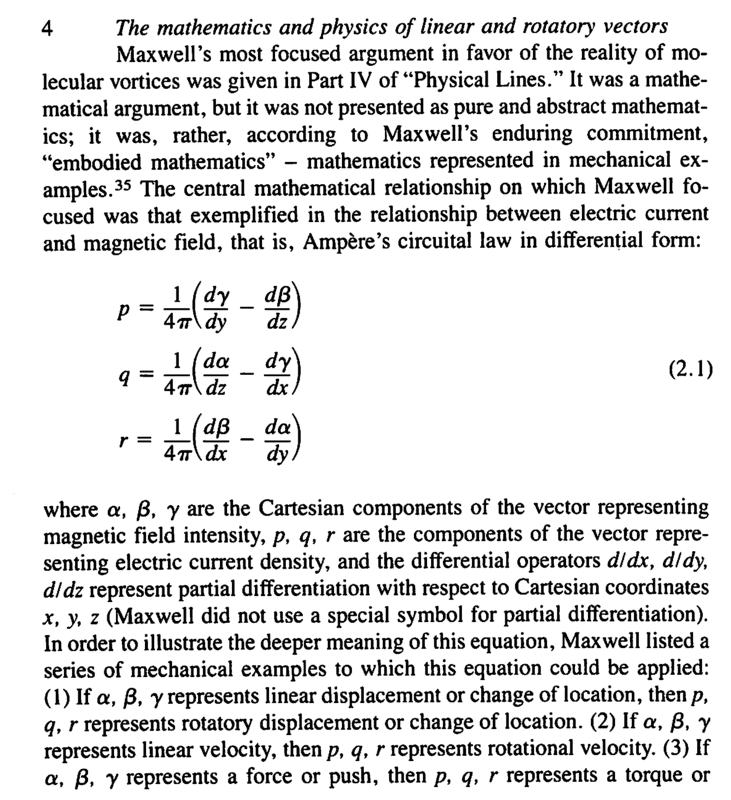
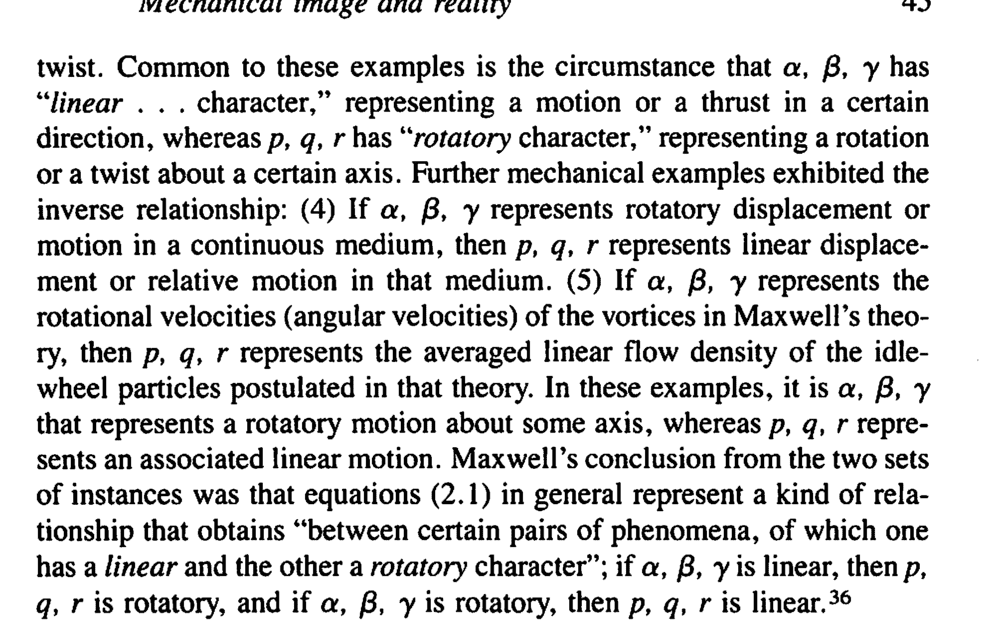
The passage is below. I don't understand the final statement. "In general represent a kind of relationship that obtains between certain pairs of phenomena , of which one has a linear and the other a rotary character. if a,b,y is linear, then p q r is rotary, and if a b y is rotary then p q r is linear."
I sort of understand why p q r would be 'rotary' since these equations are essentially the curl. But I don't really get how you would get a linear vector out if a b y are rotary - or even what it means by them being rotary.
thanks for any clarification that you can offer!