MCNP and simple nuclear physics

Click For Summary

Discussion Overview

The discussion revolves around neutron analysis in the context of converting a research reactor from highly enriched uranium (HEU) to low enriched uranium (LEU). Participants explore various steps taken to reduce uranium enrichment and the implications on reactor parameters such as K value and thermal flux. The conversation includes technical aspects of MCNP simulations and reactor physics.

Discussion Character

  • Technical explanation
  • Mathematical reasoning
  • Debate/contested

Main Points Raised

  • One participant describes attempts to reduce uranium enrichment by increasing uranium-238 and modifying the reactor's moderator area, noting changes in K value and thermal flux.
  • Questions are raised about the relationship between K value and thermal flux, with some participants suggesting they are proportional under certain conditions.
  • Concerns are expressed regarding the fixed density of uranium-235 in the input file and its implications for the overall fissionable material quantity.
  • Participants inquire about typical ranges for K value and thermal flux in research reactors, with some suggesting that a K value around 1.2 is common.
  • There is uncertainty about the significance of zero volume and mass in certain cells of the MCNP output, with suggestions that it may indicate a geometry error.
  • Discussion includes the nature of flux measurements in reactor papers and whether they pertain to specific operational conditions.
  • One participant shares their input file and seeks clarification on the geometry and definitions used in their MCNP model.
  • Another participant suggests visualizing the reactor's unit cell to better understand its configuration and geometry.

Areas of Agreement / Disagreement

Participants express varying opinions on the relationship between K value and thermal flux, the appropriateness of certain flux values for research reactors, and the implications of fixing certain parameters in the MCNP input file. The discussion remains unresolved with multiple competing views and uncertainties present.

Contextual Notes

There are limitations regarding assumptions made in the MCNP input file, particularly concerning the geometry definitions and the implications of fixed parameters. The discussion also highlights the need for clarity on the operational context of flux measurements.

Who May Find This Useful

This discussion may be useful for graduate students and researchers in nuclear engineering, particularly those interested in reactor design, neutron analysis, and MCNP simulations.

lee6853
Messages
7
Reaction score
2
Hi guys!
I'm a master's student majoring in nuclear engineering in graduate school.
I have a few questions while doing research, so I'm writing this here.

My research is simple. We conduct neutron analysis to convert a research reactor using highly enriched uranium into a low enriched uranium reactor.

I want to reduce the enrichment of the first 80% of highly enriched uranium fuel as much as possible.

Step 1 tries to lower the enrichment by increasing the amount of uranium 238 from the same amount of uranium 235. At this time, the moderator area was not used and the cladding was thinned to increase the volume of uranium fuel. It could be reduced by up to 19.9%, K value decreased from 1.2 to 1.14, and thermal FLUX decreased by 5%. It didn't have as much of an impact as I thought.

Step 2 tried to lower the concentration even further by reducing the moderator area. By reducing the moderator, the K value decreased by 1.04 and FLUX by 10% at 10% concentration.My questions here are:
1. Are K value and FLUX directly proportional to each other? I know it is proportional if there are no other factors, but I'm curious about the specific rationale.
2. My professor only considered uranium-238 as a variable and fixed the density and the amount of uranium-235. What's your opinion why he fixed density?

3. Is there a common K value range or FLUX range for a research reactor or a typical nuclear reactor? I heard that the K value should be around 1.2. My FLUX range is E+14. Does it make sense?

4. In STEP 1, the concentration decreased by about 60%, but the FLUX and K values did not decrease much. Does it seem normal? Or maybe my MCNP INPUT is wrong?

5. The reason K value and FLUX value decreased a lot in STEP2 seems to be because the moderator decreased. right?

6. In MCNP RESULT, some cells have zero volume and zero mass. Are there cases where this happens?

7. Lastly, if you look at the papers, you can check the vertical and horizontal FLUX of nuclear fuel graphically. What is this for?
 
Last edited:
Engineering news on Phys.org
If you can provide a copy of the input file, or if you can't share that a cut down copy of the input file you can share that would be helpful.

I'm a bit confused by FLUX - in a reactor at critical, flux is whatever you want it to be. 10^14 n/squarecm/second seems right for a power reactor. Might not be right for a research reactor. Are you doing BURN calculations or just KCODE?

I do not understand how in an input file you can fix the quantity of U-235 and density and vary U-238. I think I see why it was fixed - reduce the total quantity of fissionable material and K will drop really fast.

Zero volume cells might be the sign of a geometry error.

Wiser heads than mine might have more idea, this is beyond my level of MCNP. I'm a bit confused by the whole premise, if the reactor is going from HEU to LEU, wouldn't it need to be a lot bigger?
 
  • Like
Likes   Reactions: lee6853
Thanks Alex for reply.

Well, I attached my input file below.(It's original 80% HEU FA)
* cell number 3 area doesn't show volume and mass in outputfile... I don't think there is error but why they don't show me volume and mass?

1. I understood what you mean about FLUX. We can control FLUX by power. But what is the FLUX that people mentioned in their paper like "Total flux of this core is xxE+14"?. Only for the starting time? And I used only KCODE not BURN card.

2. Why you think 10^14 is not right for a research reactor?? Should it be more?

3. I calculated mass of U-238 which is needed to reduce enrichment from 80% to 19.9% by hand. And I know density so I could figure out volume then I made geometry. That how I fixed U-235 mass and reduced enrichment by increasing U-238. Of course total volume of fuel meat was increased but within original core size.
 
FUEL ASSEMBLY(80% enrichment)
c cell card =====================================================================
c 4-tube fuel assembly
1 2 -0.998207 -1 71 -72 imp:n=1 $ water
2 1 -2.6989 1 -2 71 -72 imp:n=1 $ guide tube
3 2 -0.998207 2 3 -4 5 -6 71 -72 imp:n=1 $ water
4 1 -2.6989 (-3:4:-5:6) 7 -8 9 -10 71 -72 imp:n=1 $ 1st tube
5 3 -3.8 (-7:8:-9:10) 11 -12 13 -14 71 -72 imp:n=1 $ 1st tube meat
6 1 -2.6989 (-11:12:-13:14) 15 -16 17 -18 71 -72 imp:n=1 $ 1st tube
7 2 -0.998207 (-15:16:-17:18) 19 -20 21 -22 71 -72 imp:n=1 $ water
8 1 -2.6989 (-19:20:-21:22) 23 -24 25 -26 71 -72 imp:n=1 $ 2nd tube
9 3 -3.8 (-23:24:-25:26) 27 -28 29 -30 71 -72 imp:n=1 $ 2nd tube meat
10 1 -2.6989 (-27:28:-29:30) 31 -32 33 -34 71 -72 imp:n=1 $ 2nd tube
11 2 -0.998207 (-31:32:-33:34) 35 -36 37 -38 71 -72 imp:n=1 $ water
12 1 -2.6989 (-35:36:-37:38) 39 -40 41 -42 71 -72 imp:n=1 $ 3rd tube
13 3 -3.8 (-39:40:-41:42) 43 -44 45 -46 71 -72 imp:n=1 $ 3rd tube meat
14 1 -2.6989 (-43:44:-45:46) 47 -48 49 -50 71 -72 imp:n=1 $ 3rd tube
15 2 -0.998207 (-47:48:-49:50) 51 -52 53 -54 71 -72 imp:n=1 $ water
16 1 -2.6989 (-51:52:-53:54) 55 -56 57 -58 71 -72 imp:n=1 $ 4th tube
17 3 -3.8 (-55:56:-57:58) 59 -60 61 -62 71 -72 imp:n=1 $ 4th tube meat
18 1 -2.6989 (-59:60:-61:62) 63 -64 65 -66 71 -72 imp:n=1 $ 4th tube
19 2 -0.998207 (-63:64:-65:66) 67 -68 69 -70 71 -72 imp:n=1
20 0 (-67:68:-69:70:-71:72) imp:n=0 $ void

c surface card ===================================================================
1 c/z 0 0 0.7 $ ------------- for 4tube -----------------
2 c/z 0 0 0.8
3 px -1.2
4 px 1.2
5 py -1.2
6 py 1.2
7 px -1.28
8 px 1.28
9 py -1.28
10 py 1.28
11 px -1.32
12 px 1.32
13 py -1.32
14 py 1.32
15 px -1.4
16 px 1.4
17 py -1.4
18 py 1.4
19 px -1.85
20 px 1.85
21 py -1.85
22 py 1.85
23 px -1.93
24 px 1.93
25 py -1.93
26 py 1.93
27 px -1.97
28 px 1.97
29 py -1.97
30 py 1.97
31 px -2.05
32 px 2.05
33 py -2.05
34 py 2.05
35 px -2.5
36 px 2.5
37 py -2.5
38 py 2.5
39 px -2.58
40 px 2.58
41 py -2.58
42 py 2.58
43 px -2.62
44 px 2.62
45 py -2.62
46 py 2.62
47 px -2.7
48 px 2.7
49 py -2.7
50 py 2.7
51 px -3.15
52 px 3.15
53 py -3.15
54 py 3.15
55 px -3.23
56 px 3.23
57 py -3.23
58 py 3.23
59 px -3.27
60 px 3.27
61 py -3.27
62 py 3.27
63 px -3.35
64 px 3.35
65 py -3.35
66 py 3.35
*67 px -3.575
*68 px 3.575
*69 py -3.575
*70 py 3.575
71 pz 0
72 pz 58

c data card ===================================================================
mode n
kcode 10000 1.0 100 600
ksrc -0.37 3.244 29 -0.37 2.5952 29 -0.37 1.2778 29
m1 13027 1 $ Al Density -2.6989 g/cc
m2 1001 0.666657 8016 0.333343 $ H20 Density -0.998207 g/cc
mt2 lwtr
m3 92235 -0.296
92238 -0.074 13027 -0.63 $ UAL Density -3.8 g/cc
m4 5010 0.8 5011 3.2 6000 1.0 $ B4C Density -2.52 g/cc
c 5010.80C -0.15513 5011.80C -0.62751 6000.80C -0.21739
m5 6000 0.000687 14000 0.009793 15031 0.000408
16000 0.000257 24000 0.201015 25055 0.010013
26000 0.684101 28000 0.093725 $ stainless steel Density -8 g/cc
m6 4009 1.000000 $ beryllium density 1.848g/cc
 
And should I use NPS? What is different? Make my result more precise?
 
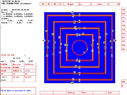
Sometimes it helps to visualise things. Instead of defining a lattice, it has a unit cell and reflecting boundaries. This is a perfectly valid problem, but the unit cell is described oddly and it differs from what is implied by the comments. So running mcnp with options ip, meaning process input file and plot, click for a default view, click in the 'click here' box and enter 'pz 3' for a cross section through the unit cell, and we see this...(attached picture)

Is that what the unit cell of the reactor is intended to be?

Cell 3 does have a volume, but because of the way it is defined as a box less a cylinder, mcnp is unable to figure it out automatically. If it were doing maths on that, for example using a tally, you'd have to work out the volume yourself and supply it to the input file. I don't know where you are getting changes in 'FLUX' from. The output file is suggesting your inactive kcode cycles are excessive, consider reducing to, say, 10. The k for this problem has been calculated at 1.52

Next time you paste a code try using code tags so formatting isn't stripped, or rename to a .txt and upload.
 

Attachments

  • HEU.png
    HEU.png
    24.2 KB · Views: 225
lee6853 said:
2. My professor only considered uranium-238 as a variable and fixed the density and the amount of uranium-235. What's your opinion why he fixed density?
In what form is the uranium fuel? U-metal has a given density, and so do various compounds. Some fuel may be metal, e.g.,. U-Mo, or U-Zr, and some fuel designs use U-Zr-H, where the moderator (H) is mixed into the fuel form. Otherwise, moderation will occur in the water surrounding the fuel elements.

Highly enriched U is usually dispersed in a matrix. Decreasing enrichment from 80% to <20%, would necessitate increasing the 238U.
 
  • Informative
Likes   Reactions: Alex A
Some details of the fuel are in the input file. It's Uranium-Aluminium, might be ignoring some elements for the sake of simplicity, but the mass fraction is 0.37 80%HEU and 0.63 Al. Total density is 3.8.

I'm at the state of absorbing a problem where I'm just confused about everything, and half of those things will turn out to be completely normal. If the 3.8 is staying fixed and the total quantity of U-235 is fixed then the dimensions need to change. Which feels weird.
 
Alex A said:
Some details of the fuel are in the input file. It's Uranium-Aluminium, might be ignoring some elements for the sake of simplicity, but the mass fraction is 0.37 80%HEU and 0.63 Al. Total density is 3.8.
Yes, I should have looked at the card/deck.
m3 92235 -0.296
92238 -0.074 13027 -0.63 $ UAL Density -3.8 g/cc

And U-Al is probably for sake of simplicity. Normally, there would be some alloying, but it is likely a dilute alloy, may be a 1000 or 6000 series alloys, and perhaps ≥99% Al. I'll ask some colleagues who are knowledgeable of dispersed U-Al systems.

Edit/update: I should clarify that the U-Al fuel is dispersed in Al, usually a powder mix, and the mixture is clad between two sheets of aluminum alloy (but the cladding could be any corrosion resistant alloy having the requisite strength and neutronic properties, i.e., low parasitic absorption). The Al mixed with U is essentially pure. I am aware that some use AL 6061.

The following might be of use/interest:
PROPERTIES OF ALUMINUM-URANIUM ALLOYS (U), SRNL, August 1989
https://www.osti.gov/servlets/purl/5462232
 
Last edited:
  • Informative
Likes   Reactions: Alex A
  • #10
Thanks a lot! I couldn't go further without your help! :)
 

Similar threads

  • · Replies 5 ·
Replies
5
Views
3K
  • · Replies 1 ·
Replies
1
Views
3K
  • · Replies 0 ·
Replies
0
Views
2K
  • · Replies 46 ·
2
Replies
46
Views
16K
  • · Replies 7 ·
Replies
7
Views
4K
  • · Replies 12 ·
Replies
12
Views
4K
  • · Replies 12 ·
Replies
12
Views
5K
Replies
1
Views
1K
  • · Replies 12 ·
Replies
12
Views
9K
Replies
15
Views
6K