Measuring Friction at a curved surface

Join the discussion
Ask a follow-up here, or get your own question answered by working scientists, mathematicians and engineers — people, not an autocomplete.
Real named experts · corrections over time · the nuance an AI answer skips
5 replies · 4K views
bartrocs
Messages
26
Reaction score
0
Hi, if I have a block of metal with a quarter circle curve cut out of it, and a metal roller of matching radius that contacts this curved piece, what are some ways I could go about measuring the friction between these two surfaces? The roller is fixed and the block is pushed into it with a horizontal force. See the image for clarification:
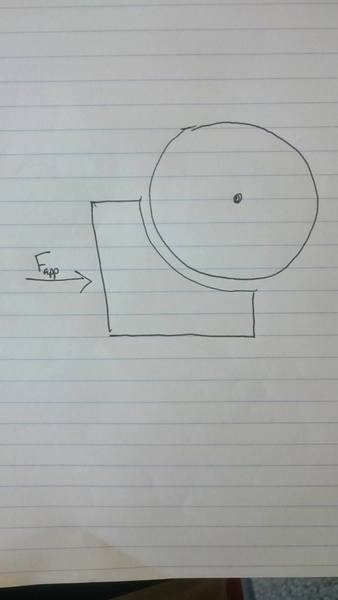
XbhVSR6.jpg
 

Attachments

  • 13016342_1007886142629956_1865588118_o.jpg
    13016342_1007886142629956_1865588118_o.jpg
    16.2 KB · Views: 604
on Phys.org
The friction coefficient will be highly dependent on lubrication and surface contamination.

To measure the coefficient, Cfrict, you need to rotate the cylinder. The torque required, Ftorque, needs to be corrected for the radius, Ftorque / r, then the ratio with your Fapp computed.
Cfrict = Ftorque / ( r * Fapp )
 
of course, I understand the theory, I was probably not clear enough but I am interested in the actual system of measurement, for example, if I had some motor driving a shaft with the drum on it. If I put a reactive torque (torsional) sensor inline between the drum and the motor, would that work to measure the frictional torque?
 
bartrocs said:
If I put a reactive torque (torsional) sensor inline between the drum and the motor, would that work to measure the frictional torque?
Yes.
But if instead you attached the motor directly to the cylinder shaft, you could then measure the torque of the motor against it's mountings. The torque gauge is then not rotating, so you need no slip rings for instrumentation cables to the gauge.
 
Baluncore said:
But if instead you attached the motor directly to the cylinder shaft, you could then measure the torque of the motor against it's mountings. The torque gauge is then not rotating, so you need no slip rings for instrumentation cables to the gauge.

Perfect! I did not think of that. It would probably be a more cost effective solution as I could use force transducers on the mountings and measure torque that way. Thanks for your help
 
bartrocs said:
I could use force transducers on the mountings and measure torque that way.
The motor could be mounted on a shaft co-axial with the roller shaft. Then only one force sensor is needed at the far end of a torque arm attached to the motor casing. So simple.