Mechanical advantage pickup truck crane

Click For Summary

Discussion Overview

The discussion revolves around calculating the mechanical advantage of a pickup truck crane, specifically focusing on the interaction between a hydraulic jack and the crane's boom. Participants explore the complexities involved in determining mechanical advantage due to changing angles and motion, as well as considerations for potential modifications to the crane.

Discussion Character

  • Exploratory
  • Technical explanation
  • Debate/contested
  • Homework-related

Main Points Raised

  • One participant seeks to calculate the mechanical advantage of a truck crane, expressing uncertainty about the connection between the hydraulic jack and the boom, and whether calculus or the law of cosines is needed.
  • Another participant questions the clarity of the term "mechanical advantage" as used by the original poster and asks for a more precise definition of what they wish to calculate.
  • A participant suggests that calculating the total mechanical advantage may depend on the properties of the jack pump and could vary with the weight being lifted and the angle of the boom.
  • Some participants propose practical approaches, such as measuring the force required to lift known weights with the crane to determine a ratio, rather than relying solely on theoretical calculations.
  • There is discussion about the need for accurate measurements of angles and lengths, with one participant noting that relative lengths could potentially be determined from a picture.
  • Another participant shares their experience with learning about mechanical advantage in middle school physics, while others clarify their own educational backgrounds in relation to physics.
  • The original poster expresses a desire to understand the calculations involved and considers modifications to the crane to improve its efficiency.

Areas of Agreement / Disagreement

Participants do not reach a consensus on the best method for calculating mechanical advantage, with multiple competing views on the approach and the factors involved. The discussion remains unresolved regarding the specific calculations needed.

Contextual Notes

Participants mention various assumptions, such as the need for knowledge of the hydraulic system's PSI and the importance of accurate measurements, which may affect the calculations. There is also uncertainty about how the changing angles and motions impact the mechanical advantage.
m iket
Messages
6
Reaction score
0
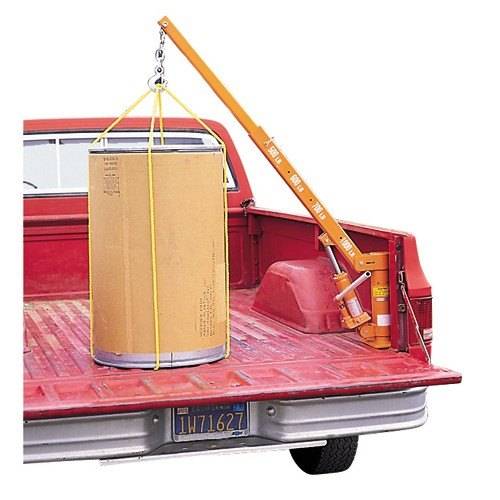
I bought this truck crane for my dad. I want to calculate the mechanical advantage of it.
image_28.jpg

http://www.harborfreight.com/1-2-half-ton-capacity-pickup-truck-crane-1647.html


I know how to calculate the mechanical advantage of a hydraulic jack and of a lever but I am not sure about where they connect to each other. When the jack lengthens it rotates back so the different angles change. How do i calculate that? Where do i start. Does it involve the law of cosines and calculus or something simpler?
 
Last edited by a moderator:
Physics news on Phys.org
Is this the right forum?
 
Hi there m_iket and welcome :smile: The Mechanical Engineering forum might be more appropriate, but I think that there might be some confusion regarding what exactly you are asking. Maybe it is a term that I am just not familiar with, but I am not sure what you mean by "mechanical advantage."

Can you state a little more precisely what you wish to calculate?
 
http://en.wikipedia.org/wiki/Mechanical_advantageI learned about that in middle school physics. I think i will ask in the mech engineering forum, I am thinking about doing some modifiications to the the crane anyways

edit: I know how to calculate that for the boom, ratio of the distances to the fulcrum and for the hydraulic jack ratio of the piston diameters. However where they connect there's changing nonperpendicular angles and linear and rotation motion so I am not sure how it works.
 
Last edited:
Do you mean you're trying to find the total mechanical advantage of the lever arm of the jack vs the arm of the boom? I'm not sure that's something you can calculate without knowing the properties of the jack pump and it may not even be constant if it depends on the weight of what you are lifting (I assume it is a pneumatic cylinder?).

Also, in terms of force, it varies with the angle of the boom.

The best you might be ablel to do is to start with the boom horizontal and pick up an object of known weight. Pump the handle of the jack a few times and measure how far the boom moved, then compare to the distance the end of the handle moves.
 
You'd have to know a lot to calculate it even roughly, like the PSI of the hydraulic system, accurate measurements of the angles and lengths of the arms etc...

i think it'd just be easier to take something you know is heavy, and attach it to the crane and see how much force it takes to life it up. That will give you a ratio which should be equivalent to what you want to know.
 
m iket said:
http://en.wikipedia.org/wiki/Mechanical_advantage


I learned about that in middle school physics. I think i will ask in the mech engineering forum, I am thinking about doing some modifiications to the the crane anyways

edit: I know how to calculate that for the boom, ratio of the distances to the fulcrum and for the hydraulic jack ratio of the piston diameters. However where they connect there's changing nonperpendicular angles and linear and rotation motion so I am not sure how it works.

Well then, I learned two new things today! 1) Definition of MA (I would have understood it to be efficiency) and 2) they offer physics to middle-schoolers! :bugeye: I wish I had physics in middle school!
 
Er i didnt have a physics only course in middle school, i had science classes but they covered basic physics(including simple machines) along with other sciences. I had my first physics course in high school.

I bought the thing, I can easily take measurements of the exact different lengths. I bet relative lengths could be determined with only a picture though. I was more looking for the formula to use than the answer anyways. I don't think i would need to know the psi exactly, just the two different piston diameters. I though about putting a weight on the boom but wasnt sure how i would measure force on the handle, well i could buy a spring scale of some sort i guess It didnt occur to me till now i can put a smaller weights on the handle till it is more or less than the bigger weight on the boom.

I wanted to do the calculations though for the fun of it! Unfortunately i don't know how. I haven't got the crane mounted to the truck yet, i need a friend to do some welding because where i want to mount it on the bed there's no frame members directly underneath to bolt down through to. It takes a large number of pumps to raise the boom, probably an excessive number for the loads I am looking at . I thought about maybe modifying it to get the attachment point of the jack closer to the fulcrum so i would need less pumps. I also though about then moving the fulcrum pin up to increase the range of motion. It more likely i won't do that. I would just like to be able to do the calculations and have an understanding of how the angles and everything work.

I posted this here because i though it would be simple and the engineering subforum was for more complicated stuff. Also their terminology maybe different. If i do modify it then i definitely think that should be the place to ask.
 

Similar threads

  • · Replies 6 ·
Replies
6
Views
4K
  • · Replies 3 ·
Replies
3
Views
1K
Replies
2
Views
2K
  • · Replies 1 ·
Replies
1
Views
3K
  • · Replies 2 ·
Replies
2
Views
1K
  • · Replies 4 ·
Replies
4
Views
4K
Replies
2
Views
2K
  • · Replies 26 ·
Replies
26
Views
9K
Replies
6
Views
11K
  • · Replies 6 ·
Replies
6
Views
4K