Mechanical Advantage vs. Lever vs. Human Error

3 replies · 2K views · last reply
BMR
Messages
1
Reaction score
1
This is my first post here, so pardon if forum guidelines/criteria require this to be designated elsewhere.

I am designing a clamp mechanism utilizing lever mechanics, and I am getting conflicting info regarding Mechanical Advantage and the Law of 1st Class Levers. Regarding MA, knowing that
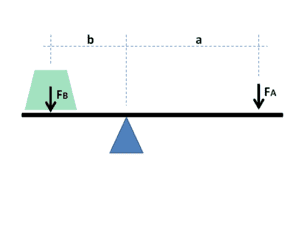
Diagram of a first-class lever: a horizontal beam pivoting on a blue triangular fulcrum, with load FB pressing down on the left and effort FA pressing down on the right, and distances b (left) and a (right) marked from the fulcrum.

e4516522ccaaa831010fc757760110894929d202


If:
FB = 40,000 lbs
FA = 1,000 lbs
Then: b = 40, a = 1, and the MA is 40:1

In regards to Levers (Specifically 1st Class Levers)
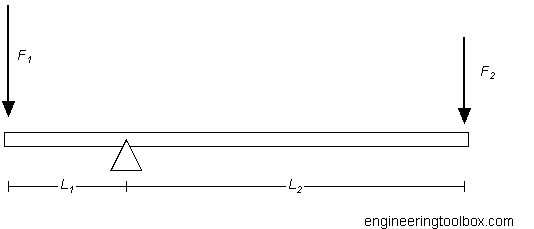
Diagram of a first-class lever: a horizontal beam pivoted on a triangular fulcrum, with downward force F1 on the left end and downward force F2 on the right end, and distances L1 (fulcrum to F1) and L2 (fulcrum to F2) marked below.

F2 = F1 L1 / L2

If:
FB = 40,000 lbs
FA = 1,000 lbs

Then:
40,000 = 1,000 (32.174 ft/s2 [gravity constant]) (L1 / L2)
40 = 32.174 (L1 / L2)
L1 / L2 = approx. 1.243 or 1.243:1.

So for 1,000 lbs to lift 40,000 lbs., either a 40:1 or 1.243:1 lever ratio is required. Am I simply wrong for factoring in a gravitational constant?
 
Attachments
  • Diagram of a first-class lever: a horizontal beam pivoting on a blue triangular fulcrum, with load FB pressing down on the left and effort FA pressing down on the right, and distances b (left) and a (right) marked from the fulcrum.
    300px-Lever_mechanical_advantage.png
    2 KB · Views: 490
  • Diagram of a first-class lever: a horizontal beam pivoted on a triangular fulcrum, with downward force F1 on the left end and downward force F2 on the right end, and distances L1 (fulcrum to F1) and L2 (fulcrum to F2) marked below.
    torque_lever.png
    657 bytes · Views: 495
  • Like
Likes   Reactions: anorlunda
BMR said:
Am I simply wrong for factoring in a gravitational constant?
Yes. You get the same mechanical advantage whether the lever is on the Earth, the Moon or in free space.

On Edit: Assuming that F1 and F2 are either both pushing forces or both weights, that is.
 
  • Like
Likes   Reactions: BMR
BMR said:
So for 1,000 lbs to lift 40,000 lbs., either a 40:1 or 1.243:1 lever ratio is required.

@kuruman gave you the correct answer. But to amplify, if you move the whole apparatus to a planet with one half Earth's gravity, then the same weights would weigh 500 lbs and 20000 lbs, but the ratio 40:1 remains unchanged and the MA remains unchanged. That is why you don't need G.
 
Another way to say the same thing as @anorlunda: If the number 1000 is a mass, then you multiply by g to get a weight which is a force. Here you have 1000 lbs which is already a force (the mass has already been multiplied by g) so it would be wrong to multiply by g again.
 
  • Like
Likes   Reactions: Tom.G and anorlunda