Mikol91
- 1
- 0
Hi guys,
I've been trying to resolve the following problem but have worked myself into a frenzy and would appreciate some guidance on how to proceed but also to set my mind completely clear.
The problem is to find the load torque around the fixed pin joint arising from the piston force F_p.
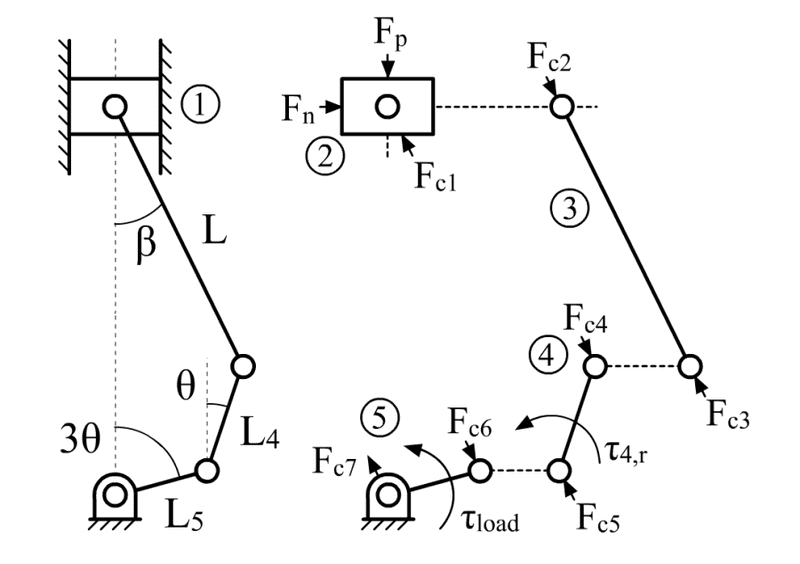
The Joint between element 2 and 3 (hereon J23) is constrained to move vertically as per the diagram.
The angle of element 4 to the global vertical is constrained to be one-third that of element 5 to the same reference. This is achieved in reality by a gear in mesh with a fixed (wrt the engine block) ring gear.
The partial solution is on the RHS of the diagram. I have propagated F_c through element 3 as a simple axial force. At link 4, balancing the input force (F_c4) requires a force F_c5 at J45. This constitutes a couple and generates a moment. To balance moments on the element a reactionary torque T_4,r is necessary. It is argued that this torque must be generated by the connection to element 5.
Similar to element 4, the force upon element 5 must be reacted at the fixed pin joint. This again creates a moment that must be balanced. The required balancing moment is designated T_load.
My problem is how to combine the moment analyses of elements 4 and 5 to find the resultant torque about the fixed pin joint. Do I simply place T_4,r on element 5 and balance moments?
e.g.
ƩM = T_5 - T_4 - T_load
(where T_5 is the torque arising from the forces upon element 5)
Or should T_4 be added to T_5? This is where my brain starts to boil.
I believe the problem lies in attempting to transmit a moment from one body to another through a pivot joint. However, I would not be surprised if there is a bigger problem at play here.
Any assistance would be kindly appreciated. Thanks.
I've been trying to resolve the following problem but have worked myself into a frenzy and would appreciate some guidance on how to proceed but also to set my mind completely clear.
The problem is to find the load torque around the fixed pin joint arising from the piston force F_p.
The Joint between element 2 and 3 (hereon J23) is constrained to move vertically as per the diagram.
The angle of element 4 to the global vertical is constrained to be one-third that of element 5 to the same reference. This is achieved in reality by a gear in mesh with a fixed (wrt the engine block) ring gear.
The partial solution is on the RHS of the diagram. I have propagated F_c through element 3 as a simple axial force. At link 4, balancing the input force (F_c4) requires a force F_c5 at J45. This constitutes a couple and generates a moment. To balance moments on the element a reactionary torque T_4,r is necessary. It is argued that this torque must be generated by the connection to element 5.
Similar to element 4, the force upon element 5 must be reacted at the fixed pin joint. This again creates a moment that must be balanced. The required balancing moment is designated T_load.
My problem is how to combine the moment analyses of elements 4 and 5 to find the resultant torque about the fixed pin joint. Do I simply place T_4,r on element 5 and balance moments?
e.g.
ƩM = T_5 - T_4 - T_load
(where T_5 is the torque arising from the forces upon element 5)
Or should T_4 be added to T_5? This is where my brain starts to boil.
I believe the problem lies in attempting to transmit a moment from one body to another through a pivot joint. However, I would not be surprised if there is a bigger problem at play here.
Any assistance would be kindly appreciated. Thanks.