Mechanics; grade 12 Projectile motion

Click For Summary

Homework Help Overview

The discussion revolves around a projectile motion problem involving a character named Scooby-Doo who runs off a ramp while a snack is launched vertically by another character, Shaggy. The problem seeks to determine the initial speed of the launched snack for Scooby to catch it midair, with specific parameters about the ramp's height and length provided.

Discussion Character

  • Mixed

Approaches and Questions Raised

  • Participants explore how to find the X and Y components of velocity without a given angle, with some suggesting to ignore gravity since it affects both Scooby and the snack equally. Others propose a relationship between the horizontal and vertical components of velocity based on the ramp's geometry.

Discussion Status

Some participants have pointed out potential errors in the calculations of the ramp's angle and the corresponding velocity components for Scooby-Doo. There is an ongoing exploration of different methods to approach the problem, with no clear consensus yet on the correct calculations or methods.

Contextual Notes

There is mention of uncertainty regarding the calculated angle of the ramp and its impact on the velocity components, as well as a suggestion that some calculations may be unnecessary. The problem context is framed within the constraints of a homework assignment.

ttt6683
Messages
1
Reaction score
0
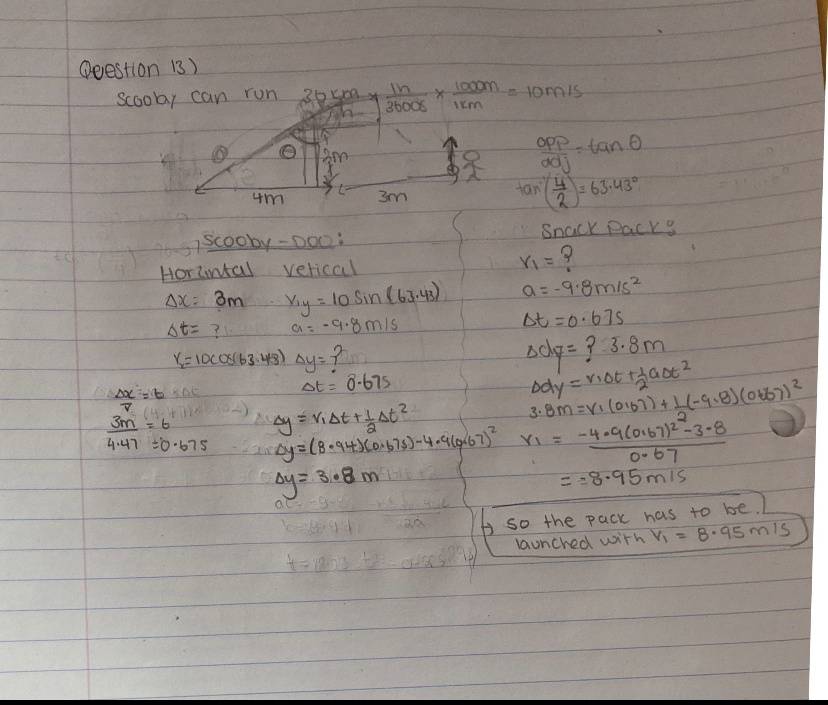
Summary:: Scooby-Doo wants a Scooby Snack. According to a website I looked up last night, Scooby can run at a speed of 36 km/h. He runs up a ramp (as shown, 2.0 meters high, 4.0 meters long) at that speed and off the edge. Three meters from the end of the ramp, Shaggy has a Scooby-Snack launcher which will fire a snack straight up. At the instant Scooby leaves the ramp, Shaggy fires the snack. What is the initial speed of the launched snack for Scooby to catch it in midair? [6]
IMG_5540.jpg
Not sure if this correct. How do you find the X and Y components with no given angle, so I tried to find the angle of the hill.

[Moderator's note: Moved from a technical forum and thus no template.]
 
Last edited by a moderator:
Physics news on Phys.org
How about ignoring gravity, as it is the same for Scooby and for the snack?

And, instead of calculating ##\theta##, why not take ##u_x = 2u_y##?
 
Welcome, ttt6683! :cool:

Your calculated angle for the ramp seems to be incorrect.
Therefore, your calculated values of ##V_x## and of ##V_y## for Scooby-Doo at the edge of the ramp are not correct either.
 
Last edited:
  • Like
Likes   Reactions: PeroK
Lnewqban said:
Welcome, ttt6683! :cool:

Your calculated angle for the ramp seems to be incorrect.
Therefore, your calculated values of ##V_x## and of ##V_y## for Scooby-Doo at the edge of the ramp are not correct either.
Which is ironic, given there was no need to calcuate the angle!

Moral: avoid unnecessary calculations.
 
ttt6683 said:
Not sure if this correct. How do you find the X and Y components with no given angle, so I tried to find the angle of the hill.

A neat way to do this is to observe that $$\frac {u_y}{u_x} = \tan \theta = \frac 2 4$$, hence $$u_x = 2u_y$$
And:
$$u^2 = u_x^2 + u_y^2 = 5u_y^2$$ hence $$u_y = \frac u {\sqrt{5}} \ \ \text{and} \ \ u_x = \frac{2u}{\sqrt{5}} $$
Where ##u = 10m/s## is the initial launch speed.
 

Similar threads

  • · Replies 3 ·
Replies
3
Views
2K
Replies
11
Views
2K
  • · Replies 3 ·
Replies
3
Views
2K
  • · Replies 16 ·
Replies
16
Views
9K
  • · Replies 3 ·
Replies
3
Views
3K
  • · Replies 3 ·
Replies
3
Views
3K
  • · Replies 2 ·
Replies
2
Views
3K
  • · Replies 2 ·
Replies
2
Views
2K
  • · Replies 13 ·
Replies
13
Views
3K
Replies
2
Views
3K