Mechanics of Materials: find combined loading

  • Context: Engineering 
  • Thread starter Thread starter SoylentBlue
  • Start date Start date
  • Tags Tags
    Mechanics of materials
Click For Summary

Discussion Overview

The discussion revolves around determining the combined stress at point E on a frame subjected to a triangular distributed load. Participants explore the calculations related to shear and moment at a specific cut in the frame, addressing the integration of distributed loads and the relationships between shear and moment diagrams.

Discussion Character

  • Technical explanation
  • Homework-related
  • Debate/contested

Main Points Raised

  • One participant expresses confusion about how the book arrived at a moment value of 8.25 kN-m, indicating a desire to understand the calculations involved.
  • Another participant suggests starting with the shear as a function of distance and integrating the distributed load to find shear and moment equations.
  • There is a discussion about the effective load at a specific distance and how to evaluate the distributed load at that point.
  • One participant calculates shear and moment values, agreeing with the book's answer key but expresses uncertainty about how these calculations fit together with previous instructional videos.
  • A later reply outlines a method for determining the slope of the triangular load and how it affects the calculations, while also acknowledging a mistake in drawing the moment diagram.
  • Some participants clarify the peak distributed load value and its implications for the calculations, noting that it is not simply a constant load at a specific distance.

Areas of Agreement / Disagreement

Participants generally express confusion and seek clarification on various aspects of the calculations, indicating that multiple competing views and interpretations exist regarding the integration of the distributed load and the resulting shear and moment values.

Contextual Notes

Some participants highlight subtleties in the definitions of distributed loads and slopes that may affect calculations, but these points remain unresolved within the discussion.

SoylentBlue
Messages
50
Reaction score
8
Thread moved from the technical forums to the schoolwork forums
Homework Statement
This is not a homework assignment. I am studying civil engineering by myself.
Relevant Equations
Sum of the moments when you cut a beam, as shown above.
TL;DR Summary: A frame with a triangular distributed load is pin-connected to a 2-force member. Find the combined stress at point E on the frame.
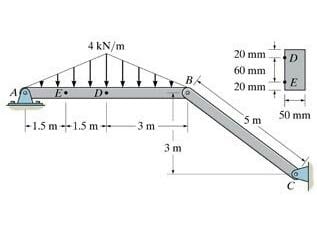
problems838-39.jpg
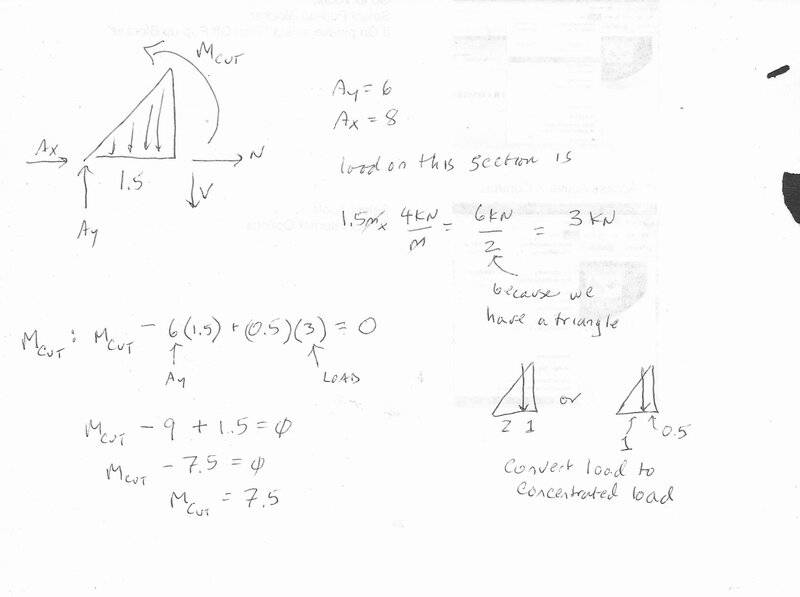
Problem8-39solution.jpg


I am stuck at determining the value of M at the cut. The book shows the value at 8.25KN-meter, but I cannot see how they arrived at that number.
Thank you in advance. I am trying to learn this on my own, so the Internet is my professor right now.
 
Last edited:
Physics news on Phys.org
Begin by writing the shear ##V## as a function of ##x##. To do this use the definition:

$$ \int dV = -\int w(x)~dx $$

Be careful writing ##w(x)##. The value of the distributed load at distance ##x## from ##A## is that of a line passing through the origin. Write the equation of that line, and integrate on the left from ##V_o## to ##V## ( note initial conditions of ##V## are not zero), and on the right from ##0## to ##x##.

Once you have obtained ##V(x)##, integrate once more to obtain ##M(x)##.
 
SoylentBlue said:
Homework Statement: This is not a homework assignment. I am studying civil engineering by myself.
Relevant Equations: Sum of the moments when you cut a beam, as shown above.

TL;DR Summary: A frame with a triangular distributed load is pin-connected to a 2-force member. Find the combined stress at point E on the frame.

View attachment 335991View attachment 335992

I am stuck at determining the value of M at the cut. The book shows the value at 8.25KN-meter, but I cannot see how they arrived at that number.
Thank you in advance. I am trying to learn this on my own, so the Internet is my professor right now.
What you are currently trying to do, you have incorrectly calculated the effective load. What is the value of the distributed load evaluated at ##x = 1.5 ~\rm{m}## ( i.e. ##w( 1.5 ~ \rm{m} ) ~\rm{ \frac{[kN]}{[m]}}##)?
 
erobz said:
Begin by writing the shear ##V## as a function of ##x##. To do this use the definition:

$$ \int dV = -\int w(x)~dx $$

Be careful writing ##w(x)##. The value of the distributed load at distance ##x## from ##A## is that of a line passing through the origin. Write the equation of that line, and integrate on the left from ##V_o## to ##V## ( note initial conditions of ##V## are not zero), and on the right from ##0## to ##x##.

Once you have obtained ##V(x)##, integrate once more to obtain ##M(x)##.
OK, so the equation for the load is simply y=4x.
To obtain shear, integrate y=4x to yield y=2x2.
At a value of x=1.5, the shear is 4.5KN, which agrees with the book's answer key.
Is this correct so far?
Integrate again and you get y=2x3/3.
At a value of 1.5, this yields a moment of 2.25 KNmeters.

I'm still a little foggy on how these pieces fit together. In a statics video using a single triangular distributed load, the instructor mentioned several times that the moment curve is the integral of the shear curve. But when he solved for the moment he did not use those relationships. Instead he cut the beam and examined the left side; he used Mcut - (distance to origin)*Ay (where Ay is the upward force at the origin) plus 0.5 (the centroid of the triangle)*concentrated load.
The book's answer key shows a triangular distributed load of 2kN/m at 1.5 meters. I'm not sure how we jumped from 4kN/m to 2kN/m using the shear-moment diagram and the intregrals.
Thank you again...all help is appreciated!! :^)
 

Attachments

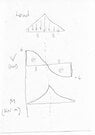
  • Prob38-9shearmomentdiagram.jpg
    Prob38-9shearmomentdiagram.jpg
    19 KB · Views: 133
OK, for anyone else who is stuck here, I found the answer in another youtube video:

The equation of our line is y=mx+b. b=0. m is the slope, which they call 4KN/3m when you examine the left-most 3 meters of the load (back to that in a, ahem, moment. Sorry, I just couldn't resist making that pun).
So the equation of our line is y= 4/3x.
V=6 - integral of 4/3xdx = 6- 4/3 x2/2 = 6 - 2/3 x2
For x = 1.5, V = 6 -2/3(1.5)2 = 4.5, which agrees with the book's answer key.
To get the moment, we integrate again: M = integral of 2/3x2dx = 2/3 x3/3 = 2/9x3. For x=1.5, we get a moment of 0.75, which, when subtracted from the moment of 9kNmeters, yields 8.25 kNmeters, which agrees with the book's answer key.

And yes, I realize I drew the moment diagram incorrectly; it should look like an upside-down U.

So, back to that determination of the slope. When I see 4KN/m, I assume 4KN rise per meter of run, or a slope of 4. They show a triangle 3 meters wide and 4 KN tall, and call the slope 4/3. Can anyone comment on this please? Thank you.
 
They show a peak distributed load value of 4 kN/m @ x = 3m. It is not 4kN load at x=3m.
 
erobz said:
They show a peak distributed load value of 4 kN/m @ x = 3m. It is not 4kN load at x=3m.
Oh, thank you!!! That was a subtlety that I had missed. And it obviously had a profound effect on the calculations. Thank you again.
 
  • Like
Likes   Reactions: erobz

Similar threads

  • · Replies 4 ·
Replies
4
Views
2K
  • · Replies 7 ·
Replies
7
Views
3K
  • · Replies 3 ·
Replies
3
Views
3K
Replies
5
Views
4K
  • · Replies 2 ·
Replies
2
Views
3K
Replies
7
Views
2K
  • · Replies 2 ·
Replies
2
Views
2K
  • · Replies 1 ·
Replies
1
Views
3K
Replies
3
Views
2K
  • · Replies 4 ·
Replies
4
Views
2K